In 1983, at a clay pit at Surrey, England, an unusual dinosaur was found – one that hunted fish. William Walker, an
amateur fossil hunter, found a huge claw and later the skeleton it had come
from buried nearby. After his discovery, paleontologists uncovered more specimens
of Baryonyx, after re-examining old fossils that had been collected years before. Because Baryonyx was a Meat-eater, her discovery was more remarkable since previous fossils from this quarry had yielded only Plant-eaters.
The most surprising about this Dinosaur from the early Cretaceous (about 125 million years ago), was the half-digested
remains of fish, as well as, an Iguanodonwithin her skeletal remains. As scientists studied the fossilized bones of Baryonyx, they realized that her long
slender jaws were ideal for fishing. Moreover, her front teeth stuck out from
her narrow jaws. Larger than the rest, these teeth formed a rosette pattern
ideal for the stabbing and retention of a struggling fish. Possessing almost twice as many teeth as Tyrannosaurus rex, Baryonyx could easily snag a fish with her small sharp teeth.
With a body similar to a modern crocodile, Baryonyx was built for swimming in
swamps. Her long, streamlined body was perfect for moving about in water. With
her extended neck, Baryonyx could
lunge and spear a tasty fish, before It could escape. With her nostrils placed
back along her snout, Baryonyx would remain
nearly submerged in the water, patiently waiting for her next meal.
Furthermore, her huge claws allowed Baryonyx to fish whilst wading in
streams. Standing in the water, She would wait for a fish to swim by. Because
each of her first fingers was tipped with a large, barbed claw, Baryonyx could swipe at and hook fish.
At a time, when other carnivorous
Dinosaurs hunted only on land, Baryonyx
looked to the water. An original thinker, Baryonyx
pondered other ways of getting her food. Rather than compete on land with the other
Dinosaurs, She hunted in the ancient swamps and streams. Before there were
Bears, She was in streams hooking fish with her claws. When faced with a baffling problem, ask Baryonyx for her insights. Since She
could envision things that others could not, Baryonyx will offer you novel answers. Sort out which idea makes
sense to you and go with it.
This is a blog about nature in all her glory. The folklore and general ideas about what messages nature bring to people.
Thursday, October 29, 2015
Thursday, October 22, 2015
Animals of the Way
From my blog at Witches and Pagan's Pagan Square:
"Animals who stay to help you after delivering their message are known as “Animals of the Way.” They will travel with you for a part of your life’s journey. Although these animals are not life-long companions, they may stay with you for years. Once they are no longer needed, “Animals of the Way” will leave. As with “Message Animals,” you need to accept them. Of course, find out about who they are and how they live. Enter into conversations with them, and ask how they can help you.
Sometimes you can ask a particular animal for help for temporary aid. But first, figure out whether the animal can work with you. Some animals are better equipped to help with particular problems. For example, Ferret is preferable to Sloth in increasing your physical energy. Moreover, animals that you have a relations with will be more disposed to helping you. Before asking a “strange” animal for assistance, do something to honor them first.
For example, I was grieving over the loss of a family member, and had asked the Manatees to comfort me. Since I assisted in various conservation efforts for manatees, They were more than happy to help. These friendly vegetarians know loss, for They have grieved over their fellow Manatees killed by motor boats. Soft and peaceful, the Manatees were all encompassing in giving their love to me. Through them, I was healed."
READ THE REST AT : Animal Wisdom: Animals of the Way
"Animals who stay to help you after delivering their message are known as “Animals of the Way.” They will travel with you for a part of your life’s journey. Although these animals are not life-long companions, they may stay with you for years. Once they are no longer needed, “Animals of the Way” will leave. As with “Message Animals,” you need to accept them. Of course, find out about who they are and how they live. Enter into conversations with them, and ask how they can help you.
Sometimes you can ask a particular animal for help for temporary aid. But first, figure out whether the animal can work with you. Some animals are better equipped to help with particular problems. For example, Ferret is preferable to Sloth in increasing your physical energy. Moreover, animals that you have a relations with will be more disposed to helping you. Before asking a “strange” animal for assistance, do something to honor them first.
For example, I was grieving over the loss of a family member, and had asked the Manatees to comfort me. Since I assisted in various conservation efforts for manatees, They were more than happy to help. These friendly vegetarians know loss, for They have grieved over their fellow Manatees killed by motor boats. Soft and peaceful, the Manatees were all encompassing in giving their love to me. Through them, I was healed."
READ THE REST AT : Animal Wisdom: Animals of the Way
Thursday, October 15, 2015
Indian Flying Fox: Fearless Exploring
![]() |
| By Dibyendu Ash [CC BY-SA 3.0 (http://creativecommons.org/licenses/by-sa/3.0)], via Wikimedia Commons |
Less feared than other types of Bats, Indian Flying Fox eats only fruit. Her favorite is very soft bananas which She swallows whole. However, with mangoes, She extracts the juice and spits out the seeds. Indian Flying Fox is an important pollinator in the tropics, and a major dispenser of seeds. In certain parts of India, She is regarded as sacred.
Unfortunately for Her, her desire for fruit has led Indian Flying Fox in conflict with people. Because She causes extensive damage to fruit orchards, many farmers consider Indian Flying Fox to be a pest. Governments in South Asia have instituted kill programs to stop Her, since they consider Indian Flying Fox to be “vermin.”
Found throughout South Asia and the Maldives, Indian Flying Fox prefers living near large areas of water. She is often found in tropical forests and swamps. Once, She settles into a suitable place, Indian Flying Fox makes it her permanent Camp. (Groups of Flying Foxes are called “camps.”) Because of her strong flying abilities, Indian Flying Fox colonized many islands in the Indian and Pacific Oceans. Many species of Flying Foxes found on these islands can be traced to her.
Indian Flying Fox flies long distances at night to search for her food. Some of her travels have led her to distant lands. She is fearless in what She does knowing that She can navigate anywhere. A dauntless explorer, Indian Flying Fox travels to islands near and far. Traversing over vast stretches of ocean, She is unafraid of never reaching land. Indian Flying Fox is confident in her navigation skills. Because of her self-assuredness, She has become the mother of many island species. Take wing and fly. Just be care not to be a pest.
Wisdom of Indian Flying Fox:
Strength
Confidence
Having Adventures
Learning Not to be a Pest
Note: Indian Flying Fox is also known as Greater Indian Fruit Bat.
Thursday, October 01, 2015
CAPE GROUND SQUIRREL: Doing What Works
![]() |
| © Hans Hillewaert / , via Wikimedia Commons |
Cape Ground Squirrel will share her burrow with Meerkats and Yellow Mongooses. In gratitude, Meerkats will call alarms to warn Her. The two mammal species will live in a mutual relationship.
Cape Ground Squirrel lives with other Female Squirrels in large underground burrows. She usually feeds on seeds, leaves, and roots. However, Cape Ground Squirrel is not above acting cute and begging from people. Her favorite haunts are the rest camps of the governmental parks in South Africa.
Cape Ground Squirrel has a unique social system for Mammals. She lives with her female Friends separate from Male Cape Ground Squirrels. In her social group, They raise their Children together. Unlike other mammal groups, the Females have no “Alpha” or Head Squirrel.
Meanwhile, Male Cape Ground Squirrels live in friendly social groups by Themselves. The Males are not territorial, and will welcome other groups. (This is unusual amongst Mammals.) The only time that the Males are with the Females is when They want to mate. Even then, when Male Cape Ground Squirrels compete for mates, They rarely injure each other. Instead, the Males hold leaping displays for the Females.
Cape Ground Squirrel teaches doing what works. She may live differently than other Squirrels but that is all right with Her. Learn from Cape Ground Squirrel to find out what works for you. Living in same sex groups and being welcoming helps Her to survive in her harsh environment.
Cape Ground Squirrel’s Wisdom Includes:
Trusting
Friendship
Living in Single Sex Groups
Hospitality
Friday, September 25, 2015
EURASIAN RED SQUIRREL Living With Both Ordinariness and Wonder
Smaller and shier than Grey Squirrel, Eurasian Red Squirrel prefers
living alone in the pine forests of Europe. After searching
meticulously for food, He takes his pine cone to a secure branch for
safety. Holding the cone in his front paws, Eurasian Red Squirrel
rotates it while biting off the scales to
get at the pine seeds.
People have admired Eurasian Red Squirrel for centuries. According to the Norse of Scandinavia, Ratatosk lived in the Tree of Life. He carried messages to Eagle, perched at the top, and to Snake, coiled around the roots. For his efforts, Ratatosk enjoyed the special protection of Thor, the God of Thunder.
Medieval Christians tell the story of Eurasian Red Squirrel in the Garden of Eden. He had a long thin tail like Rat’s. One day, while sitting in a nearby tree, He witnessed Adam and Eve eating the forbidden fruit. Eurasian Red Squirrel was so horrified by the sight, that He covered his eyes. As a reward for his faithfulness, God gave Eurasian Red Squirrel a thick bushy tail.
Humble little Eurasian Red Squirrel lives in the trees, watching the people below. From his vantage point, Eurasian Red Squirrel can touch the Heavens. He is the intermediary between two worlds – the world of the ordinary and the world of wonder. You can relish the ordinary life and have time to pause for wonder.
Eurasian Red Squirrel’s Teachings Include:
“Squirrel can represent easy and free communication.” Copyright: “Beasts of Albion”, Miranda Gray.
“Red Squirrel Dreaming is a grounding force that relieves stress and anxiety caused by an unsubstantiated fear.” Copyright: “Animal Messengers”, Scott Alexander King.
Eurasian Red Squirrel (Sciurus vulgaris) is only distantly related to the Red Squirrel of North America (Tamiasciurus hudsonicus)
Conservation Note: Eurasian Red Squirrel is protected in the United Kingdom. The Forestry Commission (U.K.) has erected rope bridges to help Eurasian Red Squirrel to cross busy roads.
People have admired Eurasian Red Squirrel for centuries. According to the Norse of Scandinavia, Ratatosk lived in the Tree of Life. He carried messages to Eagle, perched at the top, and to Snake, coiled around the roots. For his efforts, Ratatosk enjoyed the special protection of Thor, the God of Thunder.
Medieval Christians tell the story of Eurasian Red Squirrel in the Garden of Eden. He had a long thin tail like Rat’s. One day, while sitting in a nearby tree, He witnessed Adam and Eve eating the forbidden fruit. Eurasian Red Squirrel was so horrified by the sight, that He covered his eyes. As a reward for his faithfulness, God gave Eurasian Red Squirrel a thick bushy tail.
Humble little Eurasian Red Squirrel lives in the trees, watching the people below. From his vantage point, Eurasian Red Squirrel can touch the Heavens. He is the intermediary between two worlds – the world of the ordinary and the world of wonder. You can relish the ordinary life and have time to pause for wonder.
Eurasian Red Squirrel’s Teachings Include:
“Squirrel can represent easy and free communication.” Copyright: “Beasts of Albion”, Miranda Gray.
“Red Squirrel Dreaming is a grounding force that relieves stress and anxiety caused by an unsubstantiated fear.” Copyright: “Animal Messengers”, Scott Alexander King.

- Eurasian Red Squirrel’s Wisdom Includes:
- Making Mischief
- Pivot of Worlds
- Learning Wisdom
- Feeling of Recognition and Belonging
Eurasian Red Squirrel (Sciurus vulgaris) is only distantly related to the Red Squirrel of North America (Tamiasciurus hudsonicus)
Conservation Note: Eurasian Red Squirrel is protected in the United Kingdom. The Forestry Commission (U.K.) has erected rope bridges to help Eurasian Red Squirrel to cross busy roads.
Monday, September 21, 2015
GRAY!GREY SQUIRREL: Living in the Past, Present, and Future
Agile and alert, Grey Squirrel remains active throughout the year.
Chattering on tree branches, Grey Squirrel amuses people who watch her
antics. What people do not know is that Grey Squirrel was a creature of
the virgin forests of North America. She is one of the few Mammals who
adapted to cities.
Grey Squirrel needs to eat every day even in the winter. Active at dawn, She searches for fruits and nuts or whatever is in season. In spring, She eats plant shoots. In winter, Grey Squirrel eats tree bark and nuts that She stored in the fall. She locates her stored nuts by smell. Any acorns that Grey Squirrel does not find will grow into trees for future squirrel homes.
Grey Squirrel is very expressive. She chatters and flicks her bushy tail to indicate her many moods. Relaxed, She lays on a thick tree branch with her tail hanging down. When Grey Squirrel is angry, her body becomes ramrod straight, and her tail flaps wildly. Her high voiced “Chee! Chee!” means “I AM annoyed with you!”
Grey Squirrel lives in the past, present, and future. In the summer, She also gathers nuts and acorns for the future. In the winter, Grey Squirrel looks for the nuts that She stored in the past. In the present, whatever season it is, She gathers nuts and acorns to eat today. Grey Squirrel lives in a tree sprouted from a nut that She buried and forgot about. Like Grey Squirrel, you can live in the past, present, and future.
Grey Squirrel’s Teachings Include:
“As far as our noblest hardwood forests are concerned, the animals, especially squirrels and jays, are our greatest and almost only benefactors. It is to them that we owe this gift. It is not in vain that the squirrels live in or about every forest tree, or hollow lot, and every wall and heap of stones.” -- Henry David Thoreau, American Essayist.
Conservation Note: People brought Grey Squirrel to the United Kingdom and South Africa, where She does not belong. Consult the local animal authorities on how to control the Grey Squirrel population.
Grey Squirrel needs to eat every day even in the winter. Active at dawn, She searches for fruits and nuts or whatever is in season. In spring, She eats plant shoots. In winter, Grey Squirrel eats tree bark and nuts that She stored in the fall. She locates her stored nuts by smell. Any acorns that Grey Squirrel does not find will grow into trees for future squirrel homes.
Grey Squirrel is very expressive. She chatters and flicks her bushy tail to indicate her many moods. Relaxed, She lays on a thick tree branch with her tail hanging down. When Grey Squirrel is angry, her body becomes ramrod straight, and her tail flaps wildly. Her high voiced “Chee! Chee!” means “I AM annoyed with you!”
Grey Squirrel lives in the past, present, and future. In the summer, She also gathers nuts and acorns for the future. In the winter, Grey Squirrel looks for the nuts that She stored in the past. In the present, whatever season it is, She gathers nuts and acorns to eat today. Grey Squirrel lives in a tree sprouted from a nut that She buried and forgot about. Like Grey Squirrel, you can live in the past, present, and future.

“As far as our noblest hardwood forests are concerned, the animals, especially squirrels and jays, are our greatest and almost only benefactors. It is to them that we owe this gift. It is not in vain that the squirrels live in or about every forest tree, or hollow lot, and every wall and heap of stones.” -- Henry David Thoreau, American Essayist.
Conservation Note: People brought Grey Squirrel to the United Kingdom and South Africa, where She does not belong. Consult the local animal authorities on how to control the Grey Squirrel population.
Thursday, September 17, 2015
SQUIRREL FAMILY Cooperation
When people think “Squirrel”, they generally think of the
tree-dwelling variety. Squirrels, however, come in three main
groups–Tree Squirrels, Ground Squirrels, and Flying Squirrels. The
defining characteristic of a Squirrel, a Squirrel is their bushy tail.
Their family name Sciuridae means “shade-tailed”.
Tree Squirrels have the bushiest tails. Tree Squirrels use their tails for balancing and steering when They jump from branch to branch. Active during the day, Tree Squirrels chase each other through the trees, look for nuts, and work on their nests (dreys). They bury nuts and seeds in the ground for future use. Any nuts one Tree Squirrel does not eat, another Tree Squirrel will eat.
Ground Squirrels include Chipmunks, Prairie Dogs and Marmots. Ground Squirrels rarely climb trees. Instead, They often live in colonies in a complex system of burrows. A Prairie Dog town contains thousand of residents living in sleeping quarters, with their own nurseries and latrines. Extremely adaptable, Ground Squirrels will live near people.
The third kind of Squirrel is Flying Squirrel, who glides through the
air using a flap of skin between his front and rear limbs. Pushing off
from a tree branch, He stretches out his arms and legs and glides to
another branch. Unlike other Squirrels, Flying Squirrels is active at
night.
Squirrel Family teaches cooperation. Some forms of Squirrel cooperation are obvious such as building a Prairie Dog town. Tree Squirrels warn other Squirrels of approaching enemies. A more subtler form is Tree Squirrels burying nuts not only for Themselves but also for other Squirrels. Squirrels cooperate with each other in a variety of ways. Learn how to cooperate with others from Squirrel Family.
Tree Squirrels have the bushiest tails. Tree Squirrels use their tails for balancing and steering when They jump from branch to branch. Active during the day, Tree Squirrels chase each other through the trees, look for nuts, and work on their nests (dreys). They bury nuts and seeds in the ground for future use. Any nuts one Tree Squirrel does not eat, another Tree Squirrel will eat.
Ground Squirrels include Chipmunks, Prairie Dogs and Marmots. Ground Squirrels rarely climb trees. Instead, They often live in colonies in a complex system of burrows. A Prairie Dog town contains thousand of residents living in sleeping quarters, with their own nurseries and latrines. Extremely adaptable, Ground Squirrels will live near people.

Squirrel Family teaches cooperation. Some forms of Squirrel cooperation are obvious such as building a Prairie Dog town. Tree Squirrels warn other Squirrels of approaching enemies. A more subtler form is Tree Squirrels burying nuts not only for Themselves but also for other Squirrels. Squirrels cooperate with each other in a variety of ways. Learn how to cooperate with others from Squirrel Family.
Thursday, September 10, 2015
Understanding Animal Messengers
My new post at Witches and Pagans explores when a tarantula comes in response for your request for help. Read it here: understanding messages from animals
Friday, September 04, 2015
DILOPHOSAURUS: Keep Asking Questions
![]() |
|
Arthur Weasley,
via Wikimedia Commons
|
A relative of Ceratosaurus, Dilophosaurus was a primitive meat-eating Dinosaur from the Early Jurassic (about 200 million years ago). Discovered in the 1940s and later named in 1970 by Dr. Samuel Welles, Dilophosaurus became famous in the movie “Jurassic Park” (1993, Steven Spielberg). What made Her well-known was her two semi-circular crests on her head, which lead to her name “double-crested lizard.”
When She was discovered, Dilophosaurus was one of three fossil specimens. Since these were some of the most complete fossils of anyone in Her Family, much was learned about Her and Her Family, the Ceratosaurs. Despite this wealth of information, no one really knows why Dilophosaurus had a crest or what it was used for.
Who was Dilophosaurus? This speedy bi-pedal hunter was the consummate predator. With her four-fingered hand, opposable first finger and powerful claws, Dilophosaurus could grab her victim, pin him down, bite his neck and then pluck off his flesh. With her hollow bones and slender build, She was one of the fastest and deadliest Dinosaurs of her day.
The story of Dilophosaurus is one of exploration and further study. When She was first found, no one knew who she was. In 1954, She was first called Megalosaurus (who was one of the early Theropods). However, unsatisfied to what her identity was, Dr. Welles kept studying Her. By 1964, he knew that Dilophosaurus was someone else. Finally, in 1970, Dr. Welles renamed Her after her true nature.
Dilophosaurus invites curiosity and exploration. For one thing, there is no evidence that She spit poison as depicted in “Jurassic Park.” More questions await Her. Perhaps someone will figure out what her crests are for. Never be satisfied with the status quo, always be curious. Keep asking questions is what Dilophosaurus teaches.
Friday, August 21, 2015
Animal Messengers
My blog post at "Witches and Pagans" discusses how animals deliver messages.
"Sometime
ago, I dreamt that I was a giant squid playing with the other squids in
the blue ocean. Wiggling my tentacles, I had fun jetting from here to
there. When I woke up, I pondered what Giant Squid had wanted to tell me."
"While
pondering my dream, I understood that Giant Squid wanted me to play
more. Moreover, She came to remind me to be more flexible. With my brain
injury, I have become a fixed thinker. Since it takes me a long time to
do my chores, I tend to focus solely on getting them done. Giant Squid
decided to enter my dreams to have me become more fluid in my waking
life. She told me to zoom away from housework and go play."
Read the rest at Animal Wisdom: Messengers
Friday, August 14, 2015
CERATOSAURUS: Accept Yourself
![]() |
| Debivort at English Wikipedia [GFDL (www.gnu.org/copyleft/fdl.html) or CC-BY-SA-3.0 (http://creativecommons.org/licenses/by-sa/3.0/)], via Wikimedia Commons |
Called “horned lizard,” because of her two “horns” on her head, Ceratosaurus lived during the Late Jurassic. This puzzled many paleontologists since She was a primitive meat-eating Dinosaur. (These Dinosaurs were thought to only have lived in the late Triassic.) Ceratosaurus live amongst the more advanced Dinosaurs such as fearsome Allosaurus and ferocious Torvosaurus.
One of the oldest known Ceratosaurs (a Family of Primitive Meat-eaters), Ceratosaurus was one of the first of her Family to be discovered. Found in the 1880s, She was named in 1884 by the paleontologist Othniel C. Marsh. The family of Ceratosaurus is a highly diverse group, including Noasaurus, with his strange teeth and Abelisaurus, with her ridiculously short arms, all dissimilar Dinosaurs. Ceratosaurs are often lumped with Coelophysis’ Family. However, Coelophysis and his relatives are an earlier branch of the Theropods (Meat-eaters).
Modestly-sized Ceratosaurus shared the Western U.S. landscape with giant Allosaurus, a formidable predator. However, She was a hunter to be reckoned with, with her short powerful neck and large teeth. This effective predator, also, had a massive tail and bulky body. Small enough to be agile,Ceratosaurus chased fast prey on her two strong legs. Using her superior hunting skills, She ate quite well.
What made Ceratosaurus stand out amongst the other Meat-eaters was her ornamentation. Her nasal “horn” was an extension of the bones at her snout. Her other “horn” was the fusion of separate bones. Besides her nose “horn,” Ceratosaurus had two short brow ridges and bony knobs above her eyes. Unlike other Theropods, She had osteoderms (plates) running down her back. This ridge made Her resemble an ancient dragon.
Standing out in the landscape, Ceratosaurus, so different from the other Theropods, demonstrates how to “let your freak flag fly.” Her odd and strange appearance shows a sense of adventurous and unconventional thinking. Ceratosaurus accepts Herself. Being comfortable with who She is, Ceratosaurus is a consummate hunter, succeeding in living well. Let Her teach you how to accept yourself, “warts and all.”
Thursday, August 06, 2015
COELOPHYSIS: Fierceness
![]() |
| Jeff Martz, U.S. NPS |
The Dinosaur Family that Coelophysis belongs to is extremely diverse. The Coelophysoida (Coelophysis and Friends) includes Birds and probably Tyrannosaurus Rex. Many paleontologists regard the taxonomy of His Family to be fluid, and under constant review. About the only thing that Members of this Family have in common is that They are more closely related to Birds than to Carnosaurs, who are the other Meat-eaters.
Discovered in 1881 by David Baldwin, Coelophysis was named by Edward Cope 1889. Then in 1947, a huge number of fossils were found at Ghost Ranch in New Mexico (U.S.). Apparently, these Coelophysis were caught in a massive flood. This huge cache of fossils gave paleontologists much to study about Coelophysis.
Built to hunt, Coelophysis had pointed, serrated, and bladed-like teeth to bite down on his victims. He could also tear out the flesh. With his long fingers and claws, Coelophysis could either grasp or clutch his prey. In other words, He hunted any way He could.
Whilst studying the fossils at Ghost Ranch, scientists found that Coelophysis came in two types. The gracile (the more slender ones) seemed to be females whilst the robust ones seemed to be males. Another find, which was quite troubling, was uncovering young Coelophysis inside the adults. After much investigation, scientists concluded that the adults did not eat the young, since the flood threw everyone together. Their bones had mixed together.
Small and light Coelophysis was a feared predator. Using his long legs, He could run at fast speeds to chase down his victims. Since He had quick reflexes, Coelophysis darted and dodged about to confuse his prey.
Although Coelophysis was small, He was big in terror. Moreover, He passed on that fierceness to his descendants like Velociraptor. Like Him, They inspired terror in their victims. Fierceness comes in all sizes, for it lies in the attitude of the person. Let Coelophysis show you how. But do not be so terrifying, that you frighten everyone.
Monday, August 03, 2015
White Lions: "A Gift from God"
![]() | ||
| By Stano Novak (Own work) [CC BY 2.5 (http://creativecommons.org/licenses/by/2.5)], via Wikimedia Commons |
Legends of White Lions exist in various oral traditions, in the Timbavati Region of Africa, from the time of Queen Numbi, who ruled about four hundred years ago. Tradition holds that once every century a White Lion appears. A gift from God, White Lions represent the good in all creatures. In the 1970s, White Lions were found in the Timbavati Region in South Africa. (They are now in South African zoos for protection from poachers.)
White Lion's Teachings Also Include:
“Championing righteousness and promise, White Lion Dreaming teaches us to look for, identify, and celebrate the golden glow of potential in others.” Copyright: “Animal Messengers” by Scott Alexander King
- Lion Christian Symbols:
- Lion: Christ
- With Cross-Shaped Nimbus: Lion of the Tribe of Judah
- Carrying a Book: Christ as the Teacher
- Sleeping: Christ, the Divine Watcher
- Winged: St. Mark, the Evangelist
Friday, July 31, 2015
LION: Group Dynamics
Known as the King of the Jungle, Lion actually lives on the open
African grasslands. Originally, He ranged from the Mediterranean Sea to
Asia and south to Africa. Hunted by Romans for their Games, Lion first
disappeared from Europe and Asia Minor. As Lion hunting increased, his
range shrank to where now Lion lives only in Africa.
Unlike most members of the Cat Family, Lion is social. He lives in a Pride and forms coalitions with his Male Friends. In his Pride, Lionesses work together to hunt and chase off predators. Meanwhile with his Male Partners, Lion defends their territory against intruders. With his Coalition, Lion rules the Pride for a few years until a new Coalition arises. Then He and his Male Partners leave.
When Lions hunt, They form a cooperative group. Whether They are killing Seals on a beach or Cape Buffalos on the savannah, the Pride forms a plan of action. Some Lionesses wait downwind while their Sisters herd the animals towards Them. Other Lionesses travel around the prey to close off avenues of escape. Suddenly, a Lioness shows Herself, causing panic among the prey. The animals rush headlong into the Pride’s ambush.
Because Lion is yellow, and loves sleeping in the sun, He has been the symbol of the Sun for many cultures. People so admired Lion, that they thought He possessed spiritual powers equal to his physical attitudes. As King of the Beasts, Lion was wise and just.
Killing a Lion was a symbol of manhood. In Africa, young men were initiated through lion combat. The Zulu and Masai were expected to defeat a lion to become a man among their peoples. In Ethiopia, the Emperor awarded the bravest warriors with a lion mane headdress.
In China, Lion is a mythic creature, a symbol of nobility and dignity. Guardian Lion statues protect Chinese buildings. Lion Dancing, which has a very long tradition, is an essential part of Chinese festivals. The Lion Dance brings good luck, prosperity, and happiness to the people at the festival.
Lion teaches constructive group dynamics. When hunting, Everyone contributes to bringing down the prey. Working together patiently makes for a successful hunt. Even though Lions have strong personalities, They cooperate successfully. Learn from Lion how to accomplish much in your group.
Lion’s Teachings Also Include:
“We need to know how to relax when we are stressed. Lion gives us spiritual strength, he teaches us to be strong and proud and not let important things in life be taken for granted, like family.” Copyright: Rabbit’s Warren of Wisdom.
Unlike most members of the Cat Family, Lion is social. He lives in a Pride and forms coalitions with his Male Friends. In his Pride, Lionesses work together to hunt and chase off predators. Meanwhile with his Male Partners, Lion defends their territory against intruders. With his Coalition, Lion rules the Pride for a few years until a new Coalition arises. Then He and his Male Partners leave.
When Lions hunt, They form a cooperative group. Whether They are killing Seals on a beach or Cape Buffalos on the savannah, the Pride forms a plan of action. Some Lionesses wait downwind while their Sisters herd the animals towards Them. Other Lionesses travel around the prey to close off avenues of escape. Suddenly, a Lioness shows Herself, causing panic among the prey. The animals rush headlong into the Pride’s ambush.
Because Lion is yellow, and loves sleeping in the sun, He has been the symbol of the Sun for many cultures. People so admired Lion, that they thought He possessed spiritual powers equal to his physical attitudes. As King of the Beasts, Lion was wise and just.
Killing a Lion was a symbol of manhood. In Africa, young men were initiated through lion combat. The Zulu and Masai were expected to defeat a lion to become a man among their peoples. In Ethiopia, the Emperor awarded the bravest warriors with a lion mane headdress.
In China, Lion is a mythic creature, a symbol of nobility and dignity. Guardian Lion statues protect Chinese buildings. Lion Dancing, which has a very long tradition, is an essential part of Chinese festivals. The Lion Dance brings good luck, prosperity, and happiness to the people at the festival.
Lion teaches constructive group dynamics. When hunting, Everyone contributes to bringing down the prey. Working together patiently makes for a successful hunt. Even though Lions have strong personalities, They cooperate successfully. Learn from Lion how to accomplish much in your group.

“We need to know how to relax when we are stressed. Lion gives us spiritual strength, he teaches us to be strong and proud and not let important things in life be taken for granted, like family.” Copyright: Rabbit’s Warren of Wisdom.
- Lion’s Wisdom Includes:
- Nobleness
- Proper Use of Power and Strength
- Group Energy
- Community
- Roles in A Group
- Balanced Leadership
- Male Friendship
- Sisterhood
Thursday, July 30, 2015
Blogging on Animal Wisdom at Witches and Pagans.
Dear readers,
I now have another blog, where I write about general topics on animal wisdom. I will post links to the blog here.
However, I will continue writing here as well. I have a lot to say that doesn't always fit the topic of animal wisdom.
Look for more postings on the teachings of dinosaurs next week.
Animal Wisdom: Connecting People and Animals. Will open in a new window.
My introduction to Animal Wisdom
However, I will continue writing here as well. I have a lot to say that doesn't always fit the topic of animal wisdom.
Look for more postings on the teachings of dinosaurs next week.
Animal Wisdom: Connecting People and Animals. Will open in a new window.
My introduction to Animal Wisdom
Thursday, July 23, 2015
SPERM WHALE: Exploring the Abyss
The largest of all Toothed Whales, Sperm Whale can dive longer, faster, and deeper than any other Mammal. Known as nature’s submarine, Sperm Whale is well equipped to hunt in the ocean abyss for Giant Squid. Swimming in total darkness, He uses his echolocation to locate Squid. His huge head, which makes up a third of his total body length, houses the wax-filled spermaceti organ that helps Him to dive deep. With steady clicks, Sperm Whale approaches his Prey, then surprises Giant Squid with a sonic scream, disabling Him.
Among Whales, Sperm Whale has a unique social life. Elder Mother Sperm Whale governs his Nursery Pod. In the tropics, Sperm Whale Mothers, Females, and Young Males live together. When Sperm Whale reaches maturity, He leaves and joins a Bachelor Pod. Together, He and his Friends roam from the Polar Seas, where Squid lives, to the Tropics where the Nursery Pods are. When He is older, Sperm Whale will navigate the oceans by Himself.
Diving vertically into the abyss, Sperm Whale searches for Giant Squid. Using echolocation, Sperm Whale clicks until He sense the outline of Squid in the murky depths. No one knows what exactly happens in the murky depths; only that Sperm Whale is usually victorious. Like this extraordinary Whale, you can explore the Abyss. Just remember to surface from time to time.
Sperm Whale’s Teachings Also Include:
“There is more character in the Sperm Whale's head. As you behold it, you involuntarily yield the immense superiority to him, in point of pervading dignity. In the present instance, too, this dignity is heightened by the pepper and salt colour of his head at the summit, giving token of advanced age and large experience.” – Copyright: “Moby Dick”, Herman Melville
Sperm Whale’s Wisdom Includes:
Being Comfortable with Your Own Self
Being Comfortable with Your Own Sex
Diver of the Deeps
Lord of the Seas
Conservation Note: Sperm Whales are endangered, and are protected by international treaties. Because of extensive hunting, numbers of Sperm Whale Males are seriously low.
For reading on the teachings of Moby Dick, the most famous sperm whale of all: Moby Dick (opens in new window)
Among Whales, Sperm Whale has a unique social life. Elder Mother Sperm Whale governs his Nursery Pod. In the tropics, Sperm Whale Mothers, Females, and Young Males live together. When Sperm Whale reaches maturity, He leaves and joins a Bachelor Pod. Together, He and his Friends roam from the Polar Seas, where Squid lives, to the Tropics where the Nursery Pods are. When He is older, Sperm Whale will navigate the oceans by Himself.
Diving vertically into the abyss, Sperm Whale searches for Giant Squid. Using echolocation, Sperm Whale clicks until He sense the outline of Squid in the murky depths. No one knows what exactly happens in the murky depths; only that Sperm Whale is usually victorious. Like this extraordinary Whale, you can explore the Abyss. Just remember to surface from time to time.
Sperm Whale’s Teachings Also Include:
“There is more character in the Sperm Whale's head. As you behold it, you involuntarily yield the immense superiority to him, in point of pervading dignity. In the present instance, too, this dignity is heightened by the pepper and salt colour of his head at the summit, giving token of advanced age and large experience.” – Copyright: “Moby Dick”, Herman Melville
Sperm Whale’s Wisdom Includes:
Being Comfortable with Your Own Self
Being Comfortable with Your Own Sex
Diver of the Deeps
Lord of the Seas
Conservation Note: Sperm Whales are endangered, and are protected by international treaties. Because of extensive hunting, numbers of Sperm Whale Males are seriously low.
For reading on the teachings of Moby Dick, the most famous sperm whale of all: Moby Dick (opens in new window)
Thursday, July 16, 2015
BALEEN WHALE FAMILY: Travel the World
![]() |
| Southern Right Whale |
Each Baleen Whale has their own type of baleen and style of feeding. Bowhead Whale, who has the largest baleen, feeds yearlong in the Arctic. Meanwhile, Right Whale cruises with her mouth (which is full of finely fringed baleen plates) open. Swimming on his side, Gray Whale stirs up sediment in the shallow waters with his head. Using his tongue, Gray Whale pumps the sediment into his mouth, strains out the dirt, and eats his prey.
“Songs of the Whales” made Baleen Whales famous in the 1970s. Unlike Toothed Whales, who communicate with clicks, Baleen Whales use vocal sounds. Forming a language, these complex songs, which can last for 15 minutes, travel long distances through the ocean depths. Blue Whale uses the lowest sound on the bass register. Fin Whale also emits bass-frequency grunts, but not as low as Blue Whale. Among the Whales, Humpback Whale sings his famous songs during mating season.
Besides their songs, Baleen Whales are also known for their long migrations. Many spend summers in the food-rich polar waters, and move to warmer waters in the winter for breeding. Baleen Whales in the Southern Hemisphere migrate from the Antarctic to New Caledonia. Meanwhile, in the Northern Hemisphere, They go from Greenland to the West Indies. As They go on their epic migrations, Baleen Whales live on the energy stored in their bodies. Although Many Baleen Whales are not sociable, as a rule, They will travel in small groups to their winter and summer grounds.
Baleen Whales are great travelers. On their annual migrations, Some Whales cover a distance almost equal to half the earth’s circumference. Long journeys do not seem to faze Them. “Come see the world,” the Baleen Whales call to you.
- Families of Baleen Whales (Mysticeti):
- Rorquals (Blue, Fin, Humpback, Minke, and Sei)
- Right Whale
- Pigmy Right Whale
- Gray Whale
- Bowhead Whale
Note: Baleens are thin, long, triangular plates of keratin (same material that human hair and nails are made from). These plates grow down from the Whale’s gums, covering the upper jaw.
Conservation Note: Baleen Whales are seriously endangered, and some species may not recover. They are protected by international treaties. Moreover, many countries have restrictions on whale watching to keep the whales safe during breeding seasons.
Friday, July 10, 2015
Runes: "Double Chevron" Spread
An explanation of Runes (opens new window)
For the third reading, I used another spread from Krasskova’s book. The Double Chevron spread, which consists of two intertwined “V’s,” helps people to look into the Well of the Wyrd and uncover any spiritual influences that are in their lives. In this spread, Runes 6, 7, and 8 intersect Runes 1, 2, 3, 4 and 5 at Runes 2 and 4. The corner Runes 1, 5, 6, and 8 are the external influences on the questioner. The interior Runes 2, 3, 4 and 7 are the internal influences coming from the questioner.
My question for the Runes was “Do you have any guidance for me about my brain injury.” I am at a crossroads on what my direction in life should be now. I felt the need to consult the Runes about this.
For the external influences, I drew (1) Dagaz, (5) Eihwaz, (6) Perthro and (8) Thurisaz. (Their traditional meanings are “day,” “horse,” “dice” and “thorn.”) Dagaz said to me to expect rapid change, and Eihwaz pointed out that the transformation will come from the Worlds. Perthro indicated that that source would be the Well of the Wyrd, whilst Thurisaz counseled that this would be a focused change.
The internal influences were (2) Fehu, (3) Algiz, (4) Isa and (7) Hagalaz. (Their meanings are “wealth,” “elk,” “ice” and “hail” respectively.) Fehu told me of the connection from the Gods, one of which is protection (Algiz). Isa, to me, represented the dynamic interactions that are provided by having boundaries. Hagalaz told me again of the descent into the Realms of the Dead. As I go into those places, I will be protected with gifts from the Gods, which also includes firm boundaries.
From the entirety of the reading, I see that my injury placed me between the Worlds of the Dead and the Living, where I have a foot in both. My injury has transformed me and I must embrace it, instead of fighting it. Since public blogging is now an aspect of my new direction, I can be a voice for all the animals.
For the third reading, I used another spread from Krasskova’s book. The Double Chevron spread, which consists of two intertwined “V’s,” helps people to look into the Well of the Wyrd and uncover any spiritual influences that are in their lives. In this spread, Runes 6, 7, and 8 intersect Runes 1, 2, 3, 4 and 5 at Runes 2 and 4. The corner Runes 1, 5, 6, and 8 are the external influences on the questioner. The interior Runes 2, 3, 4 and 7 are the internal influences coming from the questioner.
My question for the Runes was “Do you have any guidance for me about my brain injury.” I am at a crossroads on what my direction in life should be now. I felt the need to consult the Runes about this.
For the external influences, I drew (1) Dagaz, (5) Eihwaz, (6) Perthro and (8) Thurisaz. (Their traditional meanings are “day,” “horse,” “dice” and “thorn.”) Dagaz said to me to expect rapid change, and Eihwaz pointed out that the transformation will come from the Worlds. Perthro indicated that that source would be the Well of the Wyrd, whilst Thurisaz counseled that this would be a focused change.
The internal influences were (2) Fehu, (3) Algiz, (4) Isa and (7) Hagalaz. (Their meanings are “wealth,” “elk,” “ice” and “hail” respectively.) Fehu told me of the connection from the Gods, one of which is protection (Algiz). Isa, to me, represented the dynamic interactions that are provided by having boundaries. Hagalaz told me again of the descent into the Realms of the Dead. As I go into those places, I will be protected with gifts from the Gods, which also includes firm boundaries.
From the entirety of the reading, I see that my injury placed me between the Worlds of the Dead and the Living, where I have a foot in both. My injury has transformed me and I must embrace it, instead of fighting it. Since public blogging is now an aspect of my new direction, I can be a voice for all the animals.
Thursday, July 09, 2015
Runes: Three Rune layout, "Hammer Spread (9 Runes)"
For the first divination, I did the Three Rune drawing. I asked, “What guidance can you give me about having a high profile blog?” I was nervous about blogging about animals on a public platform.
As I was shuffling the Runes in the bag, Uruz jumped out. I put that Rune aside; then I drew out Eihwaz, Gebo, and Kenaz. To interpret the Runes, I consulted Galina Krasskova’s book, “Runes: Theory and Practice.” The standard meanings for Eihwaz is “yew,” Gebo “gift,” Kenaz “torch,” and Uruz “strength.” Going deeper into the Runes themselves, Eihwaz became for me the Yggdrasil, the axis mundi of the Worlds, the World Tree itself. Gebo, then, is the gifts from the Gods, with the “X” indicating that we are acting in a partnership. Kenaz is now the spark of the Divine leading me. Uruz is important since it grounds these other Runes by establishing boundaries for Them to work in.
From these Runes, I formed the sentence for my reading: “From the World Tree, I am given the gift of connection with the Divine. Therefore I can write knowing that there are firm boundaries to protect me. The Runes answered my deeper issue of being able to deal with the public.
For the next two divinations, I used two spreads featured in Krasskova’s Rune book. However, now, I set up a small altar in my divination space. The Runes informed me that They were more than simply divination tools, and wanted to be accorded the proper respect. To explore in depth, about being in the public eye, I used the Hammer Spread. I asked, "What spiritual challenges are there for me for being so public." The Hammer Spread has Runes 1, 2, 3, 4, and 9 in a vertical line with Runes 5, 6, 7, and 8 crossing at Rune 4. Runes 1 through 4 are the spiritual lessons for me to learn, Runes 5 through 8 are the physical manifestations of this spiritual lesson. Rune 9 at the top is for anything else that the Runes may have to say.
The Runes detailing the spiritual lesson were (1) Wunjo, (2) Hagalaz, (3) Othala and (4) Algiz. (The traditional meanings for these Runes are “joy,” “hail,” “family estate” and “elk” respectively.) Wunjo, for me, is the mystical Tree working through me whilst Hagalaz is the shadow work with the Dead. (After my brain injury, I have been blogging about extinct animals.) Meanwhile Othala becomes the protective boundary that the Ancestors surround me with, strengthened by Algiz, for things of the spirit. These Runes are telling me that the Great Tree will bring forth my work with the Dead (including animals), with the protection of my Ancestors.
For the physical manifestations of this lesson, I drew Thurisaz, Ansuz, Gebo, and Uruz. (Traditional meanings are “thorn,” “God,” “gift” and “strength.”) I interpreted Thurisaz to mean swift and contained fortitude, with Ansuz, opening my voice. Gebo gives balance for my struggle, whilst Uruz gives me strength to transform. With fortitude, my voice will become balanced and strong.
For Rune 9, I drew Tiewaz (“Tyr”), which means for me, “moral clarity.” When I blog, I should be scrupulous in what I write. The Hammer Spread helped me to gain insight in what was bothering me about blogging. I was counseled by the Runes to forge ahead in this endevour.
Friday, July 03, 2015
Tarot: Tarot of the Animal Lords: Daydreaming (2 of 2)
XIV. Temperance
Drifting in a canoe in the swamp, I
stopped to ask the Crocodile where I was. He told me it was hard to talk with a
plover in his mouth, whilst the Plover merely grunted at me. After picking off
the leeches from the Crocodile’s mouth, he explained that they lived in balance,
taking and giving. The Crocodile smiled, telling me that Plover was his
dentist. He said that he gets clean gums, whilst Plover gets a meal. As I
pondered the pair, I realized that one aspect of judgement was knowing when to
enter the Crocodile’s mouth.
(This shows a flamingo pouring water
from one pitcher to another. Meanwhile a grebe nests at her feet.)
As I watched Temperance, the
Flamingo, pour her water, I noticed her wistful watching of the migrating
Mallard Duck. I kept thinking that she seemed restless while waiting for Mother
Grebe to hatch her eggs. Perhaps pouring the water back and forth, steadied
her, and helped to her to be balanced for the moment. For Temperance knew that
once the eggs were hatched, she could leave. “Temperance” taken to the extreme
meant to me the inability to move.
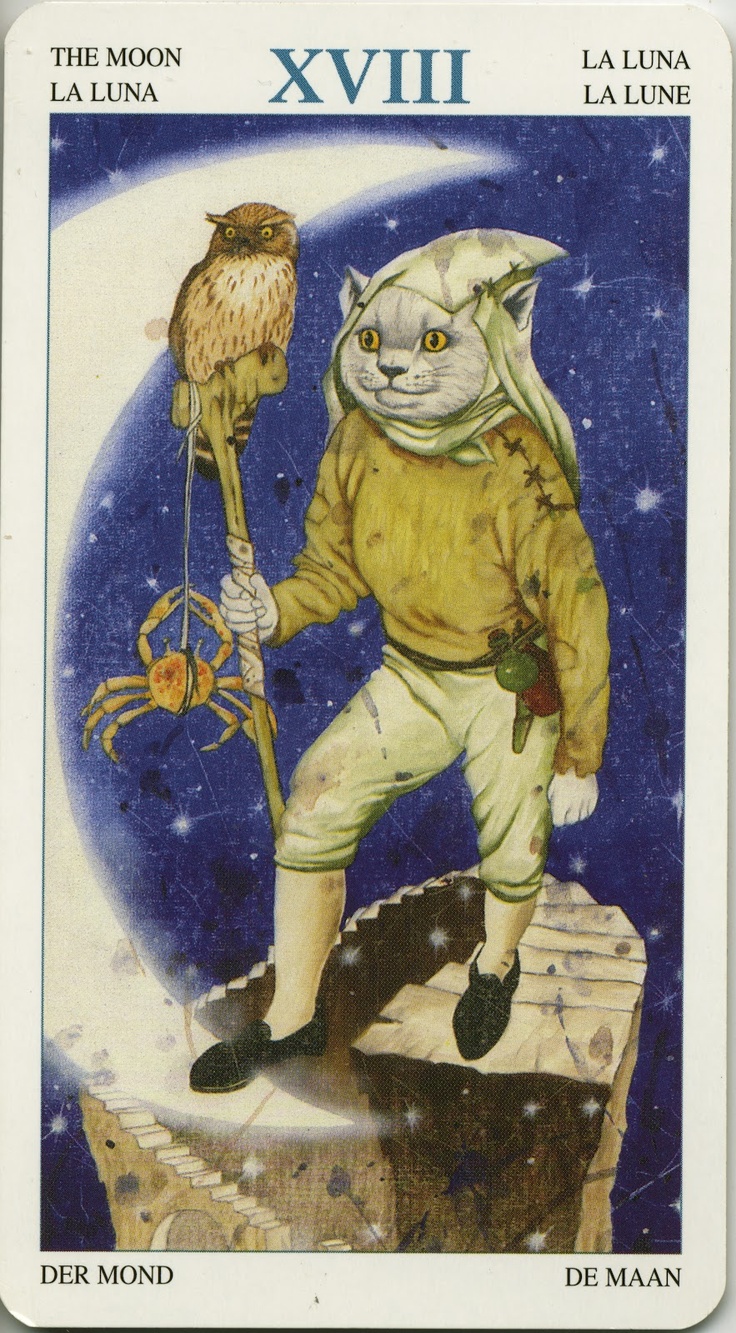
XVIII. The Moon
(This card features an owl and a cat
ascending a stair way to the crescent moon. They are taking a crab with them.)
Walking up the staircase, I marveled
at the Moon, who invited me to sit on it. The Owl and Cat told me that they
were going taking Crab home. As the trio set off, riding on the Crescent Moon,
Crab explained that he needed to return to his lady friend, before the Full
Moon. Watching this surreal scene, I felt that I had entered a dream world of
moon glow and mystery. Perhaps I did, with the illusions taking me on a confusing
magical trip.
XX. Judgement
(A crocodile sits on a mangrove tree
root holding a stick. A plover perches on his open mouth.)
Drifting in a canoe in the swamp, I
stopped to ask the Crocodile where I was. He told me it was hard to talk with a
plover in his mouth, whilst the Plover merely grunted at me. After picking off
the leeches from the Crocodile’s mouth, he explained that they lived in balance,
taking and giving. The Crocodile smiled, telling me that Plover was his
dentist. He said that he gets clean gums, whilst Plover gets a meal. As I
pondered the pair, I realized that one aspect of judgement was knowing when to
enter the Crocodile’s mouth.
Subscribe to:
Posts (Atom)