Showing posts with label insects. Show all posts

Friday, August 25, 2017

Firefly (Lightning Bug) Family: Recapture the Wonder

World-wide, people have marveled at the flashing lights of fireflies on warm nights. These beetles are called many names: blinkies, glowworms, moon bugs, and lightning bugs. All these names reflect the quality of fireflies’ bioluminescence to communicate.

These remarkable insects have the most efficient light in the world. Their “cold light” consists of the luciferase enzyme which acts on the luciferin in the presence of magnesium, ATP, and oxygen. The adults flash to speak with each other and to find mates. Even firefly eggs and larvae glow, as a warning to predators. They tell predators that they taste lousy.

Found on nearly every continent, fireflies are classified as Lampyridae in the Winged Beetle Order of Coleoptera. Scientists usually divide the thousands of species of fireflies into five groups (although these groupings are in a state of flux). Found in North America, the Lampyridinae synchronize their flashes. The Photurinae are known for the females eating the males. The largest group, the Luciolinae live in the Eastern Hemisphere. These fireflies flash instead of continuously glowing. The most primitive fireflies are called the Cyphonocerinae. The “catch-all” group of Lampyrinae have all the fireflies, who do not fit in any of the other groups.

The flashing is done by the adult firefly, who lives only to mate and lay eggs. Meanwhile, the firefly larvae can live for up to two years, eating snails and worms. Some will hibernate over the winter, others for longer. All usually will emerge during warm weather as adults.

Fireflies are disappearing worldwide. Various factors are to blame, most of them created by humans. In developing fields and forests, people have destroyed firefly habitats. The other major problem is light pollution. In many places, lights abound from headlights of cars to porchlights of houses to skylights of malls. All these lights disrupt the flashing patterns of the fireflies, who are trying to mate. (Consult Firefly.org (http://www.firefly.org/) for suggestions on how to help fireflies.)

Watching fireflies at dusk as they flash by recaptures the lost wonder of childhood. As adults, many of us are caught up in our daily activities and concerns. We forget that the world is full of wonder. Fireflies give people pause to see the beauty that is around them. Remember that the firefly is just an ugly bug who twinkles. But twinkle, is what they do well.

Thursday, December 11, 2014

STICK INSECT! WALKING STICK! STICK BUG: Having Many Choices

Stick Insects or Phasmids (Phasmatoidea, Phasmatidae) encompass about 2,700 known Insect species. With their long bodies that give them a twig-like appearance, Phasmids are almost invisible among the leaves of trees. When They are disturbed, Phasmids will lay motionless for hours pretending to be a stick. Sometimes, They will sway to mimic a twig blowing in the wind.

To avoid being eaten, Phasmids have many unique defenses. Although Most rely on passive camouflage to avoid predators, many large Phasmids have large spines on their hind legs for self-defense. Other Phasmids will discourage their attackers by regurgitating food at them or by squirting them with poison. American Walking Stick (Anisomorpha bupestiordes) sprays his intruder with a chemical spray that causes blindness.

Female Phasmids can reproduce without mating. Some populations consist entirely of mature Females and their Offspring. The Young are identical to their Mother. Sometimes Mother Phasmid will search for a rare Male to mate with. She will either find Him with his Friends or will attract Him by emitting a seductive scent.

Unlike other Insects, many people like to have Phasmids as pets. Usually all They require is blackberry leaves and water to thrive. However, They do prefer to have their leaves in their cages lightly misted.

Phasmids teach about having as many choices as possible. For example, people call Them by many names--Walking Stick, Stick Insect, or Stick Bug. Female Phasmids can reproduce with or without a mate. Phasmids defend Themselves in various ways. Some simply become still, while Others will squirt a poison. In life, it is important to have many options available to you.
--
Phasmids are cousins to Grasshoppers and Mantids.

Sunday, June 23, 2013

Dragonfly Family: Refinement of Skills

Dragonflies flit on the surface of small ponds and slow creeks. Their gossamer wings glisten in the dappled sunlight. Colorful and delicate-looking, Dragonflies inspire awe in everyone who sees Them.

Dragonflies were one of the first flying creatures to evolve, about three hundred million years ago. They have remained mostly unchanged during all this time. Although They are the most primitive of winged Insects, Dragonflies are the most efficient fliers. Their wings move independently allowing the Dragonflies to stop in midair, change directions, and fly backwards. Very few Birds can out-fly or hunt down Dragonflies.

Dragonflies are the Hawks of the Insect World. They swoop down from a perch and take an unsuspecting Insect by surprise. Effective hunters, Dragonflies snatch their prey in midair and devour them.

The Dragonflies teaches how you can refine your skill, and be more than you are.

Important Dragonfly Teaching: Illusion:
"When we've tricked ourselves into believing our limits prevent us from changing and growing, Dragonfly teaches us to pierce our self-created illusions. Dragonfly helps us to gain power through dreams and goals. Dragonfly asks us to look through the illusions, to become all we can be." Copyright: Unknown.

Dragonfly's Teachings Include:
"Dragonflies symbolize whirlwind, swiftness and activity. In Japan, Dragonflies represent new light and joy. Dragonflies remind us that we are light and can reflect the light in powerful ways if we choose to do so." Copyright: Unknown.

Thursday, January 10, 2013

GOLIATH BEETLE: Facing Fears

The largest and heaviest living Insect on earth is Goliath Beetle of Africa. Goliath Beetle grows up to be about thirteen centimeters (five inches) long and weighing about 100 grams (3.5 ounces). Part of nature’s clean-up crew, Goliath Beetle eats dead plant material.

Living in Africa, Mother Goliath Beetle lays her eggs in the rich moist, rotting wood of rain forest trees. After hatching, Goliath Beetle larvae eat the decomposing logs, returning various nutrients to the soil. The adult Goliath Beetle feeds on anything sugary like fruit and sap from injured trees. Because Goliath Beetle prefers high protein foods, He also eats other Insects.

Many people shriek and flee in fear when encountering a bug of any type. Face your fears with scary looking but harmless Goliath Beetle. Embrace Him, and love Goliath Beetle as you would a pet.

Goliath Beetle’s Teachings Include:
“A beetle trundling across your path means a lucky day. The bigger the beetle, the greater the luck, so don't squash it.” Copyright: “Gypsy Magic”, Patrinella Cooper.

Friday, December 21, 2012

STAG BEETLE Quiet Service

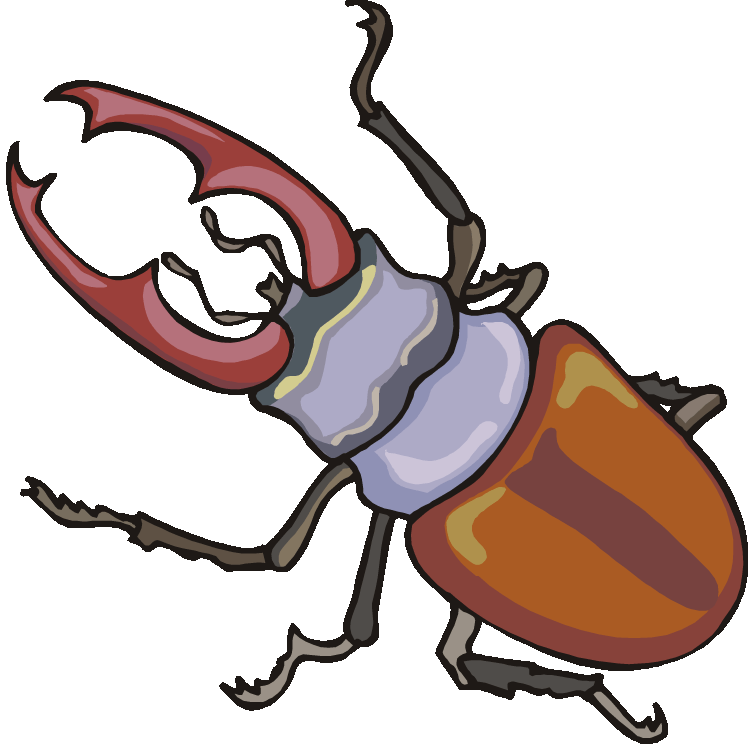
Stag Beetle gets the attention of a Female Stag Beetle by parading around with his head raised and his antler-like jaws (chelicerae) wide open. In mating battles, He spars with his Rivals using his large jaws as a Stag Deer would use his antlers. Because of his deer-like mating behavior, this Insect is called “Stag Beetle”.

The difference in size between Stag Beetle and his Mate caused people to think that They were different species. Although Stag Beetle’s jaws are huge, He cannot use them as weapons. However, his smaller Mate can, and She will give any intruder a sharp nip.

Stag Beetle Larva feeds on decaying wood and roots of tree stumps. By eating old and decaying wood, He is a helpful Insect. Stag Beetle helps the trees by returning the minerals of dead wood to the soil. Stag Beetle is a flagship species for a whole range of animals dependent on access to dead wood.

The ancient Greeks had a myth about the origin of Stag Beetle. The first man to play the lyre was a famous musician named Cerambus. Unfortunately for him, Cerambus angered the nymphs who herded his Sheep and Goats. For their revenge, the nymphs turned him into a Stag Beetle, who now wanders around the forest feeding on decaying wood. Ancient Greek children would capture Stag Beetle to use his horned head for a pretend lyre.

In medieval times, people believed that Stag Beetle flew around with a hot coal in his jaws setting fire to buildings. Meanwhile Albrecht Durer (1471 – 1528) became one of the first artists to realistically draw a Stag Beetle. In his paintings and drawings, Durer associated Stag Beetle with Christ.

People do pay attention to Stag Beetle but little understand Him or his ways. People usually disliked Him because of his ugliness. However, Stag Beetle still quietly goes about helping the forest grow. Durer did recognize Stag Beetle’s attributes when he used this Beetle to symbolize Christ’s quiet service to humanity.

Stag Beetle teaches quiet service. While others are noticed for what they do, He calmly goes about his business eating dead wood. Unnoticed, Stag Beetle faces a host of predators and unthinking people to provide a vital service for keeping the forest alive.

Wednesday, December 19, 2012

BEETLE FAMILY: Discernment

rhinoceros beetle

Beetles have been on the earth for about 300 million years and are the most numerous of all Insects. Since Beetles are the largest order in the animal kingdom, to describe Them as a single group is impossible. Aristotle named Beetles “Coleoptera” (Sheath or Shield Wings) because their hardened front wings cover their hind wings like a shield. The name “Beetle” comes from the Old English word for “little biter”.

“Good” Beetles include Dung Beetles, who scavenge on animal excrement or dung. They roll the dung into a ball, which They bury for future use. Dung Beetles help to clean up the environment. Leaf Beetles are an example of “Bad” Beetles. No sooner than leaves appear on trees than do Leaf Beetles emerge and eat them away. If They are unchecked, these colorful Beetles can deforest an area.

Beetle teaches us not to take everything on face value. Some colorful Beetles are destructive while others such as Lady Bugs (Lady Beetles) are beneficial. Take each Beetle on Its own merits. Teaches Beetle: You must use discernment in all your affairs.

Wednesday, October 10, 2012

Periodic Cicada: The Nexus of Time

In the eastern half of North America, Periodical Cicadas from Brood X invade the countryside every 13 and 17 years. Crawling up from the ground, They emerge at once, in May and June, leaving behind their exoskeletons. For a brief month, Male Periodical Cicadas fill the air with a deafening sound, advertising for a mate. These large Insects spend their brief adult lives with only one thing on their minds – mating. When a Female Periodical Cicada is ready, She will “click” to the Males, “Here I Am!” After mating, She lays her eggs in trees. When They hatch, the Offspring will move underground for another 13 to 17 years.

Living longer than any other Insects, Periodical Cicadas emerge as a single Brood. Each Brood is spaced 13 or 17 years between emergences. This long period prevents Predators from timing their activities to eat the Cicadas. The prime numbers of 13 and 17 insure that nothing can adapt to the Brood Cycle.

Called Periodical Cicadas (Magicicada)), these Insects differ from their cousins Locusts. Unlike Locusts, Periodical Cicadas do not jump. They seem like Locusts because of their larger broods that overwhelm predators by their sheer numbers. After spending many years developing underground, They come up for only two months. Then, the Adults mate and die. Then years go by before another mass emergence.

Besides Periodical Cicadas’ size and numbers, what also makes Them outstanding is their song. Male Periodical Cicadas makes the loudest sound in the Insect World. By vibrating the ribbed plate in a pair of amplifying cavities at the base of his abdomen, Male Periodical Cicada can make his sound heard for long distances. A whole chorus of these whirring sounds resembles a deafening roar of hundreds of kazoos played at once.

Many people have heard Periodical Cicadas, and have not realized it. The sound tracks of many science fiction movies that feature UFOs use the Cicadas’ droning to signal the sound of the alien space ships. Think space aliens, and you associate Periodical Cicadas with them.

The lesson of Periodical Cicadas is living at the nexus of time. For Periodical Cicadas, time merges into one Brood. When They emerge in the present, Periodical Cicadas encourage people to remember the past. Also, They prompt people to think about what the future will bring. In the present, their numbers simply overwhelm people. Periodical Cicadas bend time into a prism of past, present, and future in one moment.

Sunday, January 17, 2010

The Elements and Animals: Birds and Insects (3)

BIRDS

Hawk (Red-tailed): Air or Spirit

Air: A member of the Buteo family of “Soaring Hawks”, Red-Tailed Hawk is seen perched on treetops or utility poles. Spotting prey, she dives to grasp the animal in her talons. Hunting small mammals, Red-Tailed Hawk searches for voles, her favorite food. Although Red-Tailed Hawk prefers life in the uplands, she will live in cities. Wherever she lives, Red-Tailed Hawk builds her nest at the forest’s edge or in large trees surrounded by open areas.

Spirit: To the Pueblo Peoples, Red-Tailed Hawk was endowed with the same qualities as Eagle. Because she was a messenger of the Spirit, they called her “Red Eagle”. Through her flight, Red-Tailed Hawk communicated messages from the Great Mystery. In addition, she brought the rains and the waters necessary for life.

Hummingbird (Ruby-Throated): Fire

A native of the New World, Ruby-throated Hummingbird has enchanted all who have seen her. This tiny fast bird inspires wonder in those who watch her feed. Despite her small size, Ruby-Throated Hummingbird migrates from the eastern United States across the Gulf of Mexico to Central America. What makes this passage extraordinary is that Ruby-Throated Hummingbird does not eat on her journey. She stores up a layer of fat equal to half of her body weight.

The Aztecs of Mexico regarded Ruby-throated Hummingbird as a warrior. Despite Ruby-throated Hummingbird’s delicate appearance, she is a bold, quarrelsome bird who will readily attack any intruder that strays into her territory. With the frenzied beating of her wings, Ruby-throated Hummingbird will defend herself with her long beak.

Quail (Old World): Fire

Thought of as stout little birds, Old Word Quails are remarkable for their hardiness. When Old Word Quails are cold, they form star-shaped bevies (flocks) to receive warmth from each other. In addition, these short legged birds with round heads, will often post sentries to watch for intruders. Their plumage provides such excellent camouflage that rarely does anyone notice them until they call “wet-my-lips” or “whit-whit’tit”. (Because Old Word Quails’ calls are so distinctive, some cuckoo clocks have them sound on the quarter hours.)

Surprisingly, Old Word Quails are well-regarded in many cultures. For the Chinese, Old Word Quails were the Fire Phoenix of Spring and Summer. Among the Hindus, these birds represented the returning Sun. Furthermore, these unassuming birds were also the emblem of the Russian Tsars.

(Note: Old World Quails belong to the Pheasant Family, while New World Quails are in their own Family. They are only distantly related, and are not the same species.)

Raven: Fire or Water

Water: Raven is known for shape shifting, which Crow cannot do. More secretive than Crow, Raven is also associated with the night and dark magic. Since she is bigger and stronger than Crow, Raven’s magic is more profound. (Night and the moon are often associated with the element of water.)

Fire: Among early Christians, Raven was a messenger sent by God to feed the saints in the wilderness. Among the Native Americans of the Pacific Northwest, Raven was the Great Trickster. She created human beings, and brought fire to them. Meanwhile in China, Three-legged Raven lived in the sun, representing the sun’s three phases – dawn, noon, and dusk.

INSECTS

Dragonfly Family: Water or Air

Water: Dragonflies flit on the surface of small ponds and slow creeks. Their gossamer wings glisten in the dappled sunlight. Colorful and delicate-looking, Dragonflies inspire awe in everyone who sees them.

Air: Dragonflies were one of the first flying creatures to evolve, about three hundred million years ago. They have remained mostly unchanged during all this time. Although they are the most primitive of winged insects, Dragonflies are the most efficient fliers. Their wings move independently allowing the Dragonflies to stop in midair, change directions, and fly backwards. Very few birds can out-fly or hunt down Dragonflies.

Friday, June 20, 2008

The Leaf Cutter Bee


LEAF CUTTER BEE
Craftsmanship


Most Bees are called “Solitary Bees” because They live in individual nests. One such Bee is Leaf Cutter Bee, who lives independently of other Bees. However, She does build her nest close to other “Solitary Bees”–Mason Bees and other Leaf Cutter Bees. Together, They share a large area as their combined territory.

This hardy Bee is the first Bee seen in the early spring. While Honey Bees are still home inside their hives, Leaf Cutter Bee is busily gathering pollen. Because this fuzzy, hairy Bee emerges so early, many gardeners install special nest boxes to encourage Her to live in their gardens. Along with her Friends, She actively pollinates flowers while gathering nectar. Leaf Cutter Bee stores this nectar in her “honey stomach”, an extension of her gut. Later, She disgorges her nectar that She had gathered as food for her Young.

Quickly, Leaf Cutter Bee darts to a suitable tree, and within two minutes, selects a leaf, cuts a hole out, and then quietly departs. With her powerful, scissor-like jaws, Leaf Cutter Bee cuts leaves into tiny pieces for her nest. Each cell of her nest is made with 15 to 20 pieces of leaves. She uses the oval leaf pieces for the walls, and the round ones for the nest partitions. After filling that nest cell with nectar, Leaf Cutter Bee lays her egg, and then seals the cell. To ensure that the nest will survive the winter, She cements the leaves together with her saliva. Because her nest is covered with leaves, it is not as easy to see as Honey Bee’s nest.

Leaf Cutter Bee is particular about what leaves She uses for her nest. She prefers soft, pliable leaves from roses for constructing her nest. Leaf Cutter Bee builds with such precision that you can count the exact number of leaves in her nest. Learn craftsmanship from Leaf Cutter Bee and build a quality product that lasts.

Leaf Cutter Bee’s Wisdom Includes:
Being Fast and Stealthy
Sharing
Constructing a Home
Living Side by Side With Others

---------
Copyright: Virginia Carper, Animal Teachers 2008
For finding your Animal Totems, contact me at animalteachers @ gmail.

Thursday, June 19, 2008

Wisdom of the Bumble Bee


BUMBLE BEE
Attend to Your Affairs

Bumble Bees are large robust Bees with the color patterns of yellow and black. You can usually find Bumble Bees flying low to the ground or on flowers collecting food. They nest almost anywhere but only remain in one particular nest for a year.

Besides size, another way that you can tell how Bumble Bee is different from Honey Bee is that Bumble Bee's nest is a mess. Bumble Bees have fewer members in their colonies than Honey Bee. Also, They do not store large amounts of honey. Unlike Honey Bees, Bumble Bees rarely sting unless their nest is threatened.

Enjoy watching these fairly placid Bees as They go about their business of pollinating the flowers. Learn from Them to mind your own business. Just do not be messy in your affairs.


Bumble Bee’s Wisdom Includes:
Messenger Who Holds the Secrets of Life
Regaining Focus
Gathering
Contentment

----------------------------
Copyright: Virginia Carper, Animal Teachers, 2008

If you want to know your Animal Totems, please contact me at animalteachers@gmail.com for a consultation

Wednesday, June 18, 2008

Wisdom of the Bee Family

BEE FAMILY
Making Choices

Bees belong to the order Hymenoptera (membrane winged), whose members have two pairs of thin, clear membranous wings. Also, included in this order are Wasps and Ants.

The two Bees that most people are familiar with are Honey Bee and Bumble Bee. These Social Bees are organized into colonies, with each member of the community having certain responsibilities to fulfill. Queen Bee builds the nest and lays the eggs. Worker Bee searches for nectar and pollen to take back to the nest.

Besides Social Bees, there are Solitary Bees such as Leafcutter Bee, Carpenter Bee, and Mason Bee. Leafcutter Bee constructs her nests with leaves and wood. Carpenter Bees construct their homes in solid wood by forming tunnels. Despite their resemblance to Bumble Bees, Carpenter Bees are loath to sting anyone. In some species of Carpenter Bees, Mother Bee and her entire family fly off to search for nectar and pollen, together. Mason Bees are similar to Carpenter Bees except that They wall off their tunnel chambers with dirt and clay.

One of the busiest and most useful of insects, Bee asks you to examine your own productivity in life. Bee reflects multiple choices. When opportunities present themselves, Bee teaches you to sort through for the most important one.


Bee's Wisdom Includes:
Celebration
Organization
Service
Gathering
Industry
Frugalness and Hard Work
Fertility and the Honey of Life
Builder

------------------
Copyright: Virginia Carper, Animal Teachers, 2008
For Animal Totem Readings: contact me at animalteachers@gmail.com