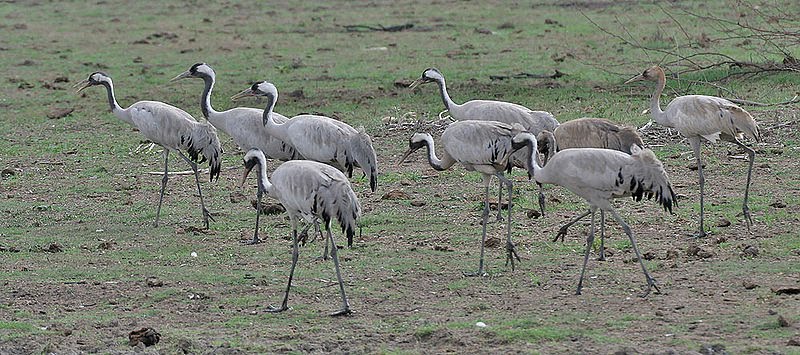
A tall, elegant Bird, Common Crane breeds in secluded wetlands of Northern Europe. During the breeding season, He and his Family keep Themselves secluded from other Common Cranes. Whilst nesting, Common Crane’s Family covers their bodies with mud to hide from the others.
During migration, Common Crane returns to the same nesting spot with his Mate. Traveling in large flocks, Common Crane and his Friends fly in a “V”. Flying with his long neck and head straight out, He looks like an alphabet letter in the sky.
The Ancient Greeks once used the migration of Common Crane as their calendar. When He arrived in the spring, it was the start of their New Year. After Common Crane left in the autumn, it was time to bring in their boats from the sea.
Lore among the early Europeans tells of Common Crane inspiring the Gods to invent writing. For the Greek, Hermes, the God of Communication, saw Common Crane flying over Crete. He formed the Greek letters from the Common Crane flocks flying across the sky. Meanwhile, Oghma of the Irish created the Oghams (the stick alphabet) from watching Common Crane.
In addition, Common Crane was associated with hidden knowledge and prophecy. Apollo, the Greek God of poets and seers, often took the form of Common Crane when He moved amongst the humans. Among the Irish, Druids carried Crane bags, which were emblems of their arcane knowledge.
Through the years, Common Crane has guided people seeking to deepen their knowledge. He brought auguries to people to foretell the future. Common Crane inspired the creation of ancient alphabets. In fact, the Irish viewed Him as the Guardian of Magical Alphabets. Let Common Crane inspire you to your pursuit of knowledge.
This is a blog about nature in all her glory. The folklore and general ideas about what messages nature bring to people.
Showing posts with label waterbirds. Show all posts
Saturday, September 11, 2010
Friday, September 10, 2010
BROLGA (NATIVE CONPANION): Dance
Found in Australia and New Guinea, Brolga is famous for her intricate and stately dancing. According local Australian lore, Brolga was named for a woman who was an exquisite dancer. She was transformed into a crane after she rejected all of her suitors. (“Brogla” is the shortened version of “Burralga” (from Gamilaraay) the official name.)
Within her flock, Brolga keeps to her small family. Each Brolga flock is actually a collective of families. However, when one Bird takes off, the others in the flock will follow suit. The whole group of Birds seems to move on the whim of only one Bird.
Brolga uses her dancing to bond with her Mate. She lines up opposite to Him, and begins stepping about with her wings half open. Bobbing and bowing, the two Cranes then stop and trumpet to each other. Sometimes They will jump, run, and throw sticks up in the air. At other times, the whole flock will dance together for no reason.
Dancing is an important way for people to express themselves. By moving your body, you can convey joy, sadness, and love. Brolga dances to deepen her bond with her mate. Learn the art of the dance from Brolga, and dance for no reason at all.
----------------
Within her flock, Brolga keeps to her small family. Each Brolga flock is actually a collective of families. However, when one Bird takes off, the others in the flock will follow suit. The whole group of Birds seems to move on the whim of only one Bird.
Brolga uses her dancing to bond with her Mate. She lines up opposite to Him, and begins stepping about with her wings half open. Bobbing and bowing, the two Cranes then stop and trumpet to each other. Sometimes They will jump, run, and throw sticks up in the air. At other times, the whole flock will dance together for no reason.
Dancing is an important way for people to express themselves. By moving your body, you can convey joy, sadness, and love. Brolga dances to deepen her bond with her mate. Learn the art of the dance from Brolga, and dance for no reason at all.
----------------
Thursday, September 09, 2010
CRANE FAMILY: Sacred Gifts
As one of the oldest groups of Birds, the Crane Family dates back to the Paleocene Era. For thousands of years, the beauty and grace of these Birds have inspired peoples and civilizations. From instilling sacred knowledge to inspiring speech, Cranes have always been a part of human cultures.
Scientists divide Cranes into two sub-families, the Balearicae and Gruinae. The Crowned Cranes comprise the Balearicae. These living fossils of the Crane Family are found only in Africa. Moreover, Crowned Cranes are the only Cranes who roost in trees.
Meanwhile, the Gruinae includes the typical Cranes; this sub-family is further divided into three groups (Genus). The Grus group is the typical Cranes that most people are familiar with. The Blue and Demoiselle Cranes (the Anthropoides) prefer dry grasslands and semi-arid areas instead of the usual marshes. Meanwhile, the Wattled Crane (Bugeranus carunculatus) is the only member of the Bugeranus Group. This Crane has a long bill, black legs and toes.
One custom that people notice about Cranes is what They do at dawn. Various pairs of Cranes will announce their territory with a unison call. Then, their neighbors will respond with their own calls. In the early morning, the grasslands and wetlands resound with the calls of Crane pairs. This dawn ritual is done to deepen the bonds of each pair.
The stateliness and elegance of Cranes have inspired people throughout the ages. In Asia, Sarus Crane is the symbol of marital fidelity. Meanwhile in China and Japan, Red-Crowned Crane represented happiness. Since They were messengers of the Gods, Demoiselle Cranes were places on Egyptian tombs. According to the Bambara of Africa, Crested Crane gave birth to speech. For the ancient Irish, Common Crane inspired Oghma to create the Ogham alphabets.
Cranes have given people many wonderful things. Their sacred gifts include beauty, happiness, immortality, love, loyalty, piety, and purity. These are suitable gifts that we can all possess and give to others. Let Cranes be your guide to holy things.
------------------------
Scientists divide Cranes into two sub-families, the Balearicae and Gruinae. The Crowned Cranes comprise the Balearicae. These living fossils of the Crane Family are found only in Africa. Moreover, Crowned Cranes are the only Cranes who roost in trees.
Meanwhile, the Gruinae includes the typical Cranes; this sub-family is further divided into three groups (Genus). The Grus group is the typical Cranes that most people are familiar with. The Blue and Demoiselle Cranes (the Anthropoides) prefer dry grasslands and semi-arid areas instead of the usual marshes. Meanwhile, the Wattled Crane (Bugeranus carunculatus) is the only member of the Bugeranus Group. This Crane has a long bill, black legs and toes.
One custom that people notice about Cranes is what They do at dawn. Various pairs of Cranes will announce their territory with a unison call. Then, their neighbors will respond with their own calls. In the early morning, the grasslands and wetlands resound with the calls of Crane pairs. This dawn ritual is done to deepen the bonds of each pair.
The stateliness and elegance of Cranes have inspired people throughout the ages. In Asia, Sarus Crane is the symbol of marital fidelity. Meanwhile in China and Japan, Red-Crowned Crane represented happiness. Since They were messengers of the Gods, Demoiselle Cranes were places on Egyptian tombs. According to the Bambara of Africa, Crested Crane gave birth to speech. For the ancient Irish, Common Crane inspired Oghma to create the Ogham alphabets.
Cranes have given people many wonderful things. Their sacred gifts include beauty, happiness, immortality, love, loyalty, piety, and purity. These are suitable gifts that we can all possess and give to others. Let Cranes be your guide to holy things.
------------------------
Sunday, July 04, 2010
THE STORK FAMILY: Constancy
In many cultures, Storks are highly thought of, with numerous examples abounding. In European and Islamic societies, Storks are symbols of constancy and pilgrimages. For the peoples of Northern Europe, Storks bring abundance and harmony. Meanwhile in China, these Birds bring messages from the Gods. In Ancient Rome, the Stork Law (“Lex Ciconia”) ensured that elderly parents would be cared for in the way that Storks were perceived to care for theirs. The Arawak of North America believe that Stork brought tobacco to the people.
Scientists usually divide Storks into three groups. The first group is the Typical Storks, the Ciconiini. Most people know this group as the Birds who bring babies. The bills of these Storks are long and heavy. In addition They will walk slowly, looking down to search for their prey.
Mycteriini is the second group. These Storks often have down-curved bills like the Ibis. Open-billed Storks use their bills for eating Mollusks, while Wood Storks feed by touch, wading slowly with their bills in the water. Also, Mycteriini live in colonies in the tropics.
The third group is the Leptoptilini, the Great Storks. They are Jabiru, Marabou Stork, Greater and Lesser Adjutant Storks. Because They tear at carrion with their huge bills, these Storks lack plumage on their heads. They will often follow Vultures in search for food.
Well known for centuries, the courtship of Storks has even been depicted in 13th Century manuscripts. Their courtship is referred to as the “up-down”. One stork greets his mate. Then the two Birds raise and lower their necks in a stylized manner. Afterwards, the Storks clatter their bills and make greeting noises. This is an important aspect of their pair bonding.
After a long migration Storks return to their old homes, as always. Each spring, They come back to their old nests to raise their young. Many of these nests are enormous since each year Storks keep adding sticks to them. Learn constancy in your life from Storks, and have a large nest to live in.
Scientists usually divide Storks into three groups. The first group is the Typical Storks, the Ciconiini. Most people know this group as the Birds who bring babies. The bills of these Storks are long and heavy. In addition They will walk slowly, looking down to search for their prey.
Mycteriini is the second group. These Storks often have down-curved bills like the Ibis. Open-billed Storks use their bills for eating Mollusks, while Wood Storks feed by touch, wading slowly with their bills in the water. Also, Mycteriini live in colonies in the tropics.
The third group is the Leptoptilini, the Great Storks. They are Jabiru, Marabou Stork, Greater and Lesser Adjutant Storks. Because They tear at carrion with their huge bills, these Storks lack plumage on their heads. They will often follow Vultures in search for food.
Well known for centuries, the courtship of Storks has even been depicted in 13th Century manuscripts. Their courtship is referred to as the “up-down”. One stork greets his mate. Then the two Birds raise and lower their necks in a stylized manner. Afterwards, the Storks clatter their bills and make greeting noises. This is an important aspect of their pair bonding.
After a long migration Storks return to their old homes, as always. Each spring, They come back to their old nests to raise their young. Many of these nests are enormous since each year Storks keep adding sticks to them. Learn constancy in your life from Storks, and have a large nest to live in.
Saturday, July 03, 2010
MARABOU STORK: Shadows
One of the largest members of the Stork Family, Marabou Stork often feeds on carrion instead of fish. He will haunt the local village dumps for food. Furthermore, Marabou Stork will wait patiently for workers at slaughter houses finish their work, to grab the remaining offal.
Known as the “Undertaker Bird”, Marabou Stork resembles a Vulture instead of a Stork. His bald head is encrusted with scabs. His heavy bill, resembling a meat cleaver, is supported by his bare red throat sac. With his black wings and skinny white legs, Marabou Stork looks quite sinister.
Preferring dry open savannahs to swamps, Marabou Stork relies on Vultures to find dead animals for Him. After the Vultures open up the animal’s hide, Marabou Stork uses his meat cleaver of a beak to retrieve large pieces of meat, which He swallows whole. However, if there are no animal carcasses available, Marabou Stork will eat anything He can catch, while walking or wading.
Unlike the friendly Stork that brings babies, Marabou Stork escorts souls to the Heavens. In African lore, a flying Marabou Stork is a psychopomp for the departed. He takes the freed souls to where they belong.
Marabou Stork is the “Shadow” Stork. Instead of bringing life, He ushers the dying to their final resting place. Accept your shadow side, and its rightful place in the scheme of life. To be a whole person, you need both the shadow and the light. Let Marabou Stork free your shadow self.
Friday, July 02, 2010
WHITE STORK: Fertility
Since She is often the first Bird seen in spring, the Ukrainians refer to White Stork as “The Messenger of Spring”. In northern Germany, White Stork returns to her nest in March, nine months after Midsummer. When White Stork returns in the spring, She adds more sticks to her already enormous nest. Often building her nest on the roofs of people’s homes, White Stork will then line it with paper and clothing from the humans. Since She brought prosperity to any family where She nested, people encouraged White Stork to make her home on their buildings.
As portrayed in books, White Stork brings babies to people. Since Pagan times, many people in Europe believed that She brought fertility (hence babies) to people. There is such a strong association between White Stork and babies that newborns often have “stork bites”, small pink patches on their eyelids or upper lips. These patches are believed to be “gifts” from the White Stork.
Many people associate White Stork with fertility and prosperity. However, most modern people often think of fertility only in terms of babies. But, fertility also encompasses abundance, and of course prosperity. Let White Stork nest on your roof, and experience abundance in your life. Be fertile in all areas of your life.
----------
Science Notes:
1. Oriental White Stork (Ciconia boyciana) is not a subspecies of White Stork (Ciconia ciconia). The White Stork has two subspecies: European (Ciconia ciconia ciconia) and West Asian (Ciconia ciconia asiatica).
As portrayed in books, White Stork brings babies to people. Since Pagan times, many people in Europe believed that She brought fertility (hence babies) to people. There is such a strong association between White Stork and babies that newborns often have “stork bites”, small pink patches on their eyelids or upper lips. These patches are believed to be “gifts” from the White Stork.
Many people associate White Stork with fertility and prosperity. However, most modern people often think of fertility only in terms of babies. But, fertility also encompasses abundance, and of course prosperity. Let White Stork nest on your roof, and experience abundance in your life. Be fertile in all areas of your life.
----------
Science Notes:
1. Oriental White Stork (Ciconia boyciana) is not a subspecies of White Stork (Ciconia ciconia). The White Stork has two subspecies: European (Ciconia ciconia ciconia) and West Asian (Ciconia ciconia asiatica).
Wednesday, June 16, 2010
SHOEBILL STORK (BOGBIRD, WHALE-HEADED STORK)
Connect with Deep Ancestors
One of nature’s strangest-looking Birds, Shoebill Stork is remarkable for her huge hooked bill, which is similar in shape to a shoe. She uses her bill for catching and holding her slippery prey, the Lungfish. Shoebill Stork is a remarkable Bird of which little is known about, such as what is her place in the Order of Birds. Therefore, She has her own Family – the Balaenicipitidae. Perhaps Shoebill Stork is a connection to other Birds living and extinct, who live near marshes.
The strange and other-worldly Shoebill Stork was unknown to Europeans until the 1800s. However, the Ancient Egyptians knew Her well. They painted her images on the walls of their tombs. Perhaps, when they died, She quietly waited for them in the Otherworld, to connect them to the Spirits of the past.
Living in the papyrus swamps of Africa, Shoebill Stork shrewdly hunts in areas of low oxygen. Standing motionless in the sluggish water, She patiently waits for Lungfish to come up for air. When He does, She quickly thrusts her head into the water and catches Him. Afterwards, Shoebill Stork pushes Herself upright using her wings as arms.
Soaring on the thermals, Shoebill Stork finds suitable places for nesting. Together with her Mate, They incubate their eggs. With their huge bills, the two Shoebill Storks ladle water over the eggs, and later the hatched Chicks to keep them cool. After taking trips to get water, the Adults greet each other by clattering their bills. Imitating their elders, the young Chicks hiccup their own greetings.
Let this strange Bird take you to the past, back to your deep ancestors. When you seek your distant kindred, Shoebill Stork will wait for you. Do not let her odd appearance deter you, but let it give you joy. Silently, She will guide you home to your deep past.
One of nature’s strangest-looking Birds, Shoebill Stork is remarkable for her huge hooked bill, which is similar in shape to a shoe. She uses her bill for catching and holding her slippery prey, the Lungfish. Shoebill Stork is a remarkable Bird of which little is known about, such as what is her place in the Order of Birds. Therefore, She has her own Family – the Balaenicipitidae. Perhaps Shoebill Stork is a connection to other Birds living and extinct, who live near marshes.
The strange and other-worldly Shoebill Stork was unknown to Europeans until the 1800s. However, the Ancient Egyptians knew Her well. They painted her images on the walls of their tombs. Perhaps, when they died, She quietly waited for them in the Otherworld, to connect them to the Spirits of the past.
Living in the papyrus swamps of Africa, Shoebill Stork shrewdly hunts in areas of low oxygen. Standing motionless in the sluggish water, She patiently waits for Lungfish to come up for air. When He does, She quickly thrusts her head into the water and catches Him. Afterwards, Shoebill Stork pushes Herself upright using her wings as arms.
Soaring on the thermals, Shoebill Stork finds suitable places for nesting. Together with her Mate, They incubate their eggs. With their huge bills, the two Shoebill Storks ladle water over the eggs, and later the hatched Chicks to keep them cool. After taking trips to get water, the Adults greet each other by clattering their bills. Imitating their elders, the young Chicks hiccup their own greetings.
Let this strange Bird take you to the past, back to your deep ancestors. When you seek your distant kindred, Shoebill Stork will wait for you. Do not let her odd appearance deter you, but let it give you joy. Silently, She will guide you home to your deep past.
Monday, May 24, 2010
KILLDEER: BEING A SMART PARENT
Killdeer (North America’s “Lapwing”) is a noisy conspicuous Plover of ploughed fields and golf courses. Although Killdeer is considered to be a “Shorebird”, She lives far from the water. The largest of the Ringed Plovers, Killdeer nests in gravelly areas, as long as it is near some water.
Killdeer has consummate parenting skills. When an intruder comes near her nest, She performs a complex “injury-feigning” display. First Mother Killdeer runs from the nest. Then She takes to the air, some distance away. If that does not work, Mother Killdeer lands, and proceeds to drag one of her wings. She does her “broken wing” display. Intrigued by this, the intruder usually follows Her away from her nest. After awhile, Mother Killdeer makes a miraculous recovery, and flies off, leaving the intruder confused.
Mother Killdeer is a smart parent. Wasting no energy or time, She knows what is effective in protecting her Chicks. Not only does Mother Killdeer have an excellent strategy, She also has a back-up plan. Learn effective parenting from Mother Killdeer.
-------------
Saturday, May 22, 2010
NORTHERN LAPWING (PEE-WIT): Encounters with the Sacred
Common in Eurasia, Northern Lapwing is well-known for his haunting ethereal cry. In the lonely places of the land, the marshes and moors, you hear Him singing in his plaintive voice. According to folklore, those who hear his evocative sound, will have someone close to them die soon.
Since his wings make a lapping sound, this Wader, with rounded wings, became known as “Lapwing”. In addition because of his call, Northern Lapwing is also called “Pee-wit”. In Old English, He was called “Hleapwince”, which means “leap with a waver in it”. (This name came from his seemingly erratic flight.)
Many legends worldwide allude to Northern Lapwing’s association with holy people. According to the “Qur’an”, this Bird became a trusted confidant of King Solomon. Northern Lapwing brought news to the King about the Queen of Sheba.
Meanwhile a Swedish myth tells of Northern Lapwing being a servant of the Virgin Mary. After stealing a pair of scissors from the Virgin, she fled. When she was caught, the servant turned into a Lapwing. Even today, people could hear her crying, “Tyvil! Tyvil! I stole them.”
The Hindus speak of Lord Krishna’s mercy towards a nesting Lapwing. Just before the Battle of Kurukshetra, He heard the cries of a mother Lapwing, who had her nest on the battlefield. Lord Krishna, then, placed a huge elephant bell over her nest to protect Her and her eggs from the battle’s fury.
The Celts speak of Northern Lapwing and his wail of warning to people. There are Seven Whistlers of the Otherworlds to tell people of the world’s end. Six of them are searching for the seventh one. When they find him, the world will end. Lapwing’s cries remind people of the Whistlers.
In contrast, Ben Jonson, the English scientist noted that rash people were like “Lapwings running about with shells on their heads”. He was referring to Lapwing Chicks, who hatch with bits of eggshell on their heads. These Chicks will run about as if They are fleeing danger.
When you want the Sacred near you, listen to Northern Lapwing. His voice transcends the Heavens, allowing holiness to find Him. Follow Northern Lapwing to encounter the sacred in your life. But be careful not to be too rash, running about with a shell on your head.
-------------
Copyright: Virginia Carper, Animal Teachers
Friday, May 21, 2010
PLOVER FAMILY (CHARADRIDDAE): CAMOFLAGUE
The Plover family has two groupings: the Charadriinae, who are the typical Plovers, also known as “Plover” and “Dotterel”, and their close relatives, the Vanellinae, who are the crested Plovers, also called “Lapwings”. The ancient Red-kneed Dotterel (Erythrogonys cinctus) is grouped with the Vanellinae.
Members of the Plover Family are swift running Birds. In addition, these wading Birds are usually found near water, whether it be a small pond or a large lake. Although, the Australian Dotterel (Desert Plover) makes her home in arid regions, She will nest along the margins of streams.
Many Plovers make shallow dirt nests out in the open. However, their eggs look like living pebbles, blending with the soil. Meanwhile, Plover Chicks, after their Parents sound the alarm that an intruder is near, will crouch motionless. Then They will draw back their heads to hide in plain sight. Although Plovers seem to be vulnerable, They have good camoflague.
These small plump Birds are often seen on open shores looking for Worms. Although Plovers are strong fliers, They usually hunt by standing alert actively watching for prey. While standing on one leg, Plovers vibrate the other one lightly on the ground. Attracting Worms by these slight movements, these Birds can easily obtain their next meal.
Among the Plover Family, American Golden Plover (Pluvialis dominica) has one of the most spectacular migrations of any North American Bird. Flying from Arctic Canada, He first stops in Labrador, then He goes non-stop to the northern coast of South America. After resting for awhile in the region of the Amazon River Basin, American Golden Plover then flies to the Pampas of Argentina. Later when the seasons change, He does the whole trip in reverse.
A smaller Member of the Plover Family, European Dotterel is known for her trusting nature. However unlike many other Bird species, the female is the dominant sex. Bigger and more brightly coloured, Female European Dotterel initiates their courtship. After laying her eggs, She leaves her Mate to incubate them whilst She flies off to court another Male.
With their markings, Plovers often blend into the beach, where They live. Foraging for worms, They shake their feet to disguise their movements. Nesting in exposed areas, Plovers have eggs that look like stones.
Plovers demonstrate how to blend in. Call on Plovers to show you how not to be noticed. Only when They quickly run across the ground, stopping only to eat a tasty Mollusk, do you see Them.
------------------
Science Notes:
1. Magellanic Plover, Crab-plover, and Egyptian Plover are in their own groupings and are separate from the Plover Family. Crab-plovers (Dromadida) are unique amongst waders by nesting in burrows that she digs herself. Egyptian Plovers (Pluvianidae) pick leeches off the teeth of crocodiles. Magellanic Plover (Pluvianellidae) are more closely related to Sheathbills (Chionida) than Plovers.
2. These three members of the Plover Family closely resemble each other: American Golden Plover (Pluvialis dominica), European Plover (Pluvialis apricaria), and Pacific Golden Plover (Pluvialis fluva). Only subtle differences can been seen between these three birds.
Members of the Plover Family are swift running Birds. In addition, these wading Birds are usually found near water, whether it be a small pond or a large lake. Although, the Australian Dotterel (Desert Plover) makes her home in arid regions, She will nest along the margins of streams.
Many Plovers make shallow dirt nests out in the open. However, their eggs look like living pebbles, blending with the soil. Meanwhile, Plover Chicks, after their Parents sound the alarm that an intruder is near, will crouch motionless. Then They will draw back their heads to hide in plain sight. Although Plovers seem to be vulnerable, They have good camoflague.
These small plump Birds are often seen on open shores looking for Worms. Although Plovers are strong fliers, They usually hunt by standing alert actively watching for prey. While standing on one leg, Plovers vibrate the other one lightly on the ground. Attracting Worms by these slight movements, these Birds can easily obtain their next meal.
Among the Plover Family, American Golden Plover (Pluvialis dominica) has one of the most spectacular migrations of any North American Bird. Flying from Arctic Canada, He first stops in Labrador, then He goes non-stop to the northern coast of South America. After resting for awhile in the region of the Amazon River Basin, American Golden Plover then flies to the Pampas of Argentina. Later when the seasons change, He does the whole trip in reverse.
A smaller Member of the Plover Family, European Dotterel is known for her trusting nature. However unlike many other Bird species, the female is the dominant sex. Bigger and more brightly coloured, Female European Dotterel initiates their courtship. After laying her eggs, She leaves her Mate to incubate them whilst She flies off to court another Male.
With their markings, Plovers often blend into the beach, where They live. Foraging for worms, They shake their feet to disguise their movements. Nesting in exposed areas, Plovers have eggs that look like stones.
Plovers demonstrate how to blend in. Call on Plovers to show you how not to be noticed. Only when They quickly run across the ground, stopping only to eat a tasty Mollusk, do you see Them.
------------------
Science Notes:
1. Magellanic Plover, Crab-plover, and Egyptian Plover are in their own groupings and are separate from the Plover Family. Crab-plovers (Dromadida) are unique amongst waders by nesting in burrows that she digs herself. Egyptian Plovers (Pluvianidae) pick leeches off the teeth of crocodiles. Magellanic Plover (Pluvianellidae) are more closely related to Sheathbills (Chionida) than Plovers.
2. These three members of the Plover Family closely resemble each other: American Golden Plover (Pluvialis dominica), European Plover (Pluvialis apricaria), and Pacific Golden Plover (Pluvialis fluva). Only subtle differences can been seen between these three birds.
Saturday, April 24, 2010
OSPREY (SEA HAWK): Choices
Often mistaken for an immature Bald Eagle, Osprey is the only raptor with a reversible outer toe. However, this “Fish Hawk” is neither a Hawk nor a Falcon, but instead is classified in her own family of Pandianidae. With her special toe, Osprey is perfectly adapted to capturing and securing her elusive prey-Fish.
As a fish eater, Osprey has one of the widest ranges for Birds, and can be found worldwide. Her opposable toe gives Her wide latitude also. For example, when Osprey is perching on a tree, her three toes remain in front while the fourth one grips the branch from the back. In catching a Fish, her toes line up with two on either side of her prey. Flying low over the lake, Osprey grabs her prey with her feet. Moreover, the spiny soles on her feet help Her to keep a firm grip on the slippery Fish. However if Osprey grabs a particularly large Fish, She stands a chance of drowning since She cannot let go easily.
People around the world respect Osprey and her mythic powers. The Pueblo People of North America named Her, “Water Eagle". Meanwhile other Native Americans regarded Osprey to have good powers since She often warned people of impending danger.
In Europe, Osprey was the “White Eagle” of heraldry, for She caught Fish through hypnosis. Instead of escaping, They would simply turn belly up in surrender. Because of this myth, people believed that killing an Osprey would cause the Mackerel and Herring to leave the nearby seas.
Anywhere Fish live, there you will find Osprey. With her special toe, She is highly adaptable. Wherever She dwells, Osprey employs her consummate skill at fishing. So good is Osprey that She is considered an honorary Eagle.
Osprey shows how having a skill allows you to adapt to life most anywhere. With a skill, you can thrive in any place of your choosing. Just do not become so overconfident that you grab a Fish large enough to drown you. “Choose wisely,” counsels Osprey.
-----------------------------
Copyright: Virginia Carper (2010), Animal Teachers, animalteachers @ gmail . com
As a fish eater, Osprey has one of the widest ranges for Birds, and can be found worldwide. Her opposable toe gives Her wide latitude also. For example, when Osprey is perching on a tree, her three toes remain in front while the fourth one grips the branch from the back. In catching a Fish, her toes line up with two on either side of her prey. Flying low over the lake, Osprey grabs her prey with her feet. Moreover, the spiny soles on her feet help Her to keep a firm grip on the slippery Fish. However if Osprey grabs a particularly large Fish, She stands a chance of drowning since She cannot let go easily.
People around the world respect Osprey and her mythic powers. The Pueblo People of North America named Her, “Water Eagle". Meanwhile other Native Americans regarded Osprey to have good powers since She often warned people of impending danger.
In Europe, Osprey was the “White Eagle” of heraldry, for She caught Fish through hypnosis. Instead of escaping, They would simply turn belly up in surrender. Because of this myth, people believed that killing an Osprey would cause the Mackerel and Herring to leave the nearby seas.
Anywhere Fish live, there you will find Osprey. With her special toe, She is highly adaptable. Wherever She dwells, Osprey employs her consummate skill at fishing. So good is Osprey that She is considered an honorary Eagle.
Osprey shows how having a skill allows you to adapt to life most anywhere. With a skill, you can thrive in any place of your choosing. Just do not become so overconfident that you grab a Fish large enough to drown you. “Choose wisely,” counsels Osprey.
-----------------------------
Copyright: Virginia Carper (2010), Animal Teachers, animalteachers @ gmail . com
Thursday, April 15, 2010
RAIL FAMILY: How to be Elusive

Shy and secretive, Rails are rarely seen but often heard. In the marshes, Rails race through the dense vegetation on their strong legs and long toes. With their short wings, stout legs, and compressed bodies, They can easily escape into the grasses. “Thin as a Rail” refers to their supple bodies and abilities to hide in plain sight.
The Rail Family has nearly thirty Sub-groupings. The most notable are Coots, with their bald plates, and Waterhens, who are like Hens in their activities. In addition, Swamphen, Purple Gallinules, and Tahakee comprise the Porphyrio group of Rails.
Tahakee of New Zealand is the largest living member of the Rail Family. Like many Rails found on islands, Tahakee is flightless. Because of the competition of introduced animals on their islands, many Rail species are threatened with extinction. In fact, Tahakee was thought to be extinct several times.
At a local marsh I was visiting, the naturalist could only identify the Rails by their calls but could not find Them. Moreover, none of us could see Rails amongst the reeds. The loud calls of Rails can be heard in the wetlands, but the Birds Themselves are not seen.
Like Foxes, Rails are elusive, choosing when to be noticed and not. Melding back into the reeds with relative ease, Rails can disappear in front of you. However do not become so elusive that you end up extinct by not being noticed.
Tuesday, April 13, 2010
Grebe Family: Grace

An ancient family of Birds, Grebes were once believed to be the relatives of Loons. Instead, these elegant Birds of the Water are actually related to Flamingoes. Because Loons and Grebes share similar life styles, people thought that the two Bird Families were related.
Often seen ferrying their Chicks on their backs, Grebes spend their entire lives in the water. These stately Birds court, feed, sleep, and raise their Young on the water. Even when threatened, Grebes will dive beneath the surface, with their Offspring clinging to their backs.
Best known for their elaborate courting dances, Grebes perform a long series of ritual moves. They start by swimming up to each other. Breast to breast, the two Birds twist their heads from side to side, lifting their bodies up. Then, the two Grebes beat their feet together and rock their heads. Continuing this ritual, They perform their stately weed dance.
In the 1800s, the feathers of Grebes were extensively used to decorate ladies hats. Because of this, these elegant Birds nearly went extinct. Through the efforts of the Bird Protection Movement, the population of Grebes rebounded. In fact, today many species of Grebes flourish around the world. They continue their beautiful dances for all to watch.
Grebes are endowed with the power of Grace. Their courting dances glorify physical grace. Grebes offer spiritual grace to those who saved them from extinction. They glide stately across still waters, empowering those who glimpse them. Grebes demonstrate the many aspects of grace from the physical to the spiritual. Let us learn about Grace in all its forms from these Birds.
Tuesday, February 23, 2010
COOT: Interconnectedness

Often described as ungainly, Coots (Fulicae) seems to be a combination of several Birds. They have the body and habits of Ducks, the bill of Chickens, and the lobed toes of Grebes. In addition, their featherless frontal shield gave rise to the expression “bald as a Coot”.
Splattering across the water as They take off and land, Coots are easily noticed. Relatives of Moorhens, Coots bob their heads about while walking. They are decidedly unromantic Birds.
The only members of the Rail Family who live in groups, Coots zealously guard their small territories. (A group of Coots is called a “cover”.) Both Male and Female Coots will assert Themselves, feathers erect, against intruders. Moreover, with their powerful feet, Coots will flip over a rival and try to drown Them.
These ungainly odd Birds are indicators of the health of the wetlands, for their disappearance tolls the bell for other species. However, the groundskeepers of many golf courses make war with Coots since They damage the greens and ponds. But Coots need to be tolerated for all our sakes. We need to pay attention to these Birds and keep Them safe, since Coots demonstrate our interconnectedness with all.
Monday, February 22, 2010
COMMON MOORHEN (WATERHEN, GALLINULE): Be Fierce

A familiar sight in marsh lands is Common Moorhen high stepping and bobbing along. Because of her hen-like movements, Common Gallinules is also called “Moorhen”, “Waterhen” or “Marshhen.” A greedy eater, Common Moorhen will first feast on Slugs and Snails in the water. Later She will climb onto nearby berry bushes to scarf down the blackberries that She finds.
When mating season comes, Female Common Moorhen will build a nest in the dense vegetation. Unlike many other Birds, She actively competes for Mates. With her wings raised, Common Moorhen races across the water to claim her Mate. After mating, She stoutly protects her Chicks from predators.
Common Moorhen is neither shy nor is She retiring. Instead She is fierce in all that She does. One naturalist witnessed a Common Moorhen drive off a Stoat that had been swimming near her Chicks. Fearlessly She lives her life fully. Common Moorhen urges you to be fierce, and claim your place in the world.
Sunday, February 21, 2010
RAIL FAMILY: How to be Elusive

Shy and secretive, Rails are rarely seen but often heard. In the marshes, Rails race through the dense vegetation on their strong legs and long toes. With their short wings, stout legs, and compressed bodies, They can easily escape into the grasses. “Thin as a Rail” refers to their supple bodies and abilities to hide in plain sight.
The Rail Family has nearly thirty Sub-groupings. The most notable are Coots, with their bald plates, and Waterhens, who are like Hens in their activities. In addition, Swamphen, Purple Gallinules, and Tahakee comprise the Porphyrio group of Rails.
Tahakee of New Zealand is the largest living member of the Rail Family. Like many Rails found on islands, Tahakee is flightless. Because of the competition of introduced animals on their islands, many Rail species are threatened with
extinction. In fact, Tahakee was thought to be extinct several times.
At a local marsh I was visiting, the naturalist could only identify the Rails by their calls but could not find Them. Moreover, none of us could see Rails amongst the reeds. The loud calls of Rails can be heard in the wetlands, but the Birds Themselves are not seen.
Like Foxes, Rails are elusive, choosing when to be noticed and not. Melding back into the reeds with relative ease, Rails can disappear in front of you. However do not become so elusive that you end up extinct by not being noticed.
-------------------
Science Notes:
1. In various regions of the world, Rails are called different names. In the Old World, Rails are separated into long-billed birds known as “rails”, and short-billed ones as “crakes”. The term “Rails” include coots, crakes, gallinules, and swamphens.
2. Moorhens (Gallinula chloropus) have many names. They are also called “skitty coots” and “black gallinules”. Blue Gallinules (Porphyrio porphyrio) belong to the Porphyrio sub-grouping of Rails. Water Rail (Rallus aquaticus) and Watercock (Gallicrex cinerea) are Rails of different sub-groupings.
Subscribe to:
Posts (Atom)


