 |
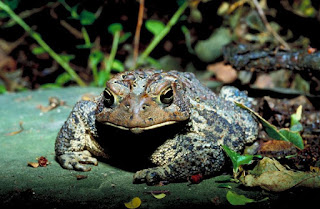
| A Toad |
We hear Frogs – their croaking at dusk and dawn, their plop as they dive into the water. We hardly ever see them because Frogs hop away faster than we can approach them. During the spring we hear male Frogs call to females in nearby ponds. To many people, Frogs mean spring and water.
Frogs are Amphibians that need water to procreate and to live in the first part of their lives. They live the adult part of their life on land. As Frogs, they must return to the water to breed.
In late spring, We see little Froglets darting about in ponds. Froglets, which many people call tadpoles (toad’s head) or pollywogs (wiggling head), are the Frogs’ juvenile forms. We see them swimming through their aquatic world, their round bodies swishing a strong muscular tail. Eventually, they will transform into Frogs, and leave the water for the land.
The entire family of Frogs is the Order
Anura (tailless amphibians). The Toad family (
Bufonidae), which contains the Cane Toad (
Bufo marinus) and the Natterjack Toad (
Bufo calamita), is one of twenty Frog families. Tree Frogs form the
Hylidae and
Rhacophoridae families. The Mid-Wife Toad (
Alytes obstetricans) belongs to the
Discoglossidae family. What people consider to be “true” Frogs are from the family
Ranidae. All these scientific categories demonstrate the wide variety of the Frog family. Little wonder why people become confused over the question, “What is a frog?” The answer is, “They all are.”
Frogs demonstrate the principle of tolerance. Frogs come in all shapes and sizes. There are the tiny Spring Peepers, ugly Horned Toads, vigorous Bullfrogs, and green Barking Tree Frogs. The old song goes, “All God’s Children sing in the choir. Some sing low, others sing higher.” Listen to Frog songs, and you will here the low jug-a-rum of the Bullfrog, the rasping natter-natter of the Natterjack Toad, and the high peeps of the Spring Peepers. Together in unison, They provide a melody pleasing to the ear.
Important Frog Teaching: Empathy
“Frog has long been associated with water and fertility. Frogs have a keen sense of hearing that is unique to their species. They can hear octaves and pitch that other aquatic animals do not. The song of Frog often foretells of an imminent rain. Those with Frog Medicine are often "in tune" with the weather. They are often "charged" by a rain instead of made sleepy. Frog people tend to relate to others on an emotional level, and are great empaths. The ability to purge and cleanse negativity resides within a Frog person.”
Copyright: Unknown.
Important Frog Teaching: Cleansing
“Frog holds the knowledge of weather and how to control it. Frog medicine can bring rains for every purpose – to cleanse, to heal, to help things grow, to flood, to stream. Its energies can be used to bring light showers or downpours for most any purpose.”
Copyright: “Animal-Speak”, Ted Andrews.
Frog and Toad Teachings Include:
“Frog’s familiar song is associated with rain, for frogs and toads must lay their eggs in moisture. Many tribal people pray to Frog and Toad during drought. Folk wisdom tells us that dreaming of Frog means good fortune and if Frog visits your home, you will find romance. When you see or hear Frog or Toad, close your eyes and visualize prosperity. Then give thanks to Frog and Toad for calling forth the healing, life-renewing rain.”
Copyright: Dolfyn.
“Frogs are good signs. The Frog is a doctor and healer, seer, and fortune-teller. The Frog is a messenger of rain....On the other hand, Toads are a bad power and bad luck. If you see Toad, then pray for protection.”
Copyright: “Spirits of the Earth”, Bobby Lake-Thom.
Frog’s Advice Includes:
“Are you having difficulty expressing your emotions? Are you becoming fixated on one thing to the extent that nothing else matters? Frog Clan will help you learn to express yourself and to help you heal yourself emotionally. This is the position of slow, but steady change.”
Copyright: Unknown.
- Frog’s Wisdom Includes:
- Transformation
- Joy In a New Cycle of Life
- Fertility
- Fearlessness
- Bringing Clarity
- Diversity
- Wisdom of the Soul
- Emotional Healing
- Well-Being


