Showing posts with label animal spirits. Show all posts

Friday, August 04, 2017

Chipmunk: Wise Use of Resources

The Chipmunk, a small striped-rodent, is a member of the Squirrel Family. Scientists usually divide the twenty five species of chipmunks into three groups – the Western Chipmunks (the largest group): Nectamias, the Eastern Chipmunk: Tamias, and the Siberian Chipmunk: Eutamias. The root “tamis” is Greek for steward, which reflects this species’ role in plant dispersal.

Chipmunk is named for her call – “chip-chip,” which sounds like a shrill bird-like chirp. Besides the chip-chip, She also employs a deep chuck, a trill, and a high-pitched startle call. Upon hearing her faint high chip, a dog’s ears will perk up. By the time the dog reacts, Chipmunk will be safe underground.

Living in North America and Siberia, Chipmunk is famous for her propensity to store seeds. People often see Her scurrying about with bulging cheeks full of seeds. Her cheeks can expand to equal her size. They allow Chipmunk to carry her food back to her burrow to eat. During the year, She collects and stores seeds in her vast complex of tunnels, doing most of her activity in the fall.

Besides seeds, Chipmunk will eat frogs and birds. Since She is an omnivore, She adds fungi and vegetables to her diet. Her eating habits help to spread various fungus and tree species. With the fungi, Chipmunk disperses the spores in several ways from storing the fungus to breaking it apart. By harvesting and hoarding seeds, She spreads many species of trees throughout the forest.

The underground burrow of Chipmunk has three areas for food, sleeping, and waste. Preferring sloping ground for drainage, She digs tunnels below the surface to her various chambers and for escape routes. Chipmunk can burrow through stone walls and concrete foundations, which makes Her a pest to some people. Except during mating season, Chipmunk lives by Herself in her home.

Chipmunk teaches people how to husband their resources. She stashes seeds to keep her well-supplied in food. During the winter, Chipmunk will “half-hibernate,” waking from time to time to eat. Some of the seeds, She eats right away, the others Chipmunk will save for the future. She also helps to disperse tree species, which in turn provides future sources of food. People can learn from Chipmunk how to save and when to use their various resources. 

Monday, July 17, 2017

PIG ! HOG FAMILY: Enjoying Yourself

The Family of Suidae is either called “Pigs” or “Swine”. “Pig” refers to any wild or domesticated animal in the Suidae Family. “Hog” is only used for domesticated Pigs on a farm or for Warthog of Africa. “Boar” has two uses – a male pig or the wild Pigs native to Europe and Asia.

Suidae live in forests and woodlands and are divided into five groups. They are Pigs (Sus), African Bush Pigs (Potamochoerus), Giant Forest Hogs (Hylochoerus), Warthogs (Phacochoerus), and Babirusa (Babyrousa). Suidae are native to Eurasia and Africa but not to North and South America or Australia. Wild Pigs of those places are domestic Hogs gone feral.

Surefooted and fast runners, Pigs live in tall grass or reeds. Contrary to popular beliefs, Pigs rarely overeat. They can live nearly everywhere because Pigs can find food anywhere. They root in the ground with their snouts for roots and mushrooms. Pigs also eat Worms and Snakes that They find. However, wherever Pigs are, They need water to wallow in, since Pigs have few sweat glands.

Pigs that most people are acquainted with are European Wild Boars. Domestic Hogs are descendents of Wild Boars that roam in Asia and Europe. Bush Pigs live in Africa, south of the Sahara. Like other Swine, They do their rooting after dark. Giant Forest Hogs, who have crescent-shaped growths under their eyes, also live in Africa. These Hogs were not discovered until the early 20th Century. Of course, also living in Africa are the fierce looking Warthogs, with bumps on their cheeks.

The most bizarre looking of all Mammals is Babirusa. Living in the Celebes and Moluccas Islands (of Indonesia), this Pig has tusks which grows through the roof of his snout before curving backwards. His name “Babirusa” means “pig deer”.

Among the ancient people of Britain, Pigs were important and powerful. They provided sustenance and knowledge to people. Since Pigs were incredibly fertile, people thought that They were from the Gods. In addition, ancient people told stories of how Pigs guided people to hidden knowledge such as the healing waters of Bath, England.

Pigs know how to have fun. In the mornings, They root around snorting and grunting to each other. Meanwhile, little Piglets run around and play. Later in the day, all the Pigs pile next to each other and sleep. They stretch out in their cool wallow, and snore in the warm sun. Pigs enjoy themselves and the day. Learn how to do the same from Pigs.

Pig Family’s Teachings Include:
“The Pig shatters perceptions but like a mother with a child, makes you face new and often frightening experiences in order to grow into full awareness.” Copyright: “Beasts of Albion”, Miranda Gray.

“You can open yourself to the abundance that exist through nature. Allow yourself to feast on life–to enjoy its beauties and its sensual delights.” Copyright: “Boar”, “The Druid Animal Oracle”, Philip and Stephanie Carr-Gomm.

“I like pigs. All dogs look up to you. All cats look down to you. Only the pig looks at you as an equal.” -- Winston Churchill.
Pig Family’s Wisdom Includes:
How to Nurture
Guide to Knowledge
How to Flourish
Having Common Sense
Being Intelligent
Intuitively Know How to Respond In Any Situation
Being Charge of Personal Space

Saturday, August 20, 2016

Sturgeon: Be Responsible

Sturgeon are ancient fish who swam in the waters when the dinosaurs first emerged on the earth. Today, these living fossils are considered to be the most primitive of the bony fish. Sturgeon belongs to the Acipenseridae family which has twenty-seven species. Native to the lakes, rivers, and coastlines of Eurasia and North America, these giant fish resemble armored torpedoes. Their distinctive bony plates (hard scutes) stud their back and sides.

One thing that Sturgeons are well-known for are their dramatic leaping out of the water. In his poem, The Song of Hiawatha, Longfellow described this – “saw the sturgeon, Nahma leaping, scattering drops like beads of wampum.” As the largest fish in freshwater, a massive Sturgeon can kill or break the bones of unwary boaters. As to why They leap, nobody knows. Theories range from communicating in their group to Sturgeon simply enjoying doing it.

Sturgeon have been highly regarded in many cultures. In India, Sturgeons represented royalty. Among the Natives Peoples of North America, Sturgeon provided both wisdom and food. Ancient Greeks regarded sturgeon eggs (caviar) as a gift from Aphrodite, the Goddess of Love. In Europe, Sturgeon migrating up the Danube would feed entire villages by allowing Themselves to be caught. When people became too greedy, these Fish stopped coming.

In Europe and North America, Sturgeon were once plentiful. However, the demand for caviar has halved their life expectancy from over 100 years to about 50 years. In the Great Lakes, overfishing and pollution has decimated those populations. The story of Sturgeon is a sad one of people ceasing to respect Them. Now this remarkable Fish is going extinct because of human folly.

Governments in Europe and North America have made concentrated efforts to save the remaining Sturgeon. Because of this, populations for some species of Sturgeon have stabilized on the Danube, Ural, and Volga Rivers. These Fish are making a small comeback in the Great Lakes Regions as people rehabilitate the environment to be more receptive to the well-being of the Sturgeon.

Alarmed by the pending extinction of Gulf Sturgeon, U.S. Army Corps of Engineers, U.S. Air Force, state wildlife agencies and local universities combined their efforts to save this Fish. The result is that these populations of Sturgeon are thriving in Florida, and are expanding to other regional rivers. Meanwhile, Native Peoples of North America have joined with various governments and commercial fisheries to keep the Sturgeon in their regions from becoming extinct. In 1977, the citizens living around Lake Winnebago (Wisconsin) watershed formed “Sturgeon for Tomorrow.” Their efforts were rewarded with a “stunning recovery in that watershed” for Sturgeon today.

Sturgeon teaches responsibility. Because of human carelessness and deliberate action, Sturgeon, worldwide, are close to extinction. Today, people are trying to repair the damage that has been done. It is an uncertain future for Sturgeon but They are amazingly resilient fish. Willing to work with people, Sturgeon have been consuming the invasive zebra mussels and gobies in the Great Lakes. In return, people are taking responsibility for the well-being of this ancient Fish.
-----
The sturgeon of Sturgeon Moon are the sturgeon of the Great Lakes.

Thursday, July 21, 2016

Thorny Devil: Problem Solving

Known by many names, Thorny Devil (Moloch horridus) is more than an ordinary lizard. With her spiky body and crown of thorns, She resembles a walking nightmare. Her other names – Moloch, Horny Devil, and Thorny Dragon – emphasize her “hellish” nature. The scientist who named Her, Dr. John Grey certainly thought that. He recalled an ancient demon from John Milton’s Paradise Lost, when he gave Thorny Devil, her scientific name. Dr. Grey also cited the Canaanite God Moloch from the Old Testament, who received sacrificed children.

Looks can be deceiving. The only animal that Thorny Devil terrorizes is Ant. She spends her day wandering in the Australian Outback, searching for their nests. When Thorny Devil finds one, She parks Herself next to its edge. Catching one ant at a time with her sticky tongue, She consumes 45 ants a minute (2,500 in an hour). Thorny Devil is the walking nightmare for ants.

As She roams the Outback, Thorny Devil slowly lifts one foot at a time. Swaying from side to side, this small harmless lizard walks jerkily across the sandy soil. Since Thorny Devil cannot run fast, She relies on camouflage to keep Her safe. To blend into the landscape, Thorny Devil changes her colors from pale yellow to olive to brown.

Herpetologist Eric Pianka described his frustrating experience searching for a Thorny Devil. Spending a day in the Great Victoria Desert, Dr. Pianka followed the lizard’s faint tracks, which went around in a figure eight. Searching for most of the day, he found the Thorny Devil’s eating spot, sleeping spot, and bathroom spot, but no lizard. Then as evening was coming, he nearly stumbled over the Thorny Devil. For the entire day, this lizard had been sitting in the center of the figure eight. In his search for the Thorny Devil, Dr. Pianka had passed the lizard many times.
 
Well-suited for living in the tough dry areas of Australia, Thorny Devil has a unique way of collecting scarce water. When a rare shower occurs, the tiny grooves between her spikes will channel the rain to her mouth. Tilting her body forward, Thorney Devil gulps down the water. In the morning, when the dew condenses on her spikes, these grooves will direct the moisture to her mouth for drinking.

Thorny Devil uses her prickly armor for defense. Her head horns warn predators like Blue-tongued Lizard that She is painful to swallow. On the back of her neck, Thorny Devil has a satchel or false head. When She tucks her head between her forelegs, Blue-tongued Lizard sees only this large spiky “head” and retreats.

Thorny Devil is a member of the Agamidae Family (“dragon lizards”). (This Family includes bearded dragons and Australian frilled lizards.) The Agamidae of the Old World are distantly related to the Iguanas of the New World. Thorny Devil most resembles “Horny Toad” (Horned Lizard (Phrynosoma platyrhinos)) of the Iguana Family. Living in the Southwestern United States, “Horny Toad” faces the same challenges. Although They belong to different families, these two lizards could be twins.

Living in similar habitats, Thorny Devil and “Horny Toad” have parallel lives. Both feast on ants, and obtain water using the same methods. These two lizards demonstrate convergent evolution, which means that evolutionary pathways can be predicted and repeated. How these two lizards solve their problems with similar methods is revolutionary in understanding the challenges of nature for every species on the earth.

Thorny Devil teaches problem solving. To live in her harsh homeland, She employs many strategies for survival. Her spines serve as double duty – scaring predators and collecting water. Amid the desert shrubs, her coloring conceals Thorny Devil. She eats the ants that are plentiful where She lives. An excellent problem solver, Thorny Devil teaches how to be effective and efficient. Let Her be your guide. Just remember that looks can be deceiving.

Thursday, July 14, 2016

Cryolophosaurus: Use Your Imagination

In 1991, the first dinosaur to be found in Antarctica was Cryolophosaurus. This opened up a new continent to dinosaur discoveries. Named for the geologist David Elliot, who first excavated this dinosaur, Cryolophosaurus’ full taxonomic name became “Cryolophosaurus elliotti.” In 1994, He became the first Antarctic dinosaur to be named. This dinosaur’s name means “frozen crest lizard.”

Life in the Antarctic during the early Jurassic was much different than today. At that time, Antarctica was further north and closer to the equator. Also, the warm Jurassic oceans allowed for plant and animal life to flourish there. However, there were still long periods without a sunrise. This continent was also cooler than other places. Not many large dinosaurs of the Jurassic could tolerate either condition very well. Medium sized Cryolophosaurus did and thrived. This meat-eater had little completion for the Pterosaurs and Prosauropods that He hunted.

Cryolophosaurus is the oldest Tetanuran to be found. Tetanurae are dinosaurs with large stiff tails. They include Spinosaurus, Carnosaurus, and Coelurosaurus. Tetanurae bore more resemblance to birds than many other dinosaurs. Because Cryolophosaurus lived in the early Jurassic, this meant that these dinosaurs evolved earlier than originally thought.

Cryolophosaurus is also noted for his oddly shaped crest. Since this crest reminded people of Elvis Presley’s pompadour, He became known as “Elvisaurus.” Paleontologists believed that his crest was used to identify who He was and to attract Females for mating. Like an Elvis fan, Female Cryolophosaurus would “swoon” eyeing his crest, Or so people could imagine.

Cryolophosaurus encourages people to use their imaginations. Picture Him singing rock’n’roll songs to his adoring fans. Imagine his home as a warm place with trees, a Graceland just for Him. Have fun with your mind pictures about Cryolophosaurus!

Thursday, July 07, 2016

GILA MONSTER: Discerning Fact from Fiction

A striking sight with her beaded skin of pink and black, Gila Monster blends well into her desert home in Arizona. This sluggish-seeming lizard intently flicks her tongue to detect a tasty mouse. At other times, She adroitly climbs the cactus with her sharp claws to hunt for perching birds. Tasting the air with her forked tongue, Gila Monster finds Desert Rat, and quickly chomps down with her vice-like jaws. Then She swallows her paralyzed victim whole and head first.

Gila Monster with her Brother – Mexican Beaded Lizard – are the only venomous lizards (Helodermatidae) in the world. Because of their venom and forked tongues, Gila Monster (Heloderma suspectum) and her Brother (Heloderma horridum ) are distant relatives of snakes. These two lizards are also close relatives to monitor lizards (Varanidae), who possess poisonous saliva, and could be ancestors of snakes. These two beaded lizards have an ancient ancestry, extending back to the mid-Cretaceous.

Contrary to popular belief, Gila Monster uses her venom for defense and not to hunt with. When She is angry, Gila Monster will open her mouth very wide and hiss. When She does this, her venom is pumped from her salivary glands into her grooved teeth. Thus when She bites Coyote, and clamps down hard, her venom flows into his wound. Locking her jaws, Gila Monster will hang on until Coyote howls in pain. After making her point, She then lets go. Learning his lesson, Coyote limps off.

Reclusive Gila Monster spends much of her time in her burrow. Digging deep with her heavy claws, She creates a snug home for herself. In the extreme heat of summer and cold of winter, Gila Monster rarely leaves it. The springtime is when She feasts. The rest of the year, Gila Monster lives off the fat contained in her large wide tail. (Her tail acts like a camel’s hump, storing food instead of water.)

Poorly understood, Gila Monster is the subject of many myths. More than that, these stories about Her are presented as facts. For example, Gila Monster does have powerful jaws and a tenacious bite. From this comes the legend, “Once She clamps her jaw on something, Gila Monster will not let go before sundown.” That is patently untrue. Other myths state that Gila Monster can kill with her bad breath, and has no anal opening. None of these silly stories are true, but they often get repeated as facts.

Another legend informs people that Gila Monster is a killer. Yes, her venom is toxic, but a human can easily avoid her bite. Old timers in Arizona say that only an idiot gets bitten. They add that said idiot would have to place Her on his bare leg, then annoy Her until Gila Monster bites. In other words, the said idiot would want to be bitten.

Sluggish in appearance, Gila Monster can suddenly turn and bite, usually when She senses a tasty meal. She warns those who would disturb Her, so that they leave Gila Monster alone. Separating fact from fiction is what Gila Monster teaches. Inspired by her tenacity, you can hang on for the truth. Before repeating something, discover whether it is false first. Some fiction comes disguised as the truth. Do not be an idiot counsels Gila Monster.

Thursday, June 30, 2016

Megalosaurus: The Door to New Worlds

The first dinosaur ever to be named was Megalosaurus. The first fossil to be “officially” discovered (England, 1676), Megalosaurus was believed to be a giant human. As the first dinosaur to be drawn, her thigh fossil was depicted as a piece of male anatomy by Robert Plot. This prompted Dr. Richard Brookes to name it “scrotum humanum” in 1763.

Meanwhile, Reverend William Buckland had different ideas about Megalosaurus. An avid fossil collector, Rev. Buckland realized that the bones he possessed were instead from an ancient animal. After reviewing Buckland’s collection, Baron George Cuvier said that the fossils were of a giant lizard creature. (Cuvier was the first scientist to realize that extinction occurs.) In 1824, Rev. Buckland wrote a scientific paper and named this “lizard,” Megalosaurus, which means “great lizard.”

In his paper, Rev. Buckland described Megalosaurus as a giant land-living reptile who lived in the ancient past. According to him, She was a fifty foot (about 16 meters) long lizard, who walked on all fours. After examining her teeth, Rev. Buckland said that She was a meat eater. His reasoning was that Megalosaurus had sharp teeth like a monitor lizard.

Then in 1842, British scientist Richard Owen was pondering just what were Megalosaurus, Iguanodon, and Hylaeosaurus (an ankylosaur). These were all recent discoveries of extinct animals. Owen noted that their fossils were different from any other reptile living or from the past. Their legs were directly underneath their bodies, unlike modern lizards. Also they had extra bones in their hips. Owen grouped these three animals into their own family – Dinosauria (deinous means “terrible,” and sauros means “lizard”).

Later Owen decided to present Megalosaurus and her friends to the public. He had “life-sized” sculptures placed at the Crystal Palace Exhibition of 1851, which being held in London. Megalosaurus was depicted as a lizard walking on four legs, with a crocodile-shaped head and a hump on her back. After seeing this sculpture, Charles Dickens described Her in his novel “Bleak House.” (This was the first mention of a dinosaur in literature.)

Despite being the first named dinosaur, Megalosaurus is still relatively unknown. Rev. Buckland’s collection had contained fossils of different families of dinosaurs. Scientists first had to sift through his collection to determine which fossils belonged to what dinosaur. As more complete skeletons were found for other dinosaurs, scientists could begin to identify the bones of Megalosaurus.

Who was Megalosaurus? She looked nothing like Owen’s sculpture. Related to the ferocious Spinosaurus, Megalosaurus walked on two legs and hunted large sauropods. Her thick muscular legs allowed Megalosaurus to run fast for short distances. In this way, She could ambush and charge her prey. Also, She had large powerful jaws and long sharp teeth. Using them, Megalosaurus ripped off chunks of meat for her meal.

Megalosaurus opens the door to mystery, inviting people to walk through. Once people discovered her bones, they entered an ancient world, they never knew existed. She prompted them to consider new and strange animals. Through Megalosaurus, the world of dinosaurs came to life. Follow Her in and leave your old ideas behind.

Friday, May 27, 2016

TUATARA: Dedication to Your Cause

Although Tuatara resembles a lizard, He is not one. Tuatara is the last surviving species of the ancient order of Rhynchocephalia (“beak-heads”). Only his family of Sphenodontidae (“wedge-toothed”) is left of this group of reptiles. The rest of the Rhynchocephalia went extinct about 60 million years ago. Because of that, Tuatara is often thought of as a “living fossil.” (However, He has actually evolved to live in modern times.) Because of his link to prehistoric reptiles, scientists can study Tuatara to see how lizards and snakes evolved.

Tuatara has distinctive characteristics that makes Him different from lizards. He has fused jaw teeth, and a beak formed by overhanging upper teeth. (This is what gives Tuatara, a “beak-head.”) Like some dinosaurs, Tuatara has a large opening in his skull behind his eye socket. He also has a third eyelid that passes over his open eyes. Tuatara has gastralia (“abdominal ribs”) which lizards and snakes do not. All these qualities indicate that his lineage is older than theirs.

Tuatara’s most notable feature is his ridge of small spines, which runs from his head to his tail. The Maori of New Zealand call this reptile “tuatara,” which means “peaks on the back.” When threatened, Tuatara will raise these spines. To startle his enemies, He elevates his spines and opens his bright red mouth.

Unlike lizards, Tuatara has a tolerance for exceptionally cool temperatures. He has colder blood than any other active reptile. Because of his slow metabolism, Tuatara spends little energy and much of his time in his snug burrow. When resting, He breathes only once per minute, and while walking, only once every seven seconds. Because of these factors, Tuatara can live beyond 100 years, longer than any lizard. However, it takes about twenty years for him to become an adult.

Legally protected in New Zealand since 1895, Tuatara’s numbers still steadily declined. The local kiore (rats) ate Tuatara’s eggs both on the mainland as well as on the coastal islands. Since Tuatara reproduce very slowly (once every five years), this became a great disaster. Tuatara simply could not recover from the losses inflicted by the kiore. Starting in the 1980s, a concerted effort by the government, volunteers, and Maori iwi (tribes) stopped Tuatara’s decline. They removed kiore from coastal islands and re-established Tuatara populations, thereby increasing his “safe homes” to 37 islands. For the first time in hundreds of years, Tuatara now live on Mainland New Zealand at the Karori Wildlife Sanctuary in Wellington.

Tuatara teaches dedication. The people of New Zealand are determined to keep Tuatara, one of their iconic animals, from going extinct. Spending tremendous amounts of energy, money, and time, people raised captive young, eradicated kiore from various islands, and cared for re-introduced populations. Today Tuatara has been returned to many places where He went extinct. Imagine the help that this distinctive reptile can give you to find your life’s mission. He can inspire to dedicate yourself to a worthy cause. Just do not think of Tuatara as “an ordinary lizard,” since He is neither.
-----

The picture is of Henry, the world's oldest Tuatara in captivity at Invercargill, New Zealand. Still active at 111 years of age.

Picture of Henry: By KeresH (Own work), via Wikimedia Commons. Title:  "Henry at Invercargill"

Friday, April 29, 2016

WOOLLY MAMMOTH: Warmth and Hospitality

Best known of the Ice Age Mammals, Woolly Mammoth (Mammuthus primigenius) received her name from her outer layer of long hair. Underneath that layer, She had another dense inner layer of fur. To cope with the icy temperatures, Woolly Mammoth had a compact body, a high domed head and small ears.

Woolly Mammoth had a shorter but more flexible trunk than other Mammoths. At the end of her trunk was a finger-like appendage as well as another protuberance. She used these to gather grasses and other plants for eating.

The smallest of Mammoths, Woolly Mammoth had extra long tusks. These ornate twisting tusks had many uses. For example, She could dig up plants and clear snow with them. Also, Woolly Mammoth could fight off predators with her tusks by bashing the attacking animal with them. Her tusks were like tree rings, telling her age and life experience.

Meanwhile, Paleo-peoples used the tusks of Woolly Mammoth to construct their homes. Many of their houses were built from her large bones and woolly hides. In one homestead found in Ukraine, the skulls of Woolly Mammoths, placed in a semi-circle, formed the base walls. Then the jaws were used to erect the upper parts of the walls. For the entrance, they used the leg bones of Woolly Mammoth. She provided shelter for them on the flat, treeless plains.

The last known Mammoth lived about 4,000 years ago on a small island near Siberia during the Stone Age. Many people believe that Woolly Mammoth went extinct through overhunting. However others think that as the world’s climate became warm; She could not survive adequately on the new plants. Whatever the reason, Woolly Mammoth became the icon for extinction from overhunting during the Ice Age.

Woolly Mammoth exudes warmth and hospitality. Meeting others during migrations, She greets Them with touching and trumpeting with her trunk. Furthermore, Woolly Mammoth would wait for laggards as well, welcoming Them back into the herd.

Learn from Woolly Mammoth about proper hospitality and warmth. She teaches us how to care for and welcome others into our hearth and home. However do not so be taken advantage of that you end up giving up everything you have. You can be flexible but also wary.

(Note: update of post from 2010.)

Saturday, April 16, 2016

Mastodon Family: Look Closer and Think.

Often confused with Mammoths, Mastodons (Mammutidae) are in their own family, since They split off from Elephants and Mammoths earlier. Therefore, there are many differences between the two Animals. Mastodons have larger and flatter brows than Mammoths. Moreover, They have paired low conical cusps for teeth, and upper jaw tusks. In addition, Mastodons are shorter and more muscular than Mammoths. Scientists have liken Them to a bus, whereas Mammoths are more like construction cranes.

Living side by side with Mammoths, Mastodons colonized Eurasia and North America about fifteen million years ago. As browsers, They preferred to live in spruce forests and open woodlands. During the winter, Mastodons had a double coat of fur to prevent Them from freezing in the icy cold. However, they preferred warmer climates to live in.

Fossil Mastodons have been found with full stomachs, indicating that They consumed about 500 pounds (1,000 kilos) of food each day. Since their enormous appetites drove Them to seek more and more food, Mastodons roamed the countryside endlessly searching for food. Mastodons tramped through forests to feast on moss and twigs of cedar, larch, pine, and spruce trees. Their hunger drove Them deeper into bogs and swamps in search of food, where They died.

Mastodons teach to look closer and think. Do not mistake Them for their cousins, the Mammoths. Examine the differences before making a judgment. If you do not ponder what you see, you may mindlessly end up stuck in a bog. Take care in what you do.

---
Update from a previous 2010 posting

Friday, April 01, 2016

Prehistoric Elephant Family: Partnership

(Deinotheres, Elephants, Mammoths, and Mastodons)

Of the myriad Trunked Mammals who once roamed the earth, only African and Asian Elephants still remain today.  At one time, Proboscids (Trunked Mammals) lived everywhere except Antarctica and Australia.  Spreading from Africa where They originated, these Mammals flourished during the Miocene Period (from 20 million years ago (mya) to 5 mya).  Since many Proboscids were not immune to the cold, only a few survived the Ice Age.

Trunked Mammals have a long complex evolutionary history.  Beginning as small herbivores sixty mya, these Mammals resembled modern Pigmy Hippos.  For example, Moeritherium did look like a small Hippo but possessed a flexible upper lip and snout like an Elephant.  Then a cousin, Deinotherium appeared alongside the Gomphotheres (Early Elephants) about fifteen mya. Many of the Gomphotheres had flat tusks to shovel plants out of soft swampy ground. In addition, They used their trunks to uproot trees.

Mastodons split off from the Elephant Family (which also includes Mammoths). Unlike Mammoths, Mastodons had cheek teeth with low-rounded crowns. Meanwhile, Mammoths had the most highly evolved of elephantine teeth. Because of the grinding surfaces of their teeth, Mammoths could eat grasses whilst Mastodons searched the trees for tender leaves. Mastodons preferred warm climates to the Mammoths’ cold ones.

The Family of Trunked Mammals has been a part of human history from the very beginning.  Both Humans and Proboscids evolved together in Africa.  Later both spread out of Africa to populate the world.  When Paleo-humans needed food and shelter, they hunted Trunked Mammals.  They also built their homes from the bones and hides of various Proboscids. To honor Them, Paleo-peoples painted the likenesses of Mammoths and Mastodons on cave walls.

The infant science of paleontology became advanced through the study of Proboscids’ teeth and bones.  Since Trunked Mammals were widely distributed around the world, early scientists could trace their evolution.  Because Proboscid fossils were plentiful and readily available, early naturalists could learn their craft from these fossils.

Throughout the ages, humans entered into a partnership with various Trunked Mammals.  As each developed, They learned from each other.  Proboscids provided for humans and taught them basic life skills.  In return, Humans honored Them. The lesson of Trunked Mammals is that a partnership is one of equals.  We need to be good partners as They have taught us and protect their living representatives.  Today all that remain are endangered.

Science Note: Manatees, dugongs, and hyraxes are the closest living relatives of elephants. They are descended from Moeritherium.

(Updated from earlier 2010 blog.)

Thursday, January 14, 2016

Fairy-wren: Discover the Deeper Truth

Often seen in people’s gardens, Fairy-wren (Family: Malurus) is usually looking for a tasty Insect. Shy in nature, Fairy-wren is however tolerant of people. Popular in Australia, people regularly see Him in parks hopping about.

Despite his brilliant blue colors, Fairy-wren is difficult to see in the undergrowth. Since Male Fairy-wren is more cautious than the Female Fairy-wren (who has drabber feathers), He leaves promptly when an intruder approaches. If Fairy-wren spies a flying Insect, He hops straight up to snatch it, and then dives back to safety in the nearby bushes.

Fairy-wren’s family arrangements were confusing to many scientists. They thought He was socially monogamous but sexually promiscuous. However what they mistook for Female Fairy-wrens were the non-breeding Males. In Fairy-wren’s small group, there is one breeding pair – the dominant Female and her Partner. Because Fairy-wrens live long lives, They often form lasting family bonds. In their territories, Female Fairy-wrens will nest several times during a season. The non-breeding Males will help to raise each brood, and defend their area. When these Fairy-wrens are about four years old, They will leave their home nest.


Then, scientists uncovered another unique aspect about Fairy-wrens. Mother Fairy-wren teaches her unborn Chicks a special call. She sings to Them whilst the Chicks are still in their shells. Scientists believe that this call is the Fairy-wren’s version of a last name. A Chick that does not know this call is usually a brood-parasite such as a bronze-cuckoo. When that chick fails to answer, the Fairy-wren Family then abandons the intruder.

Fairy-wren teaches that things are not always what they seem. The boldly colored Male hides in the underbrush. When with his small family, He can be mistaken for a Female if He is not breeding. His family being ruled by a Female is unusual as well. Fairy-wren insists that you look beyond the surface to discover the deeper truths. However, He does caution that the deeper truth maybe staring you in the face, without any probing.

Teachings of Fairy-Wren Also Includes:
Having Strong Family Bonds
Being Bright and Beautiful
Dynamic Female Leadership
------------------
Science Notes:
1. Members of the wren family called the Troglodytidae. The wrens of Australia, New Guinea and New Zealand are not related and are not wrens. They belong to their own families. The New Zealand wrens are the Acanthisittidae, an ancient bird family. Meanwhile the wrens of Australia and New Guinea belong to the Maluridae Family, which includes fairy-wrens (Malurus), emu-wrens (Stipiturus) and grasswrens (Amytornis).

Photo By JJ Harrison (jjharrison89@facebook.com) (Own work) [CC BY-SA 3.0 (http://creativecommons.org/licenses/by-sa/3.0)], via Wikimedia Commons

(Revision of a 2008 blog entry.)

Friday, November 27, 2015

EMPEROR SCORPION (IMPERIAL SCORPION): Defying “Common Knowledge”

When people conjure up an image of a Scorpion, they will often picture Emperor Scorpion (Pandinus imperator), the Star of horror and mummy movies. This huge black Scorpion, which is eight inches (twenty centimeters) long, has the widest pincers (pedipalps) of all the Scorpions. Shaped like shovels, these pincers have tremendous crushing power. Furthermore, his huge, long tail with its very obvious and very scary stinger inspires many nightmares.

Surprise! This frightening, creepy Scorpion would rather run away than attack. Quite timid, He prefers scurrying under a rock to facing an opponent. Besides being skittish, Emperor Scorpion has only a mild level of toxicity in his venom, lower than most other Scorpions. (A healthy person may have an allergic reaction to his sting.) Because of his shyness and calm disposition, He is often kept as a pet. (The only time that Emperor Scorpion is aggressive is when a Mother carrying her Scorplings encounters a threat.)

Besides having an amiable nature, Emperor Scorpion further defies "common knowledge," that most people hold about Scorpions. Instead of living in arid deserts, He prefers the tropical rainforests of West Africa. To survive, Emperor Scorpion requires muggy, humid conditions. He makes his home deep under the moist earth in a burrow, in a streambank, or in the forest debris. Undetected in the leaf litter, He usually lives close to people, often in a Colony with his Friends.

At night, Emperor Scorpion goes out hunting for Termites. Tunneling far down into the earth (up to six feet (two meters)), He searches for evidence of termite mounds. Besides digging for Termites, Emperor Scorpion will snatch one crawling by with his huge pincers. Termites have to beware when He is on the prowl. His digging prowess and crushing power makes Emperor Scorpion a menace to those unfortunate Insects.

Emperor Scorpion flouts “conventional wisdom” that people hold about Scorpions. Unlike his fellow Arachnids, He is quite social, living in small colonies with his Friends. Scary and big, Emperor Scorpion hides a calm and non-aggressive nature. Possessing both qualities (serene and nightmarish) allows Him to be a featured Star in horror movies. Easy to work with, Emperor Scorpion will do his part to make the movie more terrifying. When you want to declare something to be true based on what is “commonly known,” remember Emperor Scorpion. Resist the temptation.

Emperor Scorpion’s Teachings Also Include:
Calm and Focused
Holding Contradictions
Being a “Star”

Thursday, November 19, 2015

SCORPION FAMILY: Being Formidable

An Order (Scorpionida) within the Class of Arachnida, Scorpions are well-known for their predatory and deadly nature. Since the Silurian Period (about 430 million years ago), these Arachnids have lived on the earth. Today, about 2,000 living species of Scorpions are grouped into thirteen families.

Contrary to popular belief, Scorpions do live in places other than hot and dry habitats. People would be surprised to know that these adaptable Arachnids also dwell in inter-tidal zones. Found world-wide (except in Antarctica), Scorpions can live almost everywhere, except for tundra regions. They will make their homes in trees, under rocks, in sand, in caves, and on mountains. Wherever there is a construction site that disturbs their homes, They will find their way into people’s houses to live. Furthermore as commerce expanded world-wide, so did Scorpions. For instance, these Arachnids were accidentally carried in shipments of fruit to England. Now, They can be found in Sheerness on the Isle of Sheppey in the U.K.

People can readily identify Scorpions by their distinctive body shape. The segmented abdomens (opisthosoma) of these Arachnids taper into a curving tail (metasoma) with the stinger (aculeus) at the end. Although They have at least six eyes, Scorpions prefer to navigate by smell and touch. With the tiny hairs on their pincers (chelae), Scorpions can sense an Insect flying by. In addition, They have slits on their legs to pick up vibrations in the air and on the ground. To grab their prey, Scorpions use their strong front claws. Then, They suck liquid out of their prey with their “claw protrusions” (chelicerae) in their mouths. The toothed jaws of Scorpions shred their meal for their stomach to suck in the juices.

What is best-known about Scorpions is their deadly venom. Each Scorpion has as many as forty-five different toxins to use on their various prey. Hunting by smell, They search for Amphibians, Crustaceans, Insects, Reptiles, and small Mammals to eat. Grabbing the unfortunate victim, Scorpion will either crush or inject venom into It. Since it takes a lot of time to replenish their spent venom, Scorpions prefer crushing to stinging. However, only about twenty-five Species are capable of killing people. It is these few Species who give all other Scorpions their deadly reputation, whether their venom is as toxic or not.

During the Silurian Period, the first Scorpions possessed gills for living in the waters. (Even today, Scorpions can stay for long periods underwater.) They ventured onto land to become one of the first animals to do so. Since They could readily adapt from life in the shallow lakes to that on land, these Arachnids have displayed tremendous staying power. Being extremely adaptable, Scorpions have evolved into an Order of nearly 2,000 living Species.

Nocturnal and solitary, Scorpions are formidable hunters. Masters of surprise, they will wait by their burrows, hidden from view, for a tasty Insect to come by. Then in an explosive move, Scorpion will suddenly grab and crush the unfortunate victim. Using her raised tail, She injects her venom for the killing stroke.

Since Scorpions have tiny mouths, They can only suck in liquid. One use for their venom, besides killing, is to turn the Insect into a liquid. While They wait, Scorpions use their “mouth claws” to bring any available liquid to their stomachs to digest. Since this process usually takes an eternity, these Arachnids possess low metabolisms. In fact, They can go an entire year without eating anything.

Besides their venomous stings, Scorpions are also noted for their impassioned and elaborate mating rituals. When Male Scorpion begins his courtship dance, He grasps Female Scorpion and turns Her in circles. In a “promenade a deux,” the Pair gently bump into each other without stinging until Male Scorpion fertilizes his Partner. Once this ritual is finished, Male Scorpion races away, before Female Scorpion changes her mind and attacks Him instead.

Contrary to popular opinion, Female Scorpion is a good mother. After being born, her Scorplings will immediately climb onto her back. She will carry Them for at least a few weeks (up until two years depending on the species). The Scorplings stay with their Mother through (at least) their first molt, and sometimes more. When They become adults, Mother Scorpion will gently removes her Scorplings off her back with her tail. For the more reluctant Ones, She will tip Them off.

These formidable Arachnids inspire awe and fear in everyone. Aggressive in hunting, Scorpions patiently spend weeks consuming their victims. Being highly adaptable, They have forty-five different kinds of venom for use on various animals. Moreover, their well-designed body maximizes their talents of sliding under rocks to elude predators, surprising their prey, and successfully living in different habitats. Since Scorpions have honed Themselves into an Order to be feared and respected, their formidable reputation is well-deserved.

When you want to be respected and feared, look to the Scorpion Family. Adapting to nearly every habitat, They have spread across the earth. Because only a few Species are deadly, people have avoided all Scorpions altogether. Just remember not to be so venomous, that your good qualities are overlooked, such as being a good parent.

Friday, November 06, 2015

SPINOSAURUS: Riding the Wheel of Fortune

The story of Spinosaurus is one of fortune found, lost, and found again. One of the largest of the Meat-eaters, Spinosaurus captured popular imagination with his mysterious sail. However, not much was known about this popular Dinosaur until 2013, when Dame Fortune smiled on the paleontologists seeking to know more about Him.

The story of Spinosaurus began with the discovery of fossils in 1912 in Egypt by Richard Markgraf. Afterwards Baron Ernst Stromer, Markgraf’s employer, named these bones Spinosaurus aegyptiacus, “Spine Lizard of Egypt.” Spinosaurus was named for his dorsal spines, which formed into a sail shape. Returning to Germany, Stromer housed his fossil collection of Spinosaurus in a museum in Munich. This proved to be disastrous when the Allies bombed the city in 1944. All that remained as proof that Spinosaurus ever existed were a few fragments of his snout and “fluted crests” displayed in museums elsewhere. The only depiction of his sail was Strummer’s drawings, which was all that was left for paleontologists to study.

Throughout the intervening years, this Dinosaur remained a mystery. The enigma of Spinosaurus was partially solved by Nizar Ibrahim, who uncovered more fossils in Morocco. Fascinated by Spinosaurus since boyhood, Ibrahim studied to be a paleontologist. After receiving a box of bones in 2008, he tried to track down the Bedouin who originally brought him the fossils. After five years of fruitless searching, Ibrahim found the man as he walked by Ibrahim’s table at an outside cafe. The Bedouin took Ibrahim to a site in Morocco, where more fossils of Spinosaurus could be found.

From this treasure trove of fossils emerged a formable predator. Larger than Tyrannosaurus rex, Spinosaurus had sharp straight teeth housed in powerful haws. Unlike many other Dinosaurs, He could walk on four or two legs, as well as swim. In examining fossils of Spinosaurus, scientists realized that He was a fish eater in a region of rivers rich with marine life. A swimmer, this huge hunter would feast on fish.

This realization solved another mystery referred to as “Stromer’s Riddle.” The question was “Why did North Africa have more Meat-eaters than Plant-eaters.” Usually, this ratio is reversed since one Carnivore needs about twenty Herbivores in order to survive. However, the region of North Africa supported three enormous Carnivores. What did these hungry Dinosaurs eat if there were only a few Plant-eaters? One answer: Spinosaurus ate fish.

With his center of gravity structured for easily moving in water, Spinosaurus hunted underwater. He had a long narrow head and nostrils high up on his snout. Resting in the water, Spinosaurus looked like a crocodile. His dense bones enabled Him to effortlessly dive deep like a penguin. His webbed front feet and powerful hind legs were like a duck’s. An accomplished swimmer, Spinosaurus feasted on fish and other marine life. Paleontologist Paul Sereno observed, “It was a Chimera – a half-duck, half-crocodile.”

By being a swimmer, Spinosaurus changed how scientists viewed Dinosaurs. He broke through the established scientific thinking on what Dinosaurs were about. Perhaps more insights about the nature of these Animals can be made through further studies of Him.

But mystery still surrounds enigmatic Spinosaurus. What was his sail used for? Stromer struggled for years to figure out why Spinosaurus needed it. Also, he pondered whether it was a merely a hump or a large spinal fin. Amongst the Spinosaurids (the Family that Spinosaurus and Baryonyx belong to), Spinosaurus is the only one with a sail. Perhaps the dorsal “hump” was to warn others that this was his territory. When other predators saw it rising from his half-submerged body, They knew to stay away. Perhaps someday, Dame Fortune will uncover that mystery.

The history of Spinosaurus depicts how the Wheel of Fortune works. First Dame Fortune smiled, then frowned, and finally smiled again. What can be learned is to remain steadfast and patient, for Dame Fortune will turn her wheel again. What may be lost today will be found tomorrow. Along the way, work hard and be prepared for the opportunity to occur. Nizar Ibrahim continued Ernest Stromer’s work, against all the odds, and found more fossils of this Dinosaur. What chances Dame Fortune gave him, he took. Spinosaurus reminds us that luck changes, and we need to be best prepared. Ride the Wheel of Fortune with this Dinosaur.

Thursday, October 29, 2015

BARYONYX: Original Thinking

In 1983, at a clay pit at Surrey, England, an unusual dinosaur was found – one that hunted fish. William Walker, an amateur fossil hunter, found a huge claw and later the skeleton it had come from buried nearby. After his discovery, paleontologists uncovered more specimens of Baryonyx, after re-examining old fossils that had been collected years before. Because Baryonyx was a Meat-eater, her discovery was more remarkable since previous fossils from this quarry had yielded only Plant-eaters.

The most surprising about this Dinosaur from the early Cretaceous (about 125 million years ago), was the half-digested remains of fish, as well as, an Iguanodonwithin her skeletal remains. As scientists studied the fossilized bones of Baryonyx, they realized that her long slender jaws were ideal for fishing. Moreover, her front teeth stuck out from her narrow jaws. Larger than the rest, these teeth formed a rosette pattern ideal for the stabbing and retention of a struggling fish. Possessing almost twice as many teeth as Tyrannosaurus rex, Baryonyx could easily snag a fish with her small sharp teeth.

With a body similar to a modern crocodile, Baryonyx was built for swimming in swamps. Her long, streamlined body was perfect for moving about in water. With her extended neck, Baryonyx could lunge and spear a tasty fish, before It could escape. With her nostrils placed back along her snout, Baryonyx would remain nearly submerged in the water, patiently waiting for her next meal.
Furthermore, her huge claws allowed Baryonyx to fish whilst wading in streams. Standing in the water, She would wait for a fish to swim by. Because each of her first fingers was tipped with a large, barbed claw, Baryonyx could swipe at and hook fish.

At a time, when other carnivorous Dinosaurs hunted only on land, Baryonyx looked to the water. An original thinker, Baryonyx pondered other ways of getting her food. Rather than compete on land with the other Dinosaurs, She hunted in the ancient swamps and streams. Before there were Bears, She was in streams hooking fish with her claws. When faced with a baffling problem, ask Baryonyx for her insights. Since She could envision things that others could not, Baryonyx will offer you novel answers. Sort out which idea makes sense to you and go with it.

Friday, July 31, 2015

LION: Group Dynamics

Known as the King of the Jungle, Lion actually lives on the open African grasslands. Originally, He ranged from the Mediterranean Sea to Asia and south to Africa. Hunted by Romans for their Games, Lion first disappeared from Europe and Asia Minor. As Lion hunting increased, his range shrank to where now Lion lives only in Africa.

Unlike most members of the Cat Family, Lion is social. He lives in a Pride and forms coalitions with his Male Friends. In his Pride, Lionesses work together to hunt and chase off predators. Meanwhile with his Male Partners, Lion defends their territory against intruders. With his Coalition, Lion rules the Pride for a few years until a new Coalition arises. Then He and his Male Partners leave.

When Lions hunt, They form a cooperative group. Whether They are killing Seals on a beach or Cape Buffalos on the savannah, the Pride forms a plan of action. Some Lionesses wait downwind while their Sisters herd the animals towards Them. Other Lionesses travel around the prey to close off avenues of escape. Suddenly, a Lioness shows Herself, causing panic among the prey. The animals rush headlong into the Pride’s ambush.

Because Lion is yellow, and loves sleeping in the sun, He has been the symbol of the Sun for many cultures. People so admired Lion, that they thought He possessed spiritual powers equal to his physical attitudes. As King of the Beasts, Lion was wise and just.

Killing a Lion was a symbol of manhood. In Africa, young men were initiated through lion combat. The Zulu and Masai were expected to defeat a lion to become a man among their peoples. In Ethiopia, the Emperor awarded the bravest warriors with a lion mane headdress.

In China, Lion is a mythic creature, a symbol of nobility and dignity. Guardian Lion statues protect Chinese buildings. Lion Dancing, which has a very long tradition, is an essential part of Chinese festivals. The Lion Dance brings good luck, prosperity, and happiness to the people at the festival.

Lion teaches constructive group dynamics. When hunting, Everyone contributes to bringing down the prey. Working together patiently makes for a successful hunt. Even though Lions have strong personalities, They cooperate successfully. Learn from Lion how to accomplish much in your group.
a lion
Lion’s Teachings Also Include:
“We need to know how to relax when we are stressed. Lion gives us spiritual strength, he teaches us to be strong and proud and not let important things in life be taken for granted, like family.” Copyright: Rabbit’s Warren of Wisdom.
Lion’s Wisdom Includes:
Nobleness
Proper Use of Power and Strength
Group Energy
Community
Roles in A Group
Balanced Leadership
Male Friendship
Sisterhood
Conservation Note: Lions are endangered and are protected by international treaties.

Thursday, July 23, 2015

SPERM WHALE: Exploring the Abyss

The largest of all Toothed Whales, Sperm Whale can dive longer, faster, and deeper than any other Mammal. Known as nature’s submarine, Sperm Whale is well equipped to hunt in the ocean abyss for Giant Squid. Swimming in total darkness, He uses his echolocation to locate Squid. His huge head, which makes up a third of his total body length, houses the wax-filled spermaceti organ that helps Him to dive deep. With steady clicks, Sperm Whale approaches his Prey, then surprises Giant Squid with a sonic scream, disabling Him.

Among Whales, Sperm Whale has a unique social life. Elder Mother Sperm Whale governs his Nursery Pod. In the tropics, Sperm Whale Mothers, Females, and Young Males live together. When Sperm Whale reaches maturity, He leaves and joins a Bachelor Pod. Together, He and his Friends roam from the Polar Seas, where Squid lives, to the Tropics where the Nursery Pods are. When He is older, Sperm Whale will navigate the oceans by Himself.

Diving vertically into the abyss, Sperm Whale searches for Giant Squid. Using echolocation, Sperm Whale clicks until He sense the outline of Squid in the murky depths. No one knows what exactly happens in the murky depths; only that Sperm Whale is usually victorious. Like this extraordinary Whale, you can explore the Abyss. Just remember to surface from time to time.

Sperm Whale’s Teachings Also Include:
“There is more character in the Sperm Whale's head. As you behold it, you involuntarily yield the immense superiority to him, in point of pervading dignity. In the present instance, too, this dignity is heightened by the pepper and salt colour of his head at the summit, giving token of advanced age and large experience.” – Copyright: “Moby Dick”, Herman Melville

Sperm Whale’s Wisdom Includes:
Being Comfortable with Your Own Self
Being Comfortable with Your Own Sex
Diver of the Deeps
Lord of the Seas

Conservation Note: Sperm Whales are endangered, and are protected by international treaties. Because of extensive hunting, numbers of Sperm Whale Males are seriously low.

For reading on the teachings of Moby Dick, the most famous sperm whale of all: Moby Dick (opens in new window)

Friday, July 03, 2015

Tarot: Tarot of the Animal Lords: Daydreaming (2 of 2)

XIV. Temperance
 
(This shows a flamingo pouring water from one pitcher to another. Meanwhile a grebe nests at her feet.) 

As I watched Temperance, the Flamingo, pour her water, I noticed her wistful watching of the migrating Mallard Duck. I kept thinking that she seemed restless while waiting for Mother Grebe to hatch her eggs. Perhaps pouring the water back and forth, steadied her, and helped to her to be balanced for the moment. For Temperance knew that once the eggs were hatched, she could leave. “Temperance” taken to the extreme meant to me the inability to move. 


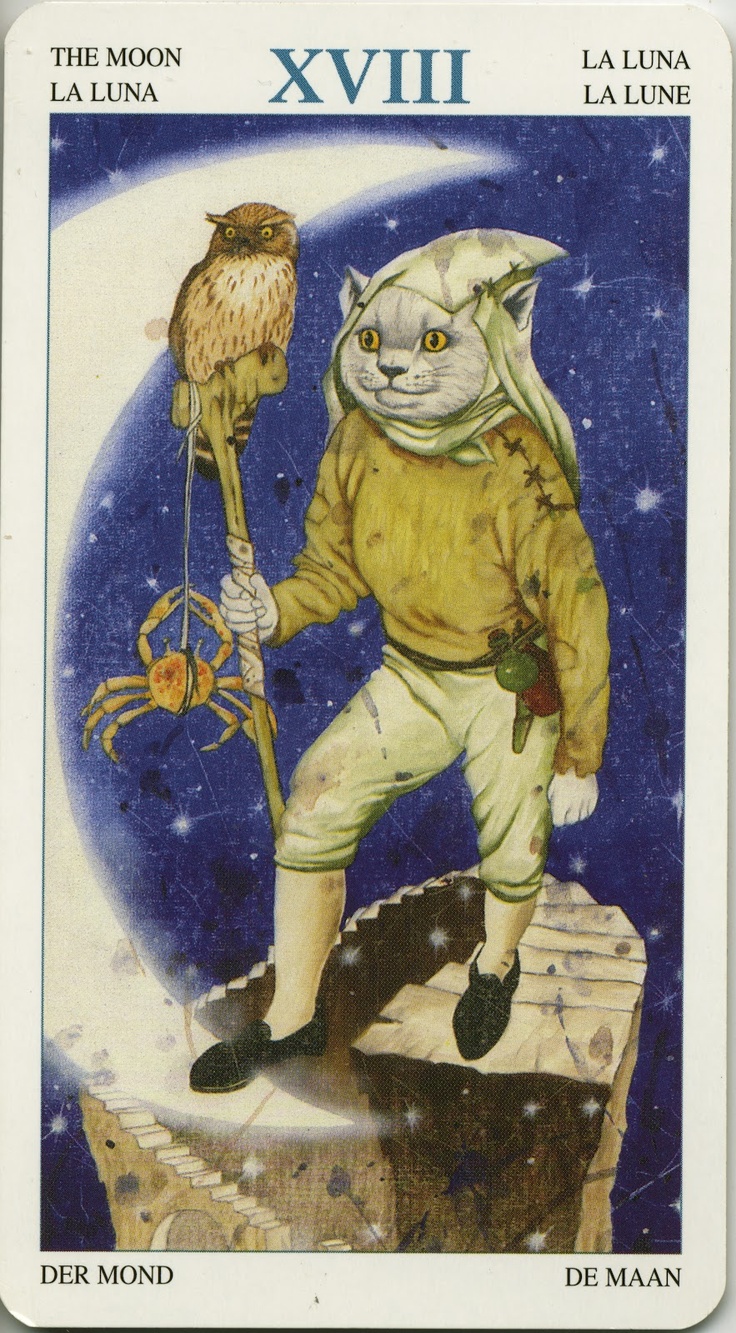
XVIII. The Moon

(This card features an owl and a cat ascending a stair way to the crescent moon. They are taking a crab with them.)

 Walking up the staircase, I marveled at the Moon, who invited me to sit on it. The Owl and Cat told me that they were going taking Crab home. As the trio set off, riding on the Crescent Moon, Crab explained that he needed to return to his lady friend, before the Full Moon. Watching this surreal scene, I felt that I had entered a dream world of moon glow and mystery. Perhaps I did, with the illusions taking me on a confusing magical trip.


 XX. Judgement

(A crocodile sits on a mangrove tree root holding a stick. A plover perches on his open mouth.)

 Drifting in a canoe in the swamp, I stopped to ask the Crocodile where I was. He told me it was hard to talk with a plover in his mouth, whilst the Plover merely grunted at me. After picking off the leeches from the Crocodile’s mouth, he explained that they lived in balance, taking and giving. The Crocodile smiled, telling me that Plover was his dentist. He said that he gets clean gums, whilst Plover gets a meal. As I pondered the pair, I realized that one aspect of judgement was knowing when to enter the Crocodile’s mouth.

Thursday, July 02, 2015

Tarot: Tarot of the Animal Lords: Daydreams (1 of 2)

When I meditated on the various cards with the "Tarot of the Animal Lords", I would enter the landscape of each card. Sometimes the characters would speak to me. At other times, I would join them in their activity. What I learnt from doing this exercise was the shadow side of the cards.


To see The Fool (opens in new window)

0.The Fool.
 Standing in the snow, I asked The Fool if he was freezing, as the Magpie, perched in the nearby tree, laughed. After walking to a nearby small cave in a hill, we made a cozy fire inside, Sitting in the warmth, The Fool told me that he was taking his friend, Puffin, home to his family in the Arctic. He was ready for this adventure, but was unsure if he made the right decision. However, he was with his friend and that was what mattered to him. This made me see The Fool as someone who did things, without much thought. But this Fool did know what was important.

To see The Emperor (opens in new window)

IV. The Emperor.
 As I was walking on the African veldt, The Emperor stopped and challenged me. He roared at me that I was trespassing in his kingdom. This was his land as far as the falcon flew, and the source of his power. Startled, I asked for permission to enter his kingdom. He allowed me in as long as I understood that the trappings of power did not matter, only the wielding of power itself. His savageness made me pause about the nature of power and its uses.

To see The Hierophant (opens in new window)


V. The Hierophant
The Hierophant greeted me with a traditional greeting of peace. Also, he noticed that I kept staring at the cardinal perched on his antlers. Laughing, The Hierophant told me that whimsy in life is important or everything will become stagnant and hidebound. What he taught me was that play was as necessary to the Spirit as was discipline.

XII. The Hanged Man
 (This card depicts a bat hanging upside down, whilst the full moon shines down on him. Below the bat are two mice, with skulls, sitting around a pool of water.)

 I stepped into the pool, accidentally splashing The Hanged Man, and woke him up. Amused, he saw how confused I seemed. The Hanged Man told me that he liked hanging upside down in the full moon, since it gave him a sense of peace and quiet. Then as I tried to leave, I got stuck in the pool, and the Mice had to pull me out. The Hanged Man taught me that it is good to pause and wait, but not too long, or one will get stuck in the mire.