This is a blog about nature in all her glory. The folklore and general ideas about what messages nature bring to people.
Showing posts with label Tarot of the Animal Lords. Show all posts
Saturday, January 07, 2017
Tarot of the Animal Lords: Judgement and the World
Judgement: This card is set in a mangrove swamp. The swamp is a liminal place, with the day being the noontime. Sitting on a mangrove tree root is a crocodile holding a staff. Perched in his open mouth is a red plover. Crocodiles and plovers live in a partnership, instead of being predator and prey. The plover gets a meal picking leeches off the reptile’s gums, and the crocodile gets his gums cleaned. The card gives the sense of balance and discernment. The scene captures a moment standing in time which I see as Judgement.
The World: A dolphin couple dance under the trees on a beautiful summer day. They are dancing on the world, itself. Surrounded by the signs of each suit, the pair seem happy and contented. They have reached the end of their arduous journey. Eventually, The World will open up more journeys for them to go on. In the meantime, the two are happy that they have come to the end of this particular one.
Previous Cards:
Star, Moon, and Sun
Friday, December 23, 2016
Tarot of the Animal Lords: The Star, The Moon, and The Sun
The Star: The Tarot of the
Animal Lords refers to this card as The Stars, indicating that a multitude
of stars can guide people. Under a starry sky dominated by one bright star, a
seahorse, dressed as a clown, pours water into a mountain lake. As he kneels on
a lily pad, a grebe nests on another pad nearby. The substantial size of the
lily pads indicate security in navigating the unknown waters. The pair is serene
and calm for The Stars will guide both to their purpose in life, although
neither will know exactly how. They trust in The Star.
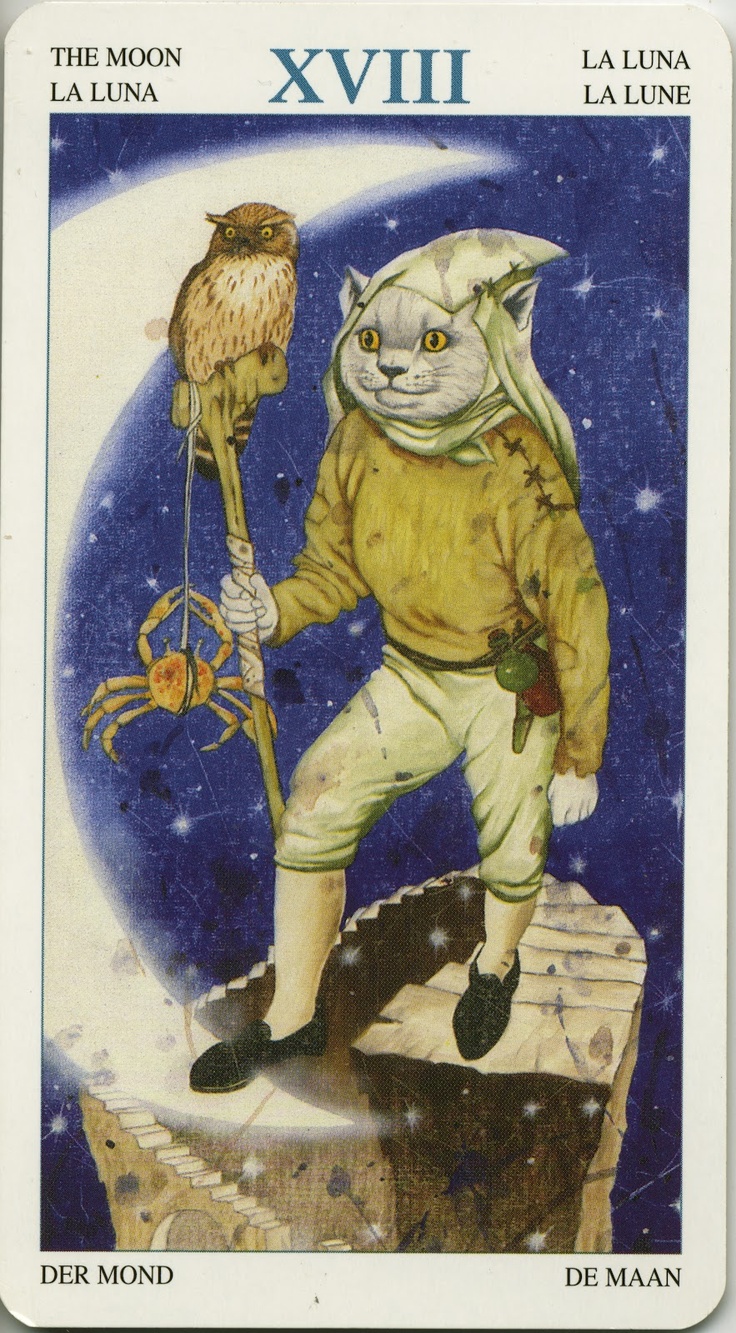
The Moon: Climbing up a ziggurat stairway, a cat with a staff steps out onto a nebulous quarter moon. Perched on the staff is an owl and dangling from the perch is a crab. The scene is of a dream, an elusive wispy illusion. The whimsy of the owl contrasts with the nightmare of the crab. The cat has the owl to show him the way, while the crab urges him to rely on his intuition. In the space between reality and dreams lies the illusion of The Moon.
The Sun: In the glare of the enveloping sun, two hares grasp hands. Surrounded by briars and flowers, the pair dance together on green grass. The hares may be enjoying themselves in the bright sunshine, but for the reader, the sun is too bright to look at. The card cautions not to be “blinded by the light,” but do enjoy the moment. The illumination of The Sun highlights the shadow, which hides just behind the light.
Other entries in this series:
Death
Temperance, Devil, and Tower
The Moon: Climbing up a ziggurat stairway, a cat with a staff steps out onto a nebulous quarter moon. Perched on the staff is an owl and dangling from the perch is a crab. The scene is of a dream, an elusive wispy illusion. The whimsy of the owl contrasts with the nightmare of the crab. The cat has the owl to show him the way, while the crab urges him to rely on his intuition. In the space between reality and dreams lies the illusion of The Moon.
The Sun: In the glare of the enveloping sun, two hares grasp hands. Surrounded by briars and flowers, the pair dance together on green grass. The hares may be enjoying themselves in the bright sunshine, but for the reader, the sun is too bright to look at. The card cautions not to be “blinded by the light,” but do enjoy the moment. The illumination of The Sun highlights the shadow, which hides just behind the light.
Other entries in this series:
Death
Temperance, Devil, and Tower
Friday, December 09, 2016
Tarot of the Animal Lords: Major Arcana: Temperance, The Devil, and The Tower
Temperance: This card depicts a flamingo pouring water from one pitcher
to another one, which is sitting on the ground. She is standing under a grove
of trees, which are far from her village that is off in the distance. A slight
breeze shakes the leaves, giving a sense of movement to the scene. The flamingo
watches a mallard migrating, while a grebe broods on her eggs, nearby. The card
gives a sense of quiet contemplation of choices yet to be made. Between leaving
and staying is Temperance that seeks the balance between the two. Perhaps the
flamingo will leave someday, but not today.
The Devil: A he-goat represents the devil in this card. He stands at the maw of a red-rock cavern, patting his buddy, the toad. Behind the pair, the full moon rises with the bats flying out to catch insects. With their jaunty poses and red eyes, the pair exudes a sense of malefic magic. Their air of nonchalance entices people into their web of promises. However, once someone enters the cavern, they become lost. The card suggests think before entering or end up being stuck forever.
The Tower: A beaver is falling headlong as he is inundated by logs and water. At one time, loggers held drives to guide their sawn logs down river to the mills. Often, a log jam would occur and the logs would pile on top of each other. A logger would need to go and pull out the key log, holding back the others. This usually resulted in the death of the logger who did the task. This Tower is the raw energy that has been pent up rushing out, killing everyone in its way. How the beaver ended up this way is something for the reader to puzzle out. Was he the heroic logger or the builder of a faulty dam?
Other entries in this series:
Death
Star, Moon, Sun
The Devil: A he-goat represents the devil in this card. He stands at the maw of a red-rock cavern, patting his buddy, the toad. Behind the pair, the full moon rises with the bats flying out to catch insects. With their jaunty poses and red eyes, the pair exudes a sense of malefic magic. Their air of nonchalance entices people into their web of promises. However, once someone enters the cavern, they become lost. The card suggests think before entering or end up being stuck forever.
The Tower: A beaver is falling headlong as he is inundated by logs and water. At one time, loggers held drives to guide their sawn logs down river to the mills. Often, a log jam would occur and the logs would pile on top of each other. A logger would need to go and pull out the key log, holding back the others. This usually resulted in the death of the logger who did the task. This Tower is the raw energy that has been pent up rushing out, killing everyone in its way. How the beaver ended up this way is something for the reader to puzzle out. Was he the heroic logger or the builder of a faulty dam?
Other entries in this series:
Death
Star, Moon, Sun
Monday, November 21, 2016
Tarot: Major Arcana: Astrology (2 of 2)
Mars
is force and energy that breaks through similar to The Tower. Jupiter, as the
planet of expansion and luck, is appropriate for The Wheel of Fortune.
Meanwhile, the principle energy of Uranus is liberation which matches The Fool.
Judgment and Pluto both focus on transformation.
What
puzzled me the most was the connections of Cancer, the Crab to The Chariot,
Sagittarius, the Archer to Temperance, Neptune to The Hanged Man, and Saturn to
The World. As a reader, I need to know the reasons for these particular
couplings. Is there a hidden aspect to each card that these astrological
concepts focus on? Am I missing something? If so, what?
Cancer
knows where they are going and how to get there, which is appropriate for The
Chariot. However, Cancer changes moods like the wind. This points to any conflict
that needs to be examined while reading The Chariot. Also Cancer stabilizes The
Chariot since this Sign is selective in what it does.
Sagittarius
is restless and high spirited, lending movement to Temperance. The subtle
message is that Temperance should not be stagnant, but instead keep flowing.
Sagittarius gives the warning to the reader of the tendency of Temperance to remain
static.
Saturn
is the planet of limitation and fate. Paired with The World, it cautions the
reader to beware of wishful thinking. Saturn grounds The World from flights of
fancy. The World is to be earned, not handed to someone is something that the
reader should know.
This
leaves Neptune and The Hanged Man, both difficult to understand. Neptune is the
mystic, whose principle energy is transcendence. The Hanged Man is in limbo,
perhaps in a chrysalis much like the caterpillar becoming a butterfly. The two
are mystics, detached from the world. Therefore, Neptune reinforce the
otherworldliness of The Hanged Man.
Part One: tarot: major arcana and astrology
Thursday, November 03, 2016
Tarot of the Animal Lords: Mythic Images
The deck that I use is The Tarot of the Animal Lords. On the
surface, the deck seems only to be animals dressed up as various Tarot
characters. Looking deeper however, the reader will see that each animal is
connected to various myths. The associations are subtle and do require a
knowledge of animal lore.
For example, The Emperor features a lion with a golden eagle. The eagle, itself, is associated with the Roman emperors, who were the representatives of Jupiter, the Ruler of the Heavens. In Roman bird augury, the golden eagle represents the will of Jupiter. Using this train of logic, I associate The Emperor with Jupiter.
The Hierophant depicts the red deer as a priest. In Europe, this animal has religious associations. Cernunnos, God of the Celts, connected to the stage in rut, is the God of the Forest. Moreover, this Horned God is depicted on the Gundestrup Cauldron, itself a sacred artifact. The mythic association for The Hierophant then becomes Cernunnos.
The Hanged Man is a bat hanging upside down. Although he is not strictly a mythological character, I associate this card with The Batman. This character is suspended between being ordinary Bruce Wayne and the obsessed Batman. He can never completely be one being or the other, but neither is he both. The Batman is my mythological connection for The Hanged Man in this deck.
Death is represented by the raven. This corvid is associated with The Morrigan, the Dark Goddess of the Celts. She knows who will die in battle, and will tell them beforehand. Since The Morrigan is also the Goddess of Sovereignty, Her decision is always final. The sovereignty of Death leads me to The Morrigan.
The Devil is represented by the billy goat. I associate this animal with Inuus, Who is one of the aspects of Faunus, the Roman God of Fertility. Inuus is venerated at the Lupercalia in February. Young men would run through town whipping women, with straps made from goatskin. (This was to make women fertile.)
The Sun features two hares dancing in the sun. Ostara, the Anglo-Saxon Goddess of Spring, often had hares as her companions. A symbol of the reborn sun, the hare is the mythical association that I have with this card. Therefore the Goddess Ostara is The Sun in this deck.
The Tarot of the Animal Lords also have animals with mythic symbolism. The fox of The Magician does his magic on a toadstool, a traditional symbol of the fairy worlds. The Empress sits on a turtle shell throne, which symbolizes fertility. The Hierophant is accompanied by a stork, the Roman symbol of fidelity and piety.
Meanwhile, the mandarin ducks of The Lovers are the Chinese symbol for married love. In Death, the chameleon represents bad luck and misfortune as told in African myths. Moreover, the toad in The Devil is considered to be a familiar of wizards, and represents dark magic.
Further study of the folklore of animals will reveal more mythic symbols in this deck. I have only touched the surface of mythic associations for this particular Tarot deck. I have worked with The Tarot of the Animal Lords for ten years, and still find new mythic connections.
For example, The Emperor features a lion with a golden eagle. The eagle, itself, is associated with the Roman emperors, who were the representatives of Jupiter, the Ruler of the Heavens. In Roman bird augury, the golden eagle represents the will of Jupiter. Using this train of logic, I associate The Emperor with Jupiter.
The Hierophant depicts the red deer as a priest. In Europe, this animal has religious associations. Cernunnos, God of the Celts, connected to the stage in rut, is the God of the Forest. Moreover, this Horned God is depicted on the Gundestrup Cauldron, itself a sacred artifact. The mythic association for The Hierophant then becomes Cernunnos.
The Hanged Man is a bat hanging upside down. Although he is not strictly a mythological character, I associate this card with The Batman. This character is suspended between being ordinary Bruce Wayne and the obsessed Batman. He can never completely be one being or the other, but neither is he both. The Batman is my mythological connection for The Hanged Man in this deck.
Death is represented by the raven. This corvid is associated with The Morrigan, the Dark Goddess of the Celts. She knows who will die in battle, and will tell them beforehand. Since The Morrigan is also the Goddess of Sovereignty, Her decision is always final. The sovereignty of Death leads me to The Morrigan.
The Devil is represented by the billy goat. I associate this animal with Inuus, Who is one of the aspects of Faunus, the Roman God of Fertility. Inuus is venerated at the Lupercalia in February. Young men would run through town whipping women, with straps made from goatskin. (This was to make women fertile.)
The Sun features two hares dancing in the sun. Ostara, the Anglo-Saxon Goddess of Spring, often had hares as her companions. A symbol of the reborn sun, the hare is the mythical association that I have with this card. Therefore the Goddess Ostara is The Sun in this deck.
The Tarot of the Animal Lords also have animals with mythic symbolism. The fox of The Magician does his magic on a toadstool, a traditional symbol of the fairy worlds. The Empress sits on a turtle shell throne, which symbolizes fertility. The Hierophant is accompanied by a stork, the Roman symbol of fidelity and piety.
Meanwhile, the mandarin ducks of The Lovers are the Chinese symbol for married love. In Death, the chameleon represents bad luck and misfortune as told in African myths. Moreover, the toad in The Devil is considered to be a familiar of wizards, and represents dark magic.
Further study of the folklore of animals will reveal more mythic symbols in this deck. I have only touched the surface of mythic associations for this particular Tarot deck. I have worked with The Tarot of the Animal Lords for ten years, and still find new mythic connections.
Friday, October 21, 2016
Tarot of the Animal Lords: Major Arcana: Justice, The Hanged Man, and Death
Justice
is a barn owl who stands on the edge of a mountain cliff. She holds the scales
and sword of Justice. However, this owl cannot go backwards because of the
massive tree behind her. One misstep forward, she falls to her doom. High in
the mountains, the owl stands keeping her balance. Like Justice, she has to weigh
both sides carefully or risk disaster. (Barn owls are traditionally found in
church and grave yards. This explains the artist’s choice for Justice, for me.)
The
Hanged Man presents a bat hanging between two trees under a full moon.
Underneath him is a small pool of water that mirrors his face. Around the pool
are night lilies, and two rats with their paws on skulls. Since bats sleep
upside down and during the day, this bat is perfectly content to wait
patiently. However, the rats seem to indicate a sense of impending death. I
wonder if the scene is depicting the feeling of peace just before dying. This
card is both disturbing and serene at the same time for me.
This leads to the next card, which
is Death. At the front of a cave
littered with bones and weapons stands a raven with a scythe. He has his hand
on a crowned skeleton. Behind him is a misty swamp. The only way out is to
cross the river in front. Meanwhile, a chameleon stands in from of the raven.
In African legend, this lizard is a sign of death and misfortune. The two animals
together give a sense of doom. There seems a sense of finality to the card.
Other entries in this series:
Thursday, October 20, 2016
Tarot of the Animal Lords: Strength, The Hermit, and The Wheel of Fortune
The Tarot deck that I use is The Tarot of the Animal Lords. Although
Strength is XI and Justice is
VIII in this deck, I switched them.
The switch now has Justice as the middle card of the Major Arcana. Justice then
becomes the “balancer” of the Major Arcana.
Strength
depicts a mongoose wrestling with a cobra. While that is happening, the earth
is opening up under them and volcanoes are erupting behind them. The scene is
enveloped in smoke and ash. I can almost smell the sulfur spewing out of the
earth. In front of the battling pair, are two salamanders, who are facing in opposite
directions. I feel the immediacy that someone has to decide quickly to flee or
be killed. However, the two center characters are frozen in the moment of the
chaos. Does that mean that Strength can be either the calm focus or the frozen
stance? Is the downside of Strength to be locked in a struggle oblivious to
what is going on?
The Hermit presents a black bear entering a dark cave. His lamp barely
pierces the blackness. This bear carries keys and scrolls with him. This made
me wonder if he hoped to find a treasure chest. Behind him in broad daylight is
a peaceful countryside. Right above him, dripping in honey is a beehive. I
think that the Hermit is leaving the sweetness of the known life for an unknown
future. This card elicits a feeling of answering a sacred call, of going deeper
into the Divine.
The Wheel (of Fortune) telescopes the concept to a circular tree
branch and the life cycle of the butterfly. The adult butterfly lays her eggs
on a leaf that hatches into the various stages of caterpillars until finally the
juvenile butterfly becomes the adult. And the cycle continues. To emphasize The
Wheel’s motion, the wind blows in a circle high up in the mountains. The dominant
theme of this card is a circle, going round and round. I get dizzy just looking
at The Wheel. This Wheel focuses on the cycles of life that we all experience
repeatedly at different points in our lives.
Saturday, September 10, 2016
Tarot of the Animal Lords: Hero's Journey (2)
Laying out The Tarot of the Animal Lords
to follow the Hero’s Journey requires a deeper knowledge of animals. Each card in
this deck reflects either the natural history or the folkloric history of various
animals. Some animals are an obvious selection for their card such as the fox
for The Magician, the lion for The Emperor, the raven for Death, and the male
goat for The Devil.
However
to understand the other animals which are representing themes in the Major
Arcana requires knowledge of their natural history. For example, The Fool is an
European Badger setting out on his own. European badgers live in societies of
setts, which are towns constructed of burrows. Some setts are over three
hundred years old, with generations of European badgers inhabiting them. A lone
European badger going out on his own would be a fool. (In contrast, American
badgers, a separate species, usually live by themselves.)
Featuring
a flamingo for Temperance is another example. These birds live in the hot salt
flats of Africa and eat brine shrimp. This gives them their bright pink color. If
they are too pink or too white, this means that the flamingo is nutritionally
out of balance, and will need to change their diet.
To
understand other animals featured in this deck’s cards for the Major Arcana
requires knowledge of their folklore. For example, The Moon features an owl and
a cat, reminding the reader of the children’s poem, The Owl and the Pussycat, by Edward Lear. In that poem, these two
animals go out to gaze at the moon and the stars in wonder. Meanwhile, The
Lovers depict two mandarin ducks. In China, these ducks are believed to be
lifelong mates. They use mandarin ducks in their wedding decorations to
symbolize fidelity.
Each
animal that is chosen for their particular card enhances the meaning of the
Hero’s Journey for me. At first glance, each selection may seem a bit opaque
but within each card are clues to explore further. The reader can ponder each
card’s meaning further through that particular animal.
------
For more information on the Hero's Journey: Tarot: Patterns of the Major Arcana, "The Hero's Journey," and Others
Thursday, August 11, 2016
Tarot of the Animal Lords: Mindmapping
The cards that I chose to mindmap with
were from The Tarot of the Animal Lords.
The center card for the map was II. The High Priestess. Upper left was III. The
Empress and upper right was VI. The Lovers. The bottom cards were IX. The
Hermit (left) and XXI. The World (right). I could match several cards but
forming a story that related to The High Priestess using all of them was
difficult.
Mindmapping was hard for me. I saw various relationships between the cards but they did not all fully coalesce around any one card. The individual cards seemed too discrete to mesh together. I could see the layout as an entire story. However, starting with one card and relating it to all of the rest was difficult.
The High Priestess is depicted as a seated cow elephant in a glade. She is holding an open book. Scurrying about her feet are two chipmunks fussing with the scrolls on the ground. The words that came to me for this card were “regal,” “knowledge,” “questioning,” and “self-knowledge.” Since The High Priestess guides through intuition, this became the starting point of the story, that unfolded card by card.
The Empress is a she-wolf sitting on a throne, with a turtle-shell shield
next to her. The scene around her is full of life with her pups chasing the butterflies. The similarities between her and The High Priestess are that they are crowned females sitting on thrones. Moreover, the two have two small animals next to them. One difference is that The Empress holds a scepter while The High Priestess a book. The story moves from the quiet reflection of The High Priestess to the busy life of The Empress. These two cards with their small animals mark the inner and outer lives, the spiritual and temporal.
The Lovers present two mandarin ducks standing under an orange tree. They are tenderly taking leave of each other. The High Priestess watches, knowing that they will need their intuition to guide them for what will be in store for them. The Empress notes the male’s duty to the Crown by his sword. The Lovers are caught between their spiritual and temporal lives. The story then becomes how they will solve their dilemma.
The answer is The Hermit. Holding a light, a moon bear enters a cave. Hanging from his belt are scrolls and keys. Behind him, attached to a tree branch is a beehive dripping in honey.
The Hermit’s life has become unsettled, forcing him to find his own answers. Perhaps he has experienced the horrors of war or has changed so much that his lover does not know him. The choices presented by The Empress and The High Priestess weighs heavily on him. Meanwhile, will his lover wait for him? How this drama will turn out is revealed in the next card.
The final card is The World. This card features two dancing dolphins. In the moonlight under a flowering tree, the dolphins are celebrating. The World is the answer to what happened to The Lovers. Finding solace within, The Hermit, he rejoined the world and his lover, who did wait for him. This coupled have weathered their separation and trouble. Now together, the mature pair dance in happiness, having lived through the worst and now enjoying the best.
The High Priestess told The Lovers to follow their intuition. The Empress showed them what they had to do before they could go on. Meanwhile, The Hermit had sought to understand what happened to him. Following his intuition and the advice of The Empress, The Hermit returned home. Now The World, The Lovers became whole again. Celebrating their long life, The Lovers thanked The High Priestess for her guidance.
Laying the cards out as a whole, I did move from one scene to the next. I could see the connections between each of the cards. The story unfolded with The Lovers as the final focus. The Empress and The High Priestess gave them choices. This became a story of a relationship grappling with separation and healing.
Mindmapping was hard for me. I saw various relationships between the cards but they did not all fully coalesce around any one card. The individual cards seemed too discrete to mesh together. I could see the layout as an entire story. However, starting with one card and relating it to all of the rest was difficult.
The High Priestess is depicted as a seated cow elephant in a glade. She is holding an open book. Scurrying about her feet are two chipmunks fussing with the scrolls on the ground. The words that came to me for this card were “regal,” “knowledge,” “questioning,” and “self-knowledge.” Since The High Priestess guides through intuition, this became the starting point of the story, that unfolded card by card.
The Empress is a she-wolf sitting on a throne, with a turtle-shell shield
next to her. The scene around her is full of life with her pups chasing the butterflies. The similarities between her and The High Priestess are that they are crowned females sitting on thrones. Moreover, the two have two small animals next to them. One difference is that The Empress holds a scepter while The High Priestess a book. The story moves from the quiet reflection of The High Priestess to the busy life of The Empress. These two cards with their small animals mark the inner and outer lives, the spiritual and temporal.
The Lovers present two mandarin ducks standing under an orange tree. They are tenderly taking leave of each other. The High Priestess watches, knowing that they will need their intuition to guide them for what will be in store for them. The Empress notes the male’s duty to the Crown by his sword. The Lovers are caught between their spiritual and temporal lives. The story then becomes how they will solve their dilemma.
The answer is The Hermit. Holding a light, a moon bear enters a cave. Hanging from his belt are scrolls and keys. Behind him, attached to a tree branch is a beehive dripping in honey.
The Hermit’s life has become unsettled, forcing him to find his own answers. Perhaps he has experienced the horrors of war or has changed so much that his lover does not know him. The choices presented by The Empress and The High Priestess weighs heavily on him. Meanwhile, will his lover wait for him? How this drama will turn out is revealed in the next card.
The final card is The World. This card features two dancing dolphins. In the moonlight under a flowering tree, the dolphins are celebrating. The World is the answer to what happened to The Lovers. Finding solace within, The Hermit, he rejoined the world and his lover, who did wait for him. This coupled have weathered their separation and trouble. Now together, the mature pair dance in happiness, having lived through the worst and now enjoying the best.
The High Priestess told The Lovers to follow their intuition. The Empress showed them what they had to do before they could go on. Meanwhile, The Hermit had sought to understand what happened to him. Following his intuition and the advice of The Empress, The Hermit returned home. Now The World, The Lovers became whole again. Celebrating their long life, The Lovers thanked The High Priestess for her guidance.
Laying the cards out as a whole, I did move from one scene to the next. I could see the connections between each of the cards. The story unfolded with The Lovers as the final focus. The Empress and The High Priestess gave them choices. This became a story of a relationship grappling with separation and healing.
Thursday, July 28, 2016
Tarot of the Animal Lords: Freewriting
For freewriting, I chose I. The
Magician, XI. Strength, and XVII. The Stars from the Tarot of the Animal
Lords. I focused on them in order
from The Magician to The Stars. (The Tarot
of the Animal Lords refer to XVII. The Star as “Stars.”)
As I was freewriting, I experienced each card differently. Then as I went from
one card to the next, they flowed together as one. The Magician created the
reality for Strength to perceive. From Strength comes the ability to receive
spiritual guidance from The Star.
Traditionally, The Magician combines
the four elements into a fifth of the spirit. The elements are represented as
the bird (air), the mouse (earth), the cups (water), and the thorns (fire), in
this card. The fifth element is represented by the toadstool, the alchemy of
the imagination. We, as the audience, become participants in The Magician’s
creation. We join in the illusion and unite with the Magician. We bring the
vital element, the spark to weld the two worlds. The Magician, as the midwife,
helps to birth the new world of magic realism.
My freewriting enabled me to
understand how strength balances the chaos and order. The mongoose is calmly focused
on the cobra, while the cobra is focused on the chaos. There is stillness
within the whirlwind. Strength becomes the balance between the rational and the
irrational. If the mongoose places too much focus on the cobra, he will fall
into the cracks opening underneath him. If the mongoose is distracted, the
cobra will slip away. Strength is deciding when to hold on and when to let go.
The salamanders remind us of the choices that we have to make to keep the
balance.
In freewriting, I pondered the
grebe. Why did the artist include her in the picture? What does the grebe have
to do with the stars? The seahorse pours light from the sky into the lake. He
is replenishing the waters of life from the heavens. Meanwhile, the grebe is
simply nesting on a lily pad.
Grebes are noted for their graceful
mating. Therefore I reasoned that the grebe was the representation of “grace.” Sitting
on her nest, the grebe patiently hatches the new soul. This self will be
infused with the waters of life. Therefore The Star is the soul at peace after
being created by the Magician and honed by Strength.
Freewriting provided me with an
entry into each of the cards. It allowed me to focus as I let my mind wander to
consider the deeper meanings in each of the cards. Freewriting allowed free
association, which brought about a deeper inquiry. For me, it was a good method
to get to know the cards.
Thursday, January 28, 2016
Tarot: The Tarot of the Animal Lords: focus on Death
The focus of my character sketch for
“The Tarot of the Animals Lords” is
XIII. Death. The card depicts a foggy day, shrouding the landscape in mist. A
raven stands at the entrance of a cave. In one hand, he holds a scythe, and with
the other pats the crown of a skeleton lying beside him. In front of the raven
is a chameleon resting near his feet.
In the outline of the story that I created from my character sketch, I focused on Raven and his deeds. The other four cards I used complete the story (in order) were XV. The Devil, XVI. The Tower, VII. The Chariot, and VIII. Justice, respectively. In my opinion, each of these cards reflected many of the facts of the Death card.
Raven gloats that he is now the Ruler of the Land. Through stealth, he has vanquished all of his rivals. As he talks to his spy, Chameleon, Raven muses on how he united with Goat to do more mischief. He ponders his next move to keep his power intact.
The scene shifts to The Devil. In a cavern with their backs to the rising moon is a goat and a toad. The standing goat is patting the toad, which squats behind him. The rocky cavern is empty except for these two figures.
Goat is waiting for Raven to arrive for more plotting of mischief. He muses how they pulled the key log from Beaver’s dam, and sent him to his death. As Goat wonders what Raven will do next, Toad agrees to meet with Chameleon. Since Chameleon is a double agent, he will find out if Raven is plotting against them.
As Major Arcana cards, Death and The Devil fit together, since we are all in bondage to death. The Devil shows people their limitations, fears, and beliefs that hold them back. Moreover, Death is the biggest fear and limitation of all. For me, Death reflects the positive aspects of The Devil, as a final release from our fears.
The next card, The Tower features a beaver being flung over the falls as his dam breaks. Flying over him is a raven. The rush of water and flying logs reflects the beaver’s doom. In this scene of the story, Beaver screams, “Help! Raven did this! Help!”
Both The Devil and Death are reflected in The Tower card. Death in the form of the raven flying overhead is the cause of the dam breaking. (Ravens are traditional symbols of death.) In the Tarot, The Tower comes after The Devil to break The Devil’s hold on us. The dam in The Tower reflects the holding power of certain beliefs. Once Death comes, the dam breaks and everything floods out. The suddenness of the flood washes away any limitations that we may hold.
Next in the story comes The Chariot. Over the mountains, a crested crane rides a mute swan. As they fly towards the plains, the sun is rising. Standing on the swan’s back, the crane is aloof as he eyes the vista below him. In the distance are migrating swans.
In my story, Crane hears Beaver’s cries, and races to help. It is unsure whether he will arrive in time or not. If he does not, he still will be a witness to what has happened to Beaver.
In the Major Arcana, The Chariot is movement. For me, The Devil, The Tower, and The Chariot reflects the several states of Death, which can be both sudden and gradual. The Devil holds death to a single instance, whilst The Tower shatters death completely. Whereas The Tower is sudden change, The Chariot is steady, the mid-point between the two extremes of inertia and discrete movement. Meanwhile, both Death and The Tower push forward to overcome The Devil’s active inertia.
The last card in the story is Justice. This card depicts a barn owl, standing on a cliff’s edge, with a sword and scales. As day dawns over the mountains, a tern flies over the owl’s head. In nature, barn owls are known as voracious ratters. Moreover, they are often found in church yards, and have become associated with death. Because of this, I connected Justice with Death.
Owl looks down at the scene of Crane’s rescue of Beaver. She decides to send Tern to Raven to ask him, why Beaver? As Justice, Owl will go down to deal with Raven, since she is equal to him in power.
One aspect of Justice is dealing with unlawful death and administering lawful death. Moreover in Justice and Death, the owl’s sword and the raven’s scythe act as the same in conducting their respective duties. Both are impartial in what they do, and do not favor anyone.
What I learnt from doing this character sketch is how the cards flow into each other, telling a story with relative ease. Death was the focus of these other four cards, with each highlighting a facet of this Major Arcana card. Also within each card were elements that related to the others in the group. The Chariot and The Tower are both about change, whilst The Devil is contained by Justice. Together, these cards weave an intricate story of intrigue and power.
In the outline of the story that I created from my character sketch, I focused on Raven and his deeds. The other four cards I used complete the story (in order) were XV. The Devil, XVI. The Tower, VII. The Chariot, and VIII. Justice, respectively. In my opinion, each of these cards reflected many of the facts of the Death card.
Raven gloats that he is now the Ruler of the Land. Through stealth, he has vanquished all of his rivals. As he talks to his spy, Chameleon, Raven muses on how he united with Goat to do more mischief. He ponders his next move to keep his power intact.
The scene shifts to The Devil. In a cavern with their backs to the rising moon is a goat and a toad. The standing goat is patting the toad, which squats behind him. The rocky cavern is empty except for these two figures.
Goat is waiting for Raven to arrive for more plotting of mischief. He muses how they pulled the key log from Beaver’s dam, and sent him to his death. As Goat wonders what Raven will do next, Toad agrees to meet with Chameleon. Since Chameleon is a double agent, he will find out if Raven is plotting against them.
As Major Arcana cards, Death and The Devil fit together, since we are all in bondage to death. The Devil shows people their limitations, fears, and beliefs that hold them back. Moreover, Death is the biggest fear and limitation of all. For me, Death reflects the positive aspects of The Devil, as a final release from our fears.
The next card, The Tower features a beaver being flung over the falls as his dam breaks. Flying over him is a raven. The rush of water and flying logs reflects the beaver’s doom. In this scene of the story, Beaver screams, “Help! Raven did this! Help!”
Both The Devil and Death are reflected in The Tower card. Death in the form of the raven flying overhead is the cause of the dam breaking. (Ravens are traditional symbols of death.) In the Tarot, The Tower comes after The Devil to break The Devil’s hold on us. The dam in The Tower reflects the holding power of certain beliefs. Once Death comes, the dam breaks and everything floods out. The suddenness of the flood washes away any limitations that we may hold.
Next in the story comes The Chariot. Over the mountains, a crested crane rides a mute swan. As they fly towards the plains, the sun is rising. Standing on the swan’s back, the crane is aloof as he eyes the vista below him. In the distance are migrating swans.
In my story, Crane hears Beaver’s cries, and races to help. It is unsure whether he will arrive in time or not. If he does not, he still will be a witness to what has happened to Beaver.
In the Major Arcana, The Chariot is movement. For me, The Devil, The Tower, and The Chariot reflects the several states of Death, which can be both sudden and gradual. The Devil holds death to a single instance, whilst The Tower shatters death completely. Whereas The Tower is sudden change, The Chariot is steady, the mid-point between the two extremes of inertia and discrete movement. Meanwhile, both Death and The Tower push forward to overcome The Devil’s active inertia.
The last card in the story is Justice. This card depicts a barn owl, standing on a cliff’s edge, with a sword and scales. As day dawns over the mountains, a tern flies over the owl’s head. In nature, barn owls are known as voracious ratters. Moreover, they are often found in church yards, and have become associated with death. Because of this, I connected Justice with Death.
Owl looks down at the scene of Crane’s rescue of Beaver. She decides to send Tern to Raven to ask him, why Beaver? As Justice, Owl will go down to deal with Raven, since she is equal to him in power.
One aspect of Justice is dealing with unlawful death and administering lawful death. Moreover in Justice and Death, the owl’s sword and the raven’s scythe act as the same in conducting their respective duties. Both are impartial in what they do, and do not favor anyone.
What I learnt from doing this character sketch is how the cards flow into each other, telling a story with relative ease. Death was the focus of these other four cards, with each highlighting a facet of this Major Arcana card. Also within each card were elements that related to the others in the group. The Chariot and The Tower are both about change, whilst The Devil is contained by Justice. Together, these cards weave an intricate story of intrigue and power.
Friday, July 03, 2015
Tarot: Tarot of the Animal Lords: Daydreaming (2 of 2)
XIV. Temperance
Drifting in a canoe in the swamp, I
stopped to ask the Crocodile where I was. He told me it was hard to talk with a
plover in his mouth, whilst the Plover merely grunted at me. After picking off
the leeches from the Crocodile’s mouth, he explained that they lived in balance,
taking and giving. The Crocodile smiled, telling me that Plover was his
dentist. He said that he gets clean gums, whilst Plover gets a meal. As I
pondered the pair, I realized that one aspect of judgement was knowing when to
enter the Crocodile’s mouth.
(This shows a flamingo pouring water
from one pitcher to another. Meanwhile a grebe nests at her feet.)
As I watched Temperance, the
Flamingo, pour her water, I noticed her wistful watching of the migrating
Mallard Duck. I kept thinking that she seemed restless while waiting for Mother
Grebe to hatch her eggs. Perhaps pouring the water back and forth, steadied
her, and helped to her to be balanced for the moment. For Temperance knew that
once the eggs were hatched, she could leave. “Temperance” taken to the extreme
meant to me the inability to move.
XVIII. The Moon
(This card features an owl and a cat
ascending a stair way to the crescent moon. They are taking a crab with them.)
Walking up the staircase, I marveled
at the Moon, who invited me to sit on it. The Owl and Cat told me that they
were going taking Crab home. As the trio set off, riding on the Crescent Moon,
Crab explained that he needed to return to his lady friend, before the Full
Moon. Watching this surreal scene, I felt that I had entered a dream world of
moon glow and mystery. Perhaps I did, with the illusions taking me on a confusing
magical trip.
XX. Judgement
(A crocodile sits on a mangrove tree
root holding a stick. A plover perches on his open mouth.)
Drifting in a canoe in the swamp, I
stopped to ask the Crocodile where I was. He told me it was hard to talk with a
plover in his mouth, whilst the Plover merely grunted at me. After picking off
the leeches from the Crocodile’s mouth, he explained that they lived in balance,
taking and giving. The Crocodile smiled, telling me that Plover was his
dentist. He said that he gets clean gums, whilst Plover gets a meal. As I
pondered the pair, I realized that one aspect of judgement was knowing when to
enter the Crocodile’s mouth.Thursday, July 02, 2015
Tarot: Tarot of the Animal Lords: Daydreams (1 of 2)
When I meditated on the various cards with the "Tarot of the Animal Lords", I would enter the landscape of each card. Sometimes the characters would speak to me. At other times, I would join them in their activity. What I learnt from doing this exercise was the shadow side of the cards.
To see The Fool (opens in new window)
0.The Fool.
Standing in the snow, I asked The Fool if he was freezing, as the Magpie, perched in the nearby tree, laughed. After walking to a nearby small cave in a hill, we made a cozy fire inside, Sitting in the warmth, The Fool told me that he was taking his friend, Puffin, home to his family in the Arctic. He was ready for this adventure, but was unsure if he made the right decision. However, he was with his friend and that was what mattered to him. This made me see The Fool as someone who did things, without much thought. But this Fool did know what was important.
To see The Emperor (opens in new window)
IV. The Emperor.
As I was walking on the African veldt, The Emperor stopped and challenged me. He roared at me that I was trespassing in his kingdom. This was his land as far as the falcon flew, and the source of his power. Startled, I asked for permission to enter his kingdom. He allowed me in as long as I understood that the trappings of power did not matter, only the wielding of power itself. His savageness made me pause about the nature of power and its uses.
To see The Hierophant (opens in new window)
V. The Hierophant
The Hierophant greeted me with a traditional greeting of peace. Also, he noticed that I kept staring at the cardinal perched on his antlers. Laughing, The Hierophant told me that whimsy in life is important or everything will become stagnant and hidebound. What he taught me was that play was as necessary to the Spirit as was discipline.
XII. The Hanged Man
(This card depicts a bat hanging upside down, whilst the full moon shines down on him. Below the bat are two mice, with skulls, sitting around a pool of water.)
I stepped into the pool, accidentally splashing The Hanged Man, and woke him up. Amused, he saw how confused I seemed. The Hanged Man told me that he liked hanging upside down in the full moon, since it gave him a sense of peace and quiet. Then as I tried to leave, I got stuck in the pool, and the Mice had to pull me out. The Hanged Man taught me that it is good to pause and wait, but not too long, or one will get stuck in the mire.
To see The Fool (opens in new window)
0.The Fool.
Standing in the snow, I asked The Fool if he was freezing, as the Magpie, perched in the nearby tree, laughed. After walking to a nearby small cave in a hill, we made a cozy fire inside, Sitting in the warmth, The Fool told me that he was taking his friend, Puffin, home to his family in the Arctic. He was ready for this adventure, but was unsure if he made the right decision. However, he was with his friend and that was what mattered to him. This made me see The Fool as someone who did things, without much thought. But this Fool did know what was important.
To see The Emperor (opens in new window)
IV. The Emperor.
As I was walking on the African veldt, The Emperor stopped and challenged me. He roared at me that I was trespassing in his kingdom. This was his land as far as the falcon flew, and the source of his power. Startled, I asked for permission to enter his kingdom. He allowed me in as long as I understood that the trappings of power did not matter, only the wielding of power itself. His savageness made me pause about the nature of power and its uses.
To see The Hierophant (opens in new window)
V. The Hierophant
The Hierophant greeted me with a traditional greeting of peace. Also, he noticed that I kept staring at the cardinal perched on his antlers. Laughing, The Hierophant told me that whimsy in life is important or everything will become stagnant and hidebound. What he taught me was that play was as necessary to the Spirit as was discipline.
XII. The Hanged Man
(This card depicts a bat hanging upside down, whilst the full moon shines down on him. Below the bat are two mice, with skulls, sitting around a pool of water.)
I stepped into the pool, accidentally splashing The Hanged Man, and woke him up. Amused, he saw how confused I seemed. The Hanged Man told me that he liked hanging upside down in the full moon, since it gave him a sense of peace and quiet. Then as I tried to leave, I got stuck in the pool, and the Mice had to pull me out. The Hanged Man taught me that it is good to pause and wait, but not too long, or one will get stuck in the mire.
Saturday, June 06, 2015
Tarot: Major Arcana: Tarot of the Animal Lords: Fool to Lovers (2 of 2)
V. The Hierophant. Dressed in ritual robes, the red stag stands stiffly holding his staff of religious office. On his antlers perches a cardinal, while standing next to him is a stork. (All these animals are connected with piety and religion.) In the background, the trees are straight with groomed, rounded crowns. As rising sun highlights the sacredness of the grove, the Hierophant offers a sense of order and strictness. Meanwhile, the bareness of green landscape emphasizes the uncluttered serenity of the Hierophant’s interior life.
VI. The Lovers. Two Mandarin ducks gaze tenderly at the other. (In animal lore, Mandarin ducks are devoted partners.) Since the male is wearing a sword, I think that these two are greeting each other after a war. Surrounding them is an orange grove (a tree noted for love). Moreover, the Lovers are standing under an arbor of oranges and orange blossoms, as orange butterflies flutter around them. The color orange gives me a feeling of tenderness and mature love. The activity of the summer’s day in the orchard fills me with contentedness. Love encompasses all things.
Other entries in this series:
Friday, June 05, 2015
Tarot: Major Arcana: Tarot of the Animal Lords: Fool to Lovers (1 of 2)
The
Tarot deck that I used to experience the Major Arcana was “The Tarot of the Animal Lords,” (Pietro Alligo and Angelo Gianni).
I chose this deck because it features animals which allows me more in-depth
readings. Also, the deck uses Rider-Waite motifs, which is helpful to me in
learning the Tarot.
To experience each card, I started by thinking about why each animal was featured. Then, I thought about what the animals were doing. As I viewed each card, I observed the landscape, season, and time of day. If there was any predominant color, I wrote that down, as well. Whenever I felt a feeling such as being pricked with thorns or freezing cold, I noted that too.
What I learned by observing and then experiencing the cards, is that often the minor details will merge into a whole. The various details caused me to ponder why they are there and what their meanings are. As I reflected on each, I would receive feelings that settled inside me. By experiencing the cards instead of just viewing them, I intuitively came to know what each meant.
The cards as I perceived them.
0. The Fool. This card highlights a young European badger walking through a dark, snowy forest on a winter’s day. Along with his hobo stick, he carries a puffin, whilst a magpie sits in a tree branch watching. After laughing about how absurd carrying a puffin around is, I then felt the cold and darkness. I became aware of an adventure that was tempered with foreboding. The dynamics of the Fool for me was represented by the magpie, who was wryly amused by the pair.
I. The Magician. This card features a red fox playing “find the bean under the cup,” with an audience of a field mouse and a scarlet tanager. Standing in a briar thicket, he uses a giant toadstool as his table. Although I feel pricked by the briar thorns, I cannot stop myself, since I want to play the game, too. The fox is an illusionist and if I am not careful, I will be caught in his invention. Meanwhile, the toadstool and the autumnal colors speak of alchemy, with the fox being the master Magician. When I entered the briar patch, I stepped in a world of mystery, beyond my senses.
II. The High Priestess. In a glen of cedar trees, a cow elephant sits regally on a tree stump with an open book, whilst sunlight bathes her head. At her feet are two striped squirrels sitting in the yellow asters. These squirrels are taking her bits of knowledge and “squirreling” them away. I feel that this High Priestess will keep the mysteries, only telling them to those who will secret them away. (Matriarch elephants hold the wisdom of their herd.) Meanwhile the curves between the trees and those of her tusks remind me of the moon, where the secrets are often kept. The bright sunlight tells me that if I develop the inner sight then I can see the mysteries, which are hidden in plain sight.
III. The Empress. Sitting on a turtle throne, a she-wolf gazes off in the distance, lost in thought. Surrounding her are her playful pups, who are chasing the butterflies. While the Empress sits in a field alive with flowers, a toucan sits behind her watching the pups. Although all life is exploding around her, the Empress seems remote and untouchable. Even though I feel safe being watched by the toucan, I wonder about the Empress. Is she serene or merely removed? Meanwhile, the profusion of butterflies and mallow flowers at her feet give a hint of her fertile powers.
IV. The Emperor. Dressed in casual clothes, the Emperor wears a crown and rests his hands on a sword, as a falcon perches on the hilt. Adding to this casual feeling is his throne which is a tree stump. Ruling the African veldt, the Emperor, who is a lion, stares directly at me with a look of authority. With his sense of easy power, the Emperor cares not what he wears or sits on, for he is in control. Meanwhile, the bright sun highlights his potent aura.
Other entries in this series:
To experience each card, I started by thinking about why each animal was featured. Then, I thought about what the animals were doing. As I viewed each card, I observed the landscape, season, and time of day. If there was any predominant color, I wrote that down, as well. Whenever I felt a feeling such as being pricked with thorns or freezing cold, I noted that too.
What I learned by observing and then experiencing the cards, is that often the minor details will merge into a whole. The various details caused me to ponder why they are there and what their meanings are. As I reflected on each, I would receive feelings that settled inside me. By experiencing the cards instead of just viewing them, I intuitively came to know what each meant.
The cards as I perceived them.
0. The Fool. This card highlights a young European badger walking through a dark, snowy forest on a winter’s day. Along with his hobo stick, he carries a puffin, whilst a magpie sits in a tree branch watching. After laughing about how absurd carrying a puffin around is, I then felt the cold and darkness. I became aware of an adventure that was tempered with foreboding. The dynamics of the Fool for me was represented by the magpie, who was wryly amused by the pair.
I. The Magician. This card features a red fox playing “find the bean under the cup,” with an audience of a field mouse and a scarlet tanager. Standing in a briar thicket, he uses a giant toadstool as his table. Although I feel pricked by the briar thorns, I cannot stop myself, since I want to play the game, too. The fox is an illusionist and if I am not careful, I will be caught in his invention. Meanwhile, the toadstool and the autumnal colors speak of alchemy, with the fox being the master Magician. When I entered the briar patch, I stepped in a world of mystery, beyond my senses.
II. The High Priestess. In a glen of cedar trees, a cow elephant sits regally on a tree stump with an open book, whilst sunlight bathes her head. At her feet are two striped squirrels sitting in the yellow asters. These squirrels are taking her bits of knowledge and “squirreling” them away. I feel that this High Priestess will keep the mysteries, only telling them to those who will secret them away. (Matriarch elephants hold the wisdom of their herd.) Meanwhile the curves between the trees and those of her tusks remind me of the moon, where the secrets are often kept. The bright sunlight tells me that if I develop the inner sight then I can see the mysteries, which are hidden in plain sight.
III. The Empress. Sitting on a turtle throne, a she-wolf gazes off in the distance, lost in thought. Surrounding her are her playful pups, who are chasing the butterflies. While the Empress sits in a field alive with flowers, a toucan sits behind her watching the pups. Although all life is exploding around her, the Empress seems remote and untouchable. Even though I feel safe being watched by the toucan, I wonder about the Empress. Is she serene or merely removed? Meanwhile, the profusion of butterflies and mallow flowers at her feet give a hint of her fertile powers.
IV. The Emperor. Dressed in casual clothes, the Emperor wears a crown and rests his hands on a sword, as a falcon perches on the hilt. Adding to this casual feeling is his throne which is a tree stump. Ruling the African veldt, the Emperor, who is a lion, stares directly at me with a look of authority. With his sense of easy power, the Emperor cares not what he wears or sits on, for he is in control. Meanwhile, the bright sun highlights his potent aura.
Other entries in this series:
Subscribe to:
Posts (Atom)