Friday, August 26, 2016

Tarot: Patterns of the Major Arcana, "The Hero's Journey," and Others


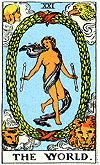
 The patterns in the Major Arcana set up by Teresa Michelsen in The Complete Tarot Reader and that of Arlene Tognetti and Lisa Lenard in The Complete Idiot’s Guide to Tarot and Fortunetelling are variations on the traditional Fool’s Journey of the Tarot. What each author did was to split their cards into groups to make this journey more understandable for themselves. Each group embraces a particular concept which is helpful to these Tarot authors. Each of the two patterns start with a young person meeting significant people and facing challenge. After wrestling with problems, young person matures and emerges in the world spiritually enlightened. The various groupings help the reader to understand The Fool’s Journey in depth by placing focus on particular parts of it from varying points of view.
 
 Meanwhile, Robert Place in The Tarot History, Symbolism, and Divination sees the Major Arcana differently. For him, it is not a journey, but a focus on particular aspects of the person. In his patterns, Place sets up Plato’s Three Parts of the Soul. Appetite, the first part of the soul, is represented by The Magician through The Chariot. These cards depict the desires a person has such as seeking power or love. The next group, which is Strength to Temperance, represents the Will (Spirit), the second part of the soul. These cards focus on the emotions such as seeking solitude or justice. The final group – The Devil to The World – represent Reason, the third part of the Soul. These cards highlight the mind, which Plato placed as the highest part of the soul.  

 Two patterns that I developed could probably be considered variations on The Fool’s Journey. The first is based on the therapeutic model of moving from illness to wellness. The Magician to The Hierophant are the various perceptions of reality, ranging from “mind over matter” to “strict rules of life.” The next group, The Lovers to Justice, are the issues of life that everyone has to cope with from changing homes to bad luck. The Hanged Man to The Tower are the struggles for people to overcome their distorted thinking and misperceptions. From The Star to The World are the rewards of healthy thinking and wellness, which only happens when the person implements these changes in their life.

 The other pattern was inspired by Journey to the Dark Goddess by Jane Meredith. This Journey is to the Underworld to meet the Dark Goddess. There, the person reclaims the lost and dark parts of themselves. Meredith says that we cannot go to the Dark Goddess while we are still in our place in the world. First, we have to be stripped of everything that we value. Once in the Underworld, we meet the Dark Goddess, who holds these remnants of our selves. Whilst in the Underworld, we are dead until a turning point occurs to restore us to life. This propels us upward. Afterwards, we become whole and emerge back into the Upper World reborn. 

 This particular Journey has four parts. The first is “Preparing for Descent.” The Magician through The Lovers are who we are in the Upper World. We have to give up all of this to undertake the second part, which is “The Descent to the Underworld.” The Chariot to Justice denotes our removal of our status and our acceptance of our fate. The third part is “Dwelling in the Underworld.” Like the Hanged Man, we are limbo as we die. Death to The Devil explains our time in the Underworld. The turning point for “The Ascent,” the fourth part, is The Tower. When we return to the Upper World we gain The Star through Judgement. Now as The World, we are reborn.

 Arranging the cards into patterns helped me to see how various processes occur in the Tarot. Each pattern highlights a different aspect of the Major Arcana. Within each pattern, I can understand how each card relates to the others such as why is Temperance between Death and The Devil. When a number of them from a group appear in a reading, the reader can figure out where the questioner is in the process. 

Works Used:
Lorenz, Hendrick, “Ancient Theories of the Soul.” Stanford Encyclopedia of Philosophy. 22 April 2009. Web. http://plato.stanford.edu/entries/ancient-soul/ .
Meredith, Janet, Journey to The Dark Goddess. Moon Books: Winchester (UK). 2012. Print.

Saturday, August 20, 2016

Sturgeon: Be Responsible

Sturgeon are ancient fish who swam in the waters when the dinosaurs first emerged on the earth. Today, these living fossils are considered to be the most primitive of the bony fish. Sturgeon belongs to the Acipenseridae family which has twenty-seven species. Native to the lakes, rivers, and coastlines of Eurasia and North America, these giant fish resemble armored torpedoes. Their distinctive bony plates (hard scutes) stud their back and sides.

One thing that Sturgeons are well-known for are their dramatic leaping out of the water. In his poem, The Song of Hiawatha, Longfellow described this – “saw the sturgeon, Nahma leaping, scattering drops like beads of wampum.” As the largest fish in freshwater, a massive Sturgeon can kill or break the bones of unwary boaters. As to why They leap, nobody knows. Theories range from communicating in their group to Sturgeon simply enjoying doing it.

Sturgeon have been highly regarded in many cultures. In India, Sturgeons represented royalty. Among the Natives Peoples of North America, Sturgeon provided both wisdom and food. Ancient Greeks regarded sturgeon eggs (caviar) as a gift from Aphrodite, the Goddess of Love. In Europe, Sturgeon migrating up the Danube would feed entire villages by allowing Themselves to be caught. When people became too greedy, these Fish stopped coming.

In Europe and North America, Sturgeon were once plentiful. However, the demand for caviar has halved their life expectancy from over 100 years to about 50 years. In the Great Lakes, overfishing and pollution has decimated those populations. The story of Sturgeon is a sad one of people ceasing to respect Them. Now this remarkable Fish is going extinct because of human folly.

Governments in Europe and North America have made concentrated efforts to save the remaining Sturgeon. Because of this, populations for some species of Sturgeon have stabilized on the Danube, Ural, and Volga Rivers. These Fish are making a small comeback in the Great Lakes Regions as people rehabilitate the environment to be more receptive to the well-being of the Sturgeon.

Alarmed by the pending extinction of Gulf Sturgeon, U.S. Army Corps of Engineers, U.S. Air Force, state wildlife agencies and local universities combined their efforts to save this Fish. The result is that these populations of Sturgeon are thriving in Florida, and are expanding to other regional rivers. Meanwhile, Native Peoples of North America have joined with various governments and commercial fisheries to keep the Sturgeon in their regions from becoming extinct. In 1977, the citizens living around Lake Winnebago (Wisconsin) watershed formed “Sturgeon for Tomorrow.” Their efforts were rewarded with a “stunning recovery in that watershed” for Sturgeon today.

Sturgeon teaches responsibility. Because of human carelessness and deliberate action, Sturgeon, worldwide, are close to extinction. Today, people are trying to repair the damage that has been done. It is an uncertain future for Sturgeon but They are amazingly resilient fish. Willing to work with people, Sturgeon have been consuming the invasive zebra mussels and gobies in the Great Lakes. In return, people are taking responsibility for the well-being of this ancient Fish.
-----
The sturgeon of Sturgeon Moon are the sturgeon of the Great Lakes.

Thursday, August 11, 2016

Tarot of the Animal Lords: Mindmapping

The cards that I chose to mindmap with were from The Tarot of the Animal Lords. The center card for the map was II. The High Priestess. Upper left was III. The Empress and upper right was VI. The Lovers. The bottom cards were IX. The Hermit (left) and XXI. The World (right). I could match several cards but forming a story that related to The High Priestess using all of them was difficult.
 
 Mindmapping was hard for me. I saw various relationships between the cards but they did not all fully coalesce around any one card. The individual cards seemed too discrete to mesh together. I could see the layout as an entire story. However, starting with one card and relating it to all of the rest was difficult. 

The High Priestess is depicted as a seated cow elephant in a glade. She is holding an open book. Scurrying about her feet are two chipmunks fussing with the scrolls on the ground. The words that came to me for this card were “regal,” “knowledge,” “questioning,” and “self-knowledge.” Since The High Priestess guides through intuition, this became the starting point of the story, that unfolded card by card. 


The Empress is a she-wolf sitting on a throne, with a turtle-shell shield
next to her. The scene around her is full of life with her pups chasing the butterflies. The similarities between her and The High Priestess are that they are crowned females sitting on thrones. Moreover, the two have two small animals next to them.  One difference is that The Empress holds a scepter while The High Priestess a book. The story moves from the quiet reflection of The High Priestess to the busy life of The Empress. These two cards with their small animals mark the inner and outer lives, the spiritual and temporal.

 The Lovers present two mandarin ducks standing under an orange tree. They are tenderly taking leave of each other. The High Priestess watches, knowing that they will need their intuition to guide them for what will be in store for them. The Empress notes the male’s duty to the Crown by his sword. The Lovers are caught between their spiritual and temporal lives. The story then becomes how they will solve their dilemma. 


The answer is The Hermit. Holding a light, a moon bear enters a cave. Hanging from his belt are scrolls and keys. Behind him, attached to a tree branch is a beehive dripping in honey.

The Hermit’s life has become unsettled, forcing him to find his own answers.  Perhaps he has experienced the horrors of war or has changed so much that his lover does not know him. The choices presented by The Empress and The High Priestess weighs heavily on him. Meanwhile, will his lover wait for him? How this drama will turn out is revealed in the next card.

 The final card is The World. This card features two dancing dolphins. In the moonlight under a flowering tree, the dolphins are celebrating. The World is the answer to what happened to The Lovers. Finding solace within, The Hermit, he rejoined the world and his lover, who did wait for him. This coupled have weathered their separation and trouble. Now together, the mature pair dance in happiness, having lived through the worst and now enjoying the best. 

The High Priestess told The Lovers to follow their intuition. The Empress showed them what they had to do before they could go on. Meanwhile, The Hermit had sought to understand what happened to him. Following his intuition and the advice of The Empress, The Hermit returned home. Now The World, The Lovers became whole again. Celebrating their long life, The Lovers thanked The High Priestess for her guidance.

 Laying the cards out as a whole, I did move from one scene to the next. I could see the connections between each of the cards. The story unfolded with The Lovers as the final focus. The Empress and The High Priestess gave them choices. This became a story of a relationship grappling with separation and healing.

Friday, August 05, 2016

Using Animal Oracle Cards to Discover Your Animals

My latest blog is up at Witches and Pagans.

A popular method for finding your Animals of the Heart is with animal oracle cards. While there are many fine decks, they are all limited in both the types and number of animals that they feature. Moreover, most decks are mammal-centric. Birds are usually represented by “Crow (or Raven),” “Eagle,” “Hawk,” “Hummingbird,” and “Owl.” Reptiles are limited to “Lizard,” “Snake,” and “Turtle.” Insects (and related others) are “Bee,” “Dragonfly,” and “Spider.”

Therefore, I would recommend a world-oriented deck since they will feature a wider range of animals. The methods that I suggest can work with most decks. Many popular decks tend to be North American specific, with a sprinkling of world animals. There are special themed decks which focus on Australian animals, birds, pets and other related topics. If you feel strongly about a certain grouping, then use those specialty decks.

To use the deck, shuffle the cards and deal seven cards. Study the animals and note your reactions. For example, you draw “Lizard,” what does that mean? I have only one deck out of the fifty that I own which features Tuatara, a lizard-like reptile. Therefore if an uncommon animal is calling to you, be prepared for a deeper investigation.

Read more at using animal oracle cards to discover your animals
This opens into a new window. 

Thursday, July 28, 2016

Tarot of the Animal Lords: Freewriting

For freewriting, I chose I. The Magician, XI. Strength, and XVII. The Stars from the Tarot of the Animal Lords. I focused on them in order from The Magician to The Stars. (The Tarot of the Animal Lords refer to XVII. The Star as “Stars.”) As I was freewriting, I experienced each card differently. Then as I went from one card to the next, they flowed together as one. The Magician created the reality for Strength to perceive. From Strength comes the ability to receive spiritual guidance from The Star.

I. The Magician features a fox playing “find the bean” game on a toad stool. He is standing in a briar patch. Watching the fox is a scarlet tanager and a mouse. At first glance, the fox is an illusionist simply switching the bean around. As I pondered the adage, “The hand is quicker than the eye,” I perceived that the fox is also an alchemist. With his gestures, he weaves illusion into reality. As the mouse and bird watch, he weaves them into his new reality. Making the beans appear and disappear under the cups, he challenges his audience to ponder if there really is a boundary between reality and imagination.
 
 Traditionally, The Magician combines the four elements into a fifth of the spirit. The elements are represented as the bird (air), the mouse (earth), the cups (water), and the thorns (fire), in this card. The fifth element is represented by the toadstool, the alchemy of the imagination. We, as the audience, become participants in The Magician’s creation. We join in the illusion and unite with the Magician. We bring the vital element, the spark to weld the two worlds. The Magician, as the midwife, helps to birth the new world of magic realism.

 XI. Strength depicts a mongoose embracing a cobra, as the earth under them is opening up. Behind them, several volcanoes are spewing out ash. While chaos erupts around them, two salamanders intently watch the battle between the mongoose and the cobra. Strangely, the watching salamanders are active, while the mongoose and cobra remain frozen in time.
 
 My freewriting enabled me to understand how strength balances the chaos and order. The mongoose is calmly focused on the cobra, while the cobra is focused on the chaos. There is stillness within the whirlwind. Strength becomes the balance between the rational and the irrational. If the mongoose places too much focus on the cobra, he will fall into the cracks opening underneath him. If the mongoose is distracted, the cobra will slip away. Strength is deciding when to hold on and when to let go. The salamanders remind us of the choices that we have to make to keep the balance. 

XVII. The Stars features a seahorse pouring out light as he kneels on a lily pad. Beside him on another lily pad is a nesting grebe. Stars in the sky and reflected in the lake surround the pair. A glowing star dominates the sky, as the pair float in serenity and peace. A feeling of spiritual rest fills the card.
 
 In freewriting, I pondered the grebe. Why did the artist include her in the picture? What does the grebe have to do with the stars? The seahorse pours light from the sky into the lake. He is replenishing the waters of life from the heavens. Meanwhile, the grebe is simply nesting on a lily pad.
 Grebes are noted for their graceful mating. Therefore I reasoned that the grebe was the representation of “grace.” Sitting on her nest, the grebe patiently hatches the new soul. This self will be infused with the waters of life. Therefore The Star is the soul at peace after being created by the Magician and honed by Strength. 

 Freewriting provided me with an entry into each of the cards. It allowed me to focus as I let my mind wander to consider the deeper meanings in each of the cards. Freewriting allowed free association, which brought about a deeper inquiry. For me, it was a good method to get to know the cards.

Thursday, July 21, 2016

Thorny Devil: Problem Solving

Known by many names, Thorny Devil (Moloch horridus) is more than an ordinary lizard. With her spiky body and crown of thorns, She resembles a walking nightmare. Her other names – Moloch, Horny Devil, and Thorny Dragon – emphasize her “hellish” nature. The scientist who named Her, Dr. John Grey certainly thought that. He recalled an ancient demon from John Milton’s Paradise Lost, when he gave Thorny Devil, her scientific name. Dr. Grey also cited the Canaanite God Moloch from the Old Testament, who received sacrificed children.

Looks can be deceiving. The only animal that Thorny Devil terrorizes is Ant. She spends her day wandering in the Australian Outback, searching for their nests. When Thorny Devil finds one, She parks Herself next to its edge. Catching one ant at a time with her sticky tongue, She consumes 45 ants a minute (2,500 in an hour). Thorny Devil is the walking nightmare for ants.

As She roams the Outback, Thorny Devil slowly lifts one foot at a time. Swaying from side to side, this small harmless lizard walks jerkily across the sandy soil. Since Thorny Devil cannot run fast, She relies on camouflage to keep Her safe. To blend into the landscape, Thorny Devil changes her colors from pale yellow to olive to brown.

Herpetologist Eric Pianka described his frustrating experience searching for a Thorny Devil. Spending a day in the Great Victoria Desert, Dr. Pianka followed the lizard’s faint tracks, which went around in a figure eight. Searching for most of the day, he found the Thorny Devil’s eating spot, sleeping spot, and bathroom spot, but no lizard. Then as evening was coming, he nearly stumbled over the Thorny Devil. For the entire day, this lizard had been sitting in the center of the figure eight. In his search for the Thorny Devil, Dr. Pianka had passed the lizard many times.
 
Well-suited for living in the tough dry areas of Australia, Thorny Devil has a unique way of collecting scarce water. When a rare shower occurs, the tiny grooves between her spikes will channel the rain to her mouth. Tilting her body forward, Thorney Devil gulps down the water. In the morning, when the dew condenses on her spikes, these grooves will direct the moisture to her mouth for drinking.

Thorny Devil uses her prickly armor for defense. Her head horns warn predators like Blue-tongued Lizard that She is painful to swallow. On the back of her neck, Thorny Devil has a satchel or false head. When She tucks her head between her forelegs, Blue-tongued Lizard sees only this large spiky “head” and retreats.

Thorny Devil is a member of the Agamidae Family (“dragon lizards”). (This Family includes bearded dragons and Australian frilled lizards.) The Agamidae of the Old World are distantly related to the Iguanas of the New World. Thorny Devil most resembles “Horny Toad” (Horned Lizard (Phrynosoma platyrhinos)) of the Iguana Family. Living in the Southwestern United States, “Horny Toad” faces the same challenges. Although They belong to different families, these two lizards could be twins.

Living in similar habitats, Thorny Devil and “Horny Toad” have parallel lives. Both feast on ants, and obtain water using the same methods. These two lizards demonstrate convergent evolution, which means that evolutionary pathways can be predicted and repeated. How these two lizards solve their problems with similar methods is revolutionary in understanding the challenges of nature for every species on the earth.

Thorny Devil teaches problem solving. To live in her harsh homeland, She employs many strategies for survival. Her spines serve as double duty – scaring predators and collecting water. Amid the desert shrubs, her coloring conceals Thorny Devil. She eats the ants that are plentiful where She lives. An excellent problem solver, Thorny Devil teaches how to be effective and efficient. Let Her be your guide. Just remember that looks can be deceiving.

Thursday, July 14, 2016

Cryolophosaurus: Use Your Imagination

In 1991, the first dinosaur to be found in Antarctica was Cryolophosaurus. This opened up a new continent to dinosaur discoveries. Named for the geologist David Elliot, who first excavated this dinosaur, Cryolophosaurus’ full taxonomic name became “Cryolophosaurus elliotti.” In 1994, He became the first Antarctic dinosaur to be named. This dinosaur’s name means “frozen crest lizard.”

Life in the Antarctic during the early Jurassic was much different than today. At that time, Antarctica was further north and closer to the equator. Also, the warm Jurassic oceans allowed for plant and animal life to flourish there. However, there were still long periods without a sunrise. This continent was also cooler than other places. Not many large dinosaurs of the Jurassic could tolerate either condition very well. Medium sized Cryolophosaurus did and thrived. This meat-eater had little completion for the Pterosaurs and Prosauropods that He hunted.

Cryolophosaurus is the oldest Tetanuran to be found. Tetanurae are dinosaurs with large stiff tails. They include Spinosaurus, Carnosaurus, and Coelurosaurus. Tetanurae bore more resemblance to birds than many other dinosaurs. Because Cryolophosaurus lived in the early Jurassic, this meant that these dinosaurs evolved earlier than originally thought.

Cryolophosaurus is also noted for his oddly shaped crest. Since this crest reminded people of Elvis Presley’s pompadour, He became known as “Elvisaurus.” Paleontologists believed that his crest was used to identify who He was and to attract Females for mating. Like an Elvis fan, Female Cryolophosaurus would “swoon” eyeing his crest, Or so people could imagine.

Cryolophosaurus encourages people to use their imaginations. Picture Him singing rock’n’roll songs to his adoring fans. Imagine his home as a warm place with trees, a Graceland just for Him. Have fun with your mind pictures about Cryolophosaurus!

Thursday, July 07, 2016

GILA MONSTER: Discerning Fact from Fiction

A striking sight with her beaded skin of pink and black, Gila Monster blends well into her desert home in Arizona. This sluggish-seeming lizard intently flicks her tongue to detect a tasty mouse. At other times, She adroitly climbs the cactus with her sharp claws to hunt for perching birds. Tasting the air with her forked tongue, Gila Monster finds Desert Rat, and quickly chomps down with her vice-like jaws. Then She swallows her paralyzed victim whole and head first.

Gila Monster with her Brother – Mexican Beaded Lizard – are the only venomous lizards (Helodermatidae) in the world. Because of their venom and forked tongues, Gila Monster (Heloderma suspectum) and her Brother (Heloderma horridum ) are distant relatives of snakes. These two lizards are also close relatives to monitor lizards (Varanidae), who possess poisonous saliva, and could be ancestors of snakes. These two beaded lizards have an ancient ancestry, extending back to the mid-Cretaceous.

Contrary to popular belief, Gila Monster uses her venom for defense and not to hunt with. When She is angry, Gila Monster will open her mouth very wide and hiss. When She does this, her venom is pumped from her salivary glands into her grooved teeth. Thus when She bites Coyote, and clamps down hard, her venom flows into his wound. Locking her jaws, Gila Monster will hang on until Coyote howls in pain. After making her point, She then lets go. Learning his lesson, Coyote limps off.

Reclusive Gila Monster spends much of her time in her burrow. Digging deep with her heavy claws, She creates a snug home for herself. In the extreme heat of summer and cold of winter, Gila Monster rarely leaves it. The springtime is when She feasts. The rest of the year, Gila Monster lives off the fat contained in her large wide tail. (Her tail acts like a camel’s hump, storing food instead of water.)

Poorly understood, Gila Monster is the subject of many myths. More than that, these stories about Her are presented as facts. For example, Gila Monster does have powerful jaws and a tenacious bite. From this comes the legend, “Once She clamps her jaw on something, Gila Monster will not let go before sundown.” That is patently untrue. Other myths state that Gila Monster can kill with her bad breath, and has no anal opening. None of these silly stories are true, but they often get repeated as facts.

Another legend informs people that Gila Monster is a killer. Yes, her venom is toxic, but a human can easily avoid her bite. Old timers in Arizona say that only an idiot gets bitten. They add that said idiot would have to place Her on his bare leg, then annoy Her until Gila Monster bites. In other words, the said idiot would want to be bitten.

Sluggish in appearance, Gila Monster can suddenly turn and bite, usually when She senses a tasty meal. She warns those who would disturb Her, so that they leave Gila Monster alone. Separating fact from fiction is what Gila Monster teaches. Inspired by her tenacity, you can hang on for the truth. Before repeating something, discover whether it is false first. Some fiction comes disguised as the truth. Do not be an idiot counsels Gila Monster.

Thursday, June 30, 2016

Megalosaurus: The Door to New Worlds

The first dinosaur ever to be named was Megalosaurus. The first fossil to be “officially” discovered (England, 1676), Megalosaurus was believed to be a giant human. As the first dinosaur to be drawn, her thigh fossil was depicted as a piece of male anatomy by Robert Plot. This prompted Dr. Richard Brookes to name it “scrotum humanum” in 1763.

Meanwhile, Reverend William Buckland had different ideas about Megalosaurus. An avid fossil collector, Rev. Buckland realized that the bones he possessed were instead from an ancient animal. After reviewing Buckland’s collection, Baron George Cuvier said that the fossils were of a giant lizard creature. (Cuvier was the first scientist to realize that extinction occurs.) In 1824, Rev. Buckland wrote a scientific paper and named this “lizard,” Megalosaurus, which means “great lizard.”

In his paper, Rev. Buckland described Megalosaurus as a giant land-living reptile who lived in the ancient past. According to him, She was a fifty foot (about 16 meters) long lizard, who walked on all fours. After examining her teeth, Rev. Buckland said that She was a meat eater. His reasoning was that Megalosaurus had sharp teeth like a monitor lizard.

Then in 1842, British scientist Richard Owen was pondering just what were Megalosaurus, Iguanodon, and Hylaeosaurus (an ankylosaur). These were all recent discoveries of extinct animals. Owen noted that their fossils were different from any other reptile living or from the past. Their legs were directly underneath their bodies, unlike modern lizards. Also they had extra bones in their hips. Owen grouped these three animals into their own family – Dinosauria (deinous means “terrible,” and sauros means “lizard”).

Later Owen decided to present Megalosaurus and her friends to the public. He had “life-sized” sculptures placed at the Crystal Palace Exhibition of 1851, which being held in London. Megalosaurus was depicted as a lizard walking on four legs, with a crocodile-shaped head and a hump on her back. After seeing this sculpture, Charles Dickens described Her in his novel “Bleak House.” (This was the first mention of a dinosaur in literature.)

Despite being the first named dinosaur, Megalosaurus is still relatively unknown. Rev. Buckland’s collection had contained fossils of different families of dinosaurs. Scientists first had to sift through his collection to determine which fossils belonged to what dinosaur. As more complete skeletons were found for other dinosaurs, scientists could begin to identify the bones of Megalosaurus.

Who was Megalosaurus? She looked nothing like Owen’s sculpture. Related to the ferocious Spinosaurus, Megalosaurus walked on two legs and hunted large sauropods. Her thick muscular legs allowed Megalosaurus to run fast for short distances. In this way, She could ambush and charge her prey. Also, She had large powerful jaws and long sharp teeth. Using them, Megalosaurus ripped off chunks of meat for her meal.

Megalosaurus opens the door to mystery, inviting people to walk through. Once people discovered her bones, they entered an ancient world, they never knew existed. She prompted them to consider new and strange animals. Through Megalosaurus, the world of dinosaurs came to life. Follow Her in and leave your old ideas behind.

Saturday, June 25, 2016

Discovering Your Animals of the Heart

My new blog at Witches and Pagans is up.

Animals of the Heart are the animals who want to share their lives with you. Offering their friendship, these animals want to be a part of you. I prefer calling animals who bond with you as “Animals of the Heart.” For me, the terms of “totem,” “power,” and “familiar” are specific to their religious traditions. I know that people use these words interchangeably to mean the same thing. “Animals of the Heart” is a general term that I use to denote the type of animal that people feel a deep connection with.

Animals of the Heart come in all forms. Some of them have been with you since childhood. I have met people who have been happy with Goldfish as their Animal of the Heart because they had them as pets. Meanwhile, other people have been fascinated by unicorns or dragons as children. As adults, they look to these mythical animals for wisdom.

Other Animals of the Heart represent your inner character or personal characteristics. For example, my family calls me, “Squirrel.” According to them, I am always “bright-eyed and bushy tailed.” They also find me to be a bit squirrelly.

Read more at Animal Wisdom: Animals of The Heart.

Opens into a new window.

Friday, June 10, 2016

Gorilla: Calmness and Strength

Lowland Gorilla
When people were first introduced to Gorillas, they believed that these primates were fiercesome monsters. King Kong symbolized people’s fear of this mammal. Since Gorillas live in the most inaccessible regions of the forests and mountains of Africa, They were the last members of the Great Ape Family to be found. Therefore, ordinary people had no ideas about what real Gorillas were like.

The largest and most powerful of all living Primates, Gorilla is actually peaceful and sociable. His easy-going nature has made it possible for several groups of Gorillas to coexist peacefully in the same region. When a strange Gorilla appears, the eldest Gorilla (Silverback) hoots excitedly, building up to an ear splitting roar. Silverback Gorilla will charge but stops short of touching the intruder. This will usually frighten the other Gorilla away.

Within His Troop, Gorilla forms a strong attachment with everyone. The strongest and most mature male – the Silverback – rules the Troop. He decides where they will eat and sleep. He is responsible for their safety and closely guards them. If Silverback Gorilla sees the Troop in any kind of danger, He will fight to protect them.

A plant eater, Gorilla especially likes bamboo shoots. Contrary to the movies, He is not a carnivore. After a day of foraging for plants on the ground, Gorilla spends the night in a tree. Nest making is simple; He rips off several branches and places them in tree nooks for a bed. Gorilla’s typical day consists of eating in the morning and evening, traveling during the day, napping in the afternoon, traveling, and then making his nest for the night.

Being very calm, Gorilla is not easily bothered. In fact, social grooming can relax Him into going into a trance. Gorilla shows interest by doing a task for its own reward. Most intelligent of the (nonhuman) Great Apes, He knows and uses language, when taught. Zoologists think that Gorilla has self-awareness like a human does.

Gorilla teaches calmness and strength. Remaining serene, He goes about his affairs. Even when a strange Gorilla shows up, He will not immediately attack. Taking control of the situation, Gorilla will state his position firmly but forcefully. As a last resort, He will attack. Learn from Gorilla how to act calmly and effectively. And keep your aggressive impulses in check.

Notes:
1. Gorillas are endangered throughout most of their range.

2. The Ape Family is really comprised of two families, the Great Apes (Hominidae) and the Lesser Apes (Hylobatidae). Lesser Apes are the gibbons. Among the Great Apes are gorillas, chimpanzees, orangutans, and humans.

3. Zoologists divide gorillas into two groups – lowland gorilla (Gorilla gorilla) and mountain gorilla (Gorilla beringei). Lowland gorillas live in the dense forests of Africa. Meanwhile mountain gorillas live in the mountains of Central Africa. The difference between the two is that lowland gorillas have short hair and weigh less.


Friday, May 27, 2016

TUATARA: Dedication to Your Cause

Although Tuatara resembles a lizard, He is not one. Tuatara is the last surviving species of the ancient order of Rhynchocephalia (“beak-heads”). Only his family of Sphenodontidae (“wedge-toothed”) is left of this group of reptiles. The rest of the Rhynchocephalia went extinct about 60 million years ago. Because of that, Tuatara is often thought of as a “living fossil.” (However, He has actually evolved to live in modern times.) Because of his link to prehistoric reptiles, scientists can study Tuatara to see how lizards and snakes evolved.

Tuatara has distinctive characteristics that makes Him different from lizards. He has fused jaw teeth, and a beak formed by overhanging upper teeth. (This is what gives Tuatara, a “beak-head.”) Like some dinosaurs, Tuatara has a large opening in his skull behind his eye socket. He also has a third eyelid that passes over his open eyes. Tuatara has gastralia (“abdominal ribs”) which lizards and snakes do not. All these qualities indicate that his lineage is older than theirs.

Tuatara’s most notable feature is his ridge of small spines, which runs from his head to his tail. The Maori of New Zealand call this reptile “tuatara,” which means “peaks on the back.” When threatened, Tuatara will raise these spines. To startle his enemies, He elevates his spines and opens his bright red mouth.

Unlike lizards, Tuatara has a tolerance for exceptionally cool temperatures. He has colder blood than any other active reptile. Because of his slow metabolism, Tuatara spends little energy and much of his time in his snug burrow. When resting, He breathes only once per minute, and while walking, only once every seven seconds. Because of these factors, Tuatara can live beyond 100 years, longer than any lizard. However, it takes about twenty years for him to become an adult.

Legally protected in New Zealand since 1895, Tuatara’s numbers still steadily declined. The local kiore (rats) ate Tuatara’s eggs both on the mainland as well as on the coastal islands. Since Tuatara reproduce very slowly (once every five years), this became a great disaster. Tuatara simply could not recover from the losses inflicted by the kiore. Starting in the 1980s, a concerted effort by the government, volunteers, and Maori iwi (tribes) stopped Tuatara’s decline. They removed kiore from coastal islands and re-established Tuatara populations, thereby increasing his “safe homes” to 37 islands. For the first time in hundreds of years, Tuatara now live on Mainland New Zealand at the Karori Wildlife Sanctuary in Wellington.

Tuatara teaches dedication. The people of New Zealand are determined to keep Tuatara, one of their iconic animals, from going extinct. Spending tremendous amounts of energy, money, and time, people raised captive young, eradicated kiore from various islands, and cared for re-introduced populations. Today Tuatara has been returned to many places where He went extinct. Imagine the help that this distinctive reptile can give you to find your life’s mission. He can inspire to dedicate yourself to a worthy cause. Just do not think of Tuatara as “an ordinary lizard,” since He is neither.
-----

The picture is of Henry, the world's oldest Tuatara in captivity at Invercargill, New Zealand. Still active at 111 years of age.

Picture of Henry: By KeresH (Own work), via Wikimedia Commons. Title:  "Henry at Invercargill"

Monday, May 16, 2016

Working with Your Shadow Animal: Summary

(Hourglass Dolphins)
My blog "Animal Wisdom" at Witches and Pagans features "Working with Your Shadow Animal: Summary"

"Our shadow animals are the dynamic that brings change to our lives. They test us, and give us the energy to change ourselves. They break us out of our comfortable places, and push us out into the world. Our shadow animals help us to integrate ourselves. Without our shadow animals, we would be incomplete.

By challenging us, shadow animals also teach us many life lessons. They help us with family legacy issues, and resolve feelings of shame and guilt. Not only that but they guide us through a life of chaos to one of empowerment.

As I have indicated in my other blog entries, there are several types of shadow animals. (I list them at the end of this blog.) They range from the shadow archetype to the dark trickster. Therefore it is also important to know what type your shadow animal is. This will help you in your shadow work."

Read more at:  witchesandpagans.com: working with your shadow animal (summary)

Friday, April 29, 2016

WOOLLY MAMMOTH: Warmth and Hospitality

Best known of the Ice Age Mammals, Woolly Mammoth (Mammuthus primigenius) received her name from her outer layer of long hair. Underneath that layer, She had another dense inner layer of fur. To cope with the icy temperatures, Woolly Mammoth had a compact body, a high domed head and small ears.

Woolly Mammoth had a shorter but more flexible trunk than other Mammoths. At the end of her trunk was a finger-like appendage as well as another protuberance. She used these to gather grasses and other plants for eating.

The smallest of Mammoths, Woolly Mammoth had extra long tusks. These ornate twisting tusks had many uses. For example, She could dig up plants and clear snow with them. Also, Woolly Mammoth could fight off predators with her tusks by bashing the attacking animal with them. Her tusks were like tree rings, telling her age and life experience.

Meanwhile, Paleo-peoples used the tusks of Woolly Mammoth to construct their homes. Many of their houses were built from her large bones and woolly hides. In one homestead found in Ukraine, the skulls of Woolly Mammoths, placed in a semi-circle, formed the base walls. Then the jaws were used to erect the upper parts of the walls. For the entrance, they used the leg bones of Woolly Mammoth. She provided shelter for them on the flat, treeless plains.

The last known Mammoth lived about 4,000 years ago on a small island near Siberia during the Stone Age. Many people believe that Woolly Mammoth went extinct through overhunting. However others think that as the world’s climate became warm; She could not survive adequately on the new plants. Whatever the reason, Woolly Mammoth became the icon for extinction from overhunting during the Ice Age.

Woolly Mammoth exudes warmth and hospitality. Meeting others during migrations, She greets Them with touching and trumpeting with her trunk. Furthermore, Woolly Mammoth would wait for laggards as well, welcoming Them back into the herd.

Learn from Woolly Mammoth about proper hospitality and warmth. She teaches us how to care for and welcome others into our hearth and home. However do not so be taken advantage of that you end up giving up everything you have. You can be flexible but also wary.

(Note: update of post from 2010.)

Saturday, April 16, 2016

Mastodon Family: Look Closer and Think.

Often confused with Mammoths, Mastodons (Mammutidae) are in their own family, since They split off from Elephants and Mammoths earlier. Therefore, there are many differences between the two Animals. Mastodons have larger and flatter brows than Mammoths. Moreover, They have paired low conical cusps for teeth, and upper jaw tusks. In addition, Mastodons are shorter and more muscular than Mammoths. Scientists have liken Them to a bus, whereas Mammoths are more like construction cranes.

Living side by side with Mammoths, Mastodons colonized Eurasia and North America about fifteen million years ago. As browsers, They preferred to live in spruce forests and open woodlands. During the winter, Mastodons had a double coat of fur to prevent Them from freezing in the icy cold. However, they preferred warmer climates to live in.

Fossil Mastodons have been found with full stomachs, indicating that They consumed about 500 pounds (1,000 kilos) of food each day. Since their enormous appetites drove Them to seek more and more food, Mastodons roamed the countryside endlessly searching for food. Mastodons tramped through forests to feast on moss and twigs of cedar, larch, pine, and spruce trees. Their hunger drove Them deeper into bogs and swamps in search of food, where They died.

Mastodons teach to look closer and think. Do not mistake Them for their cousins, the Mammoths. Examine the differences before making a judgment. If you do not ponder what you see, you may mindlessly end up stuck in a bog. Take care in what you do.

---
Update from a previous 2010 posting

Friday, April 01, 2016

Prehistoric Elephant Family: Partnership

(Deinotheres, Elephants, Mammoths, and Mastodons)

Of the myriad Trunked Mammals who once roamed the earth, only African and Asian Elephants still remain today.  At one time, Proboscids (Trunked Mammals) lived everywhere except Antarctica and Australia.  Spreading from Africa where They originated, these Mammals flourished during the Miocene Period (from 20 million years ago (mya) to 5 mya).  Since many Proboscids were not immune to the cold, only a few survived the Ice Age.

Trunked Mammals have a long complex evolutionary history.  Beginning as small herbivores sixty mya, these Mammals resembled modern Pigmy Hippos.  For example, Moeritherium did look like a small Hippo but possessed a flexible upper lip and snout like an Elephant.  Then a cousin, Deinotherium appeared alongside the Gomphotheres (Early Elephants) about fifteen mya. Many of the Gomphotheres had flat tusks to shovel plants out of soft swampy ground. In addition, They used their trunks to uproot trees.

Mastodons split off from the Elephant Family (which also includes Mammoths). Unlike Mammoths, Mastodons had cheek teeth with low-rounded crowns. Meanwhile, Mammoths had the most highly evolved of elephantine teeth. Because of the grinding surfaces of their teeth, Mammoths could eat grasses whilst Mastodons searched the trees for tender leaves. Mastodons preferred warm climates to the Mammoths’ cold ones.

The Family of Trunked Mammals has been a part of human history from the very beginning.  Both Humans and Proboscids evolved together in Africa.  Later both spread out of Africa to populate the world.  When Paleo-humans needed food and shelter, they hunted Trunked Mammals.  They also built their homes from the bones and hides of various Proboscids. To honor Them, Paleo-peoples painted the likenesses of Mammoths and Mastodons on cave walls.

The infant science of paleontology became advanced through the study of Proboscids’ teeth and bones.  Since Trunked Mammals were widely distributed around the world, early scientists could trace their evolution.  Because Proboscid fossils were plentiful and readily available, early naturalists could learn their craft from these fossils.

Throughout the ages, humans entered into a partnership with various Trunked Mammals.  As each developed, They learned from each other.  Proboscids provided for humans and taught them basic life skills.  In return, Humans honored Them. The lesson of Trunked Mammals is that a partnership is one of equals.  We need to be good partners as They have taught us and protect their living representatives.  Today all that remain are endangered.

Science Note: Manatees, dugongs, and hyraxes are the closest living relatives of elephants. They are descended from Moeritherium.

(Updated from earlier 2010 blog.)

Thursday, March 24, 2016

Shadow Animals:The Trickster and the Bringer of Death

"The Raven" from E.A. Poe's poem

My blog at Witches and Pagans is up featuring shadow animals: the trickster and the bringer of death.

From the Blog:

Two difficult types of Shadow Animals are the Trickster and the Bringer of Death. Most Pagans are familiar with Tricksters since they know about Coyote and Loki, who transgress societal norms. The Bringer of Death is an animal who causes a near-death experience. People who undergo a Near-Death Experience (NDE) often gain more spiritual power by dying and then being reborn.

Read the rest at : Witches and Pagans: Animal Wisdom

Friday, March 04, 2016

YOWIE (Australia's Bigfoot): Tenacity

Copyright: "Yowie Statue at Kilcoy, Queensland," by Seo75 (wikimedia).
When the Europeans first arrived in Australia, they encountered “the hairy man,” of Aboriginal myth. According to the Aboriginal Australians, humans share this continent with apemen. These Yowies (“hairy men”), as they were called, had inhabited Australia before the coming of any humans.

 Amongst the Aboriginal Australians, the “hairy men” were called many names and possessed different attributes. “Yowie,” the name They are called today comes from “Yuwi” as referred to by the Yuwaalaraay People of New South Wales. To them, Yowie is a spirit from Dreamtime. Meanwhile, the “Yaroma” of the Blue Mountains was a cannibal. According to the Gundungurra People, the Yaroma sharpened their long fangs on rocks. A human could escape from this cannibal by jumping into a waterhole, since the Yaroma could not get their feet wet. Other myths describe Yowies to be gigantic “hairy men,” with muscular bodies and powerful arms.

 According to cryptozoologists who study apemen, there are at least two different kinds of Yowies. The “hairy men,” known as “Jimbra” of Western Australia, “Turramulli” of Cape York, and "Lo-an” of Victoria are probably “True Giants.” (These are large hairy hominoids who leave long, four-toed foot prints.) They are classified as True Giants since they are tall and have flat faces. “Tjangara, the “Great Hairy of Man” of South Australia is also a True Giant. This apeman carries a club to kill and eat humans. Meanwhile, the Yowies of New South Wales are an unknown species of ape. They have long canine teeth over wide mouths. Also, these Yowies also possess very apelike feet, with a large second toe, and a big toe jutting out at an angle.

According to the Aboriginal Australians, Yowies have lived in Australia long before the coming of people. Bigger and faster than humans, Yowies waged war against the newcomers. Since the humans had better weapons, they pushed the Yowies into more remote areas of Australia. In Cape York, the Yalanji People banded together and killed all of the Turramulli.

As early as 1795, settlers on a hunting trip at Yowie Bay spotted a “hairy man” running away from them. In fact, Yowie Bay is reported to be named for the numerous sightings of Yowies. During 1994, Tim the Yowie Man saw his first Yowie in the Brindabella Mountains. He had reported encountering a hairy ape-like animal whilst on a field trip. Meanwhile, the people of Kilcoy in Queensland say that Yowies still live in the surrounding mountains.

Most Yowie researchers agree that Yowies are not close relatives of humans. The “Father of Yowie Research” and founder of the Australian Yowie Research Centre (AYR), Rex Gilroy thinks that one kind of Yowie is possibly an Australopithecine, a large robust relative of early humans, Homo habilis and ergaster. Others at the AYR posit that Gigantopithecus could be the True Giant Yowie. This strong, enormous and human-like ape lived in Asia alongside Homo erectus. Both could still be living in Australia.

The Aboriginal stories of Yowies speak of an inhabited land before humans. Like any other group of indwellers, the Yowies wanted the newcomers gone. Although, They lost the war, the tenacious Yowies still continue to live in their homelands. Even today, people still see Them in settled places such as Sydney. The Yowies never left, and instead learnt to avoid direct contact with humans.

Yowies teach people about tenacity. Because of their perseverance, Yowies survived. Defeated by the humans, They moved to the inaccessible parts of their homelands, and stayed. If you want help to remain in your home, look to the Yowie. But try to learn to co-exist with others.

Saturday, February 20, 2016

YETI (ABOMINABLE SNOWMAN): Reflections on the Sacred

Mention “Abominable Snowman,” and people will conjure up a picture of a huge apeman with a cone-shaped head and snow white hair. This particular man-like creature has captured the public imagination with stories, toys, and TV shows. Now, people entertain notions of unknown humans and their hidden lives in the inaccessible places of the Himalayas.

Stories of Yeti (“Abominable Snowman”) reach far back in history. Pliny the Elder, of Rome, wrote about Yeti in the First Century C.E. In his writings on the natural world, Pliny described a man-like creature, who walked on two legs, living in the mountains of India. Meanwhile ancient writings of Tibetans told of a man-beast who roamed the high passes. Also the peoples of the Himalayas regarded Yeti to be the God of Hunting.

Modern reports of Yeti began in 1921, with a newspaper article in a Calcutta newspaper, Lieutenant Colonel C.K. Howard-Bury had sighted a mountain “man” with long hair on his head and shoulders. Then in his epic climb up Mt. Everest in 1953, Sir Edmund Hillary reported seeing giant footprints, thereby setting off the Yeti craze. By 1959, Disneyland in California featured audio-animatronic Yeti in its rides.

The Sherpas of Nepal have many ways to denote the different kinds of Yeti. “Yet-teh,” which became “Yeti” in English, means “that there thing.” The Sherpas with Howard-Bury said they saw “met-teh kang-mi,” which translates into “foul-smelling snow creature.” “Teh-lma” means “that there little thing,” which refers to a small Yeti. “Dzu-teh,” meaning “big thing,” is a huge hulking animal, that stands on two legs.

Cryptozoologists, who study unknown primates, have determined that there are three species of Ape-like Yeti. (Dzu-teh is probably an unknown species of bear.) Big Yeti (“Gin-sung” in Chinese) is eight feet tall (nearly two meters), and walks on two legs. Possessing a square-like head, Big Yeti also has rusty brown hair. Little Yeti (Teh-lma), under five feet tall (a meter and a half), has a pointed head and thick-reddish grey hair. Teh-lma lives in the more tropical valleys of Nepal, and has been seen hunting frogs. Little and Big Yeti are considered relatives of humans. Meanwhile, Classic Yeti of the cone-head and greyish-white hair is believed to be a rock climbing ape.

One of the leading authorities on Yeti was the Russian scientist, Maya Bykova. She theorized that Yeti are genetic companions to modern humans. Bykova explained that the paralyzing fear that people have when they encounter a Yeti is from ancestral memories of similar prehistoric meetings. She based her conclusions on the large amount of data that she had gathered before her death in 1996.
Many Buddhist monasteries have established “sacred lands” for Yeti, whom they consider to be holy. Knowing Yeti to be fiercely territorial, few Nepalese will enter these lands. Furthermore, various monasteries possess scalps and hands of Yeti as sacred relics. Meanwhile, Bhutan has become the only country with a national park for Yeti: Thrumshingla National Park, where He can roam freely and unnoticed.

How we approach Yeti reflects how we relate to the Sacred. For many, the Sacred is cloaked in mystery and beyond comprehension. Philosopher Umberto Eco said, “The unknown is often seen in terms of the known.” Yeti is often compared to modern humans as to what “it” could be. Perhaps Yeti stands for things we were not meant to know. Or maybe Yeti is simply an unknown ape that lives in remote mountains. How do we approach the Yeti? Do we let “it” continue to be unknown or do we insist on pulling back the mystery? The choice is ours to make. Our feelings about Yeti reflects our attitudes towards the Sacred. If we allow Yeti be an enigma, then we allow Him to be numinous, one of the Sacred.

Saturday, February 13, 2016

GIRAFFE: Quiet Strength

From prehistory, Giraffe has commanded people’s attention. Early writers described Giraffe as “magnificent in appearance, bizarre in form, unique in gait, colossal in height and inoffensive in character.” Pictures of Giraffes grace the cave walls in North Africa, drawn over 10,000 years ago. In Ancient Egypt, Queen Hatshepat brought Giraffe from the headwaters of the Nile, down to her zoo. The Kingdom of Malindi, in Africa, in 1414 presented China, Giraffe as a diplomatic gift (the first ever). In Paris, when Giraffe was first seen in 1826, the City went “Giraffe crazy” for a year.

Since the beginning of time, people have tried to explain why Giraffe looks the way He does. In Africa, after the Creator Gods finished with Camel and Leopard, some parts were left over. So They made an animal large like Camel with Leopard spots. Ancient Greeks and Romans called Giraffe “Camel-Leopard”, which now is the scientific name (Camelopardalis) for Giraffe.
 
Tallest of all land mammals, Giraffe is noted for his exceptionally long neck and legs. Giraffe uses his tallness to his advantage. From his elevated view, He can watch for predators, as well as eat leaves from the tops of trees. Because of his great height, Giraffe and His Friends are called a “tower”.

However, Giraffe has many other notable features as well. Like Camel, He can go for days without drinking, and can eat from thorny plants. With his flexible neck, He can eat from the tops of trees. With his horns, Giraffe can swing his head and ably defend himself. A blow from Giraffe’s head can prove deadly to a predator.

This peaceful quiet Animal is one of the most successful vegetarians of the African Savannah. He may seem fragile but Giraffe can ably defend himself. Quiet and unassuming, Giraffe always looks out for his friends. They return the favor when He is the most vulnerable – sprawled at the water hole drinking. Be a friend like Giraffe, and learn quiet strength from Him.

Giraffe’s Teachings Also Include:

“The giraffe represents the capacity to extend beyond the limitations of the physical plane. Its ability to obtain sustenance flourishing on a seemingly unattainable perch symbolizes the necessity to overcome limitations and to allow innovative ideas to flourish.” Copyright: “Animals Divine Companion”, Lisa Hunt.

“The giraffe’s vulnerability when it lowers its head to drink reminds us that if we lose sight of our greater vision and consciousness and sink into a mundane way of life, we risk losing our spiritual connection.” Copyright: Beyond the Rainbow (Constance Barrett Sohodski).


Giraffe head
Giraffe’s Wisdom Includes:
Farsightedness
Seeing From the Heart
Foresight
Flexibility