Monday, May 26, 2014

MEDITERRANEAN MONK SEAL: Fragility of Life


Support Monk Seals in Turkey
In ancient Greece, Mediterranean Monk Seal was placed under the protection of Poseidon, the God of the Sea, and Apollo, the God of the Sun, because Monk Seal showed a great love for sea and sun. The Greek sages, Homer, Plutarch, and Aristotle, immortalized Him in their writings. As long as there have been people living around the Mediterranean, Monk Seal has been a part of their lives.

Instead of ice and snow, Mediterranean Monk Seal has sandy beaches and warm waters to live in. He is called Monk Seal because He is bald and is often alone like a Christian monk. Exceedingly shy, He prefers the company of few friends. Mediterranean Monk Seal runs contrary to modern people’s perceptions of where Seals live.

Mediterranean Monk Seal teaches the fragility of life. Once common to the sandy beaches of the Mediterranean Sea, He is now found only small islands and cliffs around rocky coasts, which are inaccessible to people. Cherish life as the people who try to save Monk Seal from extinction.

International Monk Seal Alliance


Mediterranean Monk Seal’s Teachings Include:
“We must act now. By protecting the monk seal, we protect the sea itself.”
Copyright: Hellenic Society for the Study and Protection of the Monk Seal


Wednesday, May 21, 2014

ELEPHANT SEAL: Male Spirit


elephant seal sleeping on the shore
The largest of all Seals, Father Elephant Seal towers over all his Wives. What gives Elephant Seal his name is his huge size and his elephant trunk-like snout. Along with his bellowing roar, Elephant Seal attracts many Females to be his wife by inflating his snout to an immense size.

Father Elephant Seal arrives at his breeding beach a few weeks before his Wives, to establish his territory. By raising his head and chest, tilting his head back, He issues a loud bellow to intimidate other Elephant Seals. Usually that works, but when a particularly stubborn Seal wants his territory, Father Elephant Seal rams his bulky body against his Rival and bites Him. By the time his Wives arrive, Elephant Seal has his territory.

After breeding season is over, Everyone goes their separate ways. Alone, Elephant Seal will travel from continent to continent. In searching for his favorite food, Squid, He will dive as deep as 1,250 meters, and stay underwater for as long as an hour. Few Seals, let alone other Mammals, can do these feats.

Father Elephant Seal demonstrates the many aspects of the Male Spirit. He bellows and inflates his snout to impress the Ladies, and to announce what is his. His enormous size enables Father Elephant Seal to travel long distances both on the ocean’s surface and below. His dark side is his need to dominate to the point of risking his life. However, all things balance out, since Father Elephant Seal is the favorite food of Great White Shark, the Queen of the Seas.

Monday, May 12, 2014

SEAL FAMILY: Seeing With Your Mind's Eye


Seals (Phocidae) are distant cousins to Sea Lions (Otariidae), who are, in fact, closer cousins to Walruses (Odobenidae). To many people, this seems odd, since they think that Seals and Sea Lions look alike. Actually, the “trained seals” at circuses are really female California Sea Lions. Seals are more streamlined and without noticeable ears. When on land, Seals move like Caterpillars, instead of walking, like Sea Lions and Walruses.

Contrary to popular belief, Seals not only live only in the Arctic and Antarctic, but also in the warmer seas as well. Also, Seals can be found living in inland seas like the Caspian Sea and Mediterranean Seas. Ringed Seal and Baikal Seal live in freshwater lakes. Hawaiian Monk Seal can be seen sleeping on the beaches of Hawai’i.

Humans have long traditions regarding Seals. The Romans believed that sealskins would protect people from thunder and lightening. The Scots and Welsh tell of seal-people (Selkies), who would become human by laying aside their sealskins and walking on the land. Some Irish and Scottish families claim Selchies as ancestors. Other Celtic peoples regarded Seals to be messengers from the Fairy Realms.

Seals connect people with the mysterious. They live in the water yet come on land from time to time. Seals have large eyes, rounded heads, and receding chins that resemble human children. Bobbing above the surface of the ocean, Seals watch life with uncannily human eyes. They could be people if you had the imagination to see Seals as “seal-people”. Seals help people to see beyond what is and to see with their mind’s eye.

Monday, May 05, 2014

WALRUS: Hidden Talents

Although Walrus’ home is the Arctic, He is well known. Familiar to everyone, Walrus is often depicted in cartoons as a banker. With his long tusks, wrinkled skin, and mustache, He makes an unforgettable sight.
Related to Seals and Sea Lions, He shares the same Pinniped characteristics of ‘fin feet’. Walrus may have flippers for feet, but He is better known for his tusks. People in the Arctic call Him “tooth walker”. Moreover, Walrus’ scientific name Odobenidae is Greek for “one who walks with his teeth.”

Walrus spends his days resting on ice floes or swimming in open water near the shore. Where there is no ice, He hauls out (pulls himself out of the sea) on to rocky shores. Walrus enjoys sunbathing, and like many people, He gets sunburned. (His name “Walrus” comes from the Norse languages for “rust-colored whale.”)
Usually, you can find Him in a big pile of other Walruses, usually a hundred or more. Walrus communicates with his Friends with knocks, bells, clacks, and whistles. However, if Someone takes up too much room, Walrus will poke Him with his tusks, forcefully telling the other Walrus to “Move over.”

Walrus uses his distinctive mustache to search for food. He feels the sandy bottom with his sensitive whiskers. When Walrus finds a Clam, He squirts high power jets of water out of his mouth. He uses his talent to imitate a water drill to loosen the Clams living under the mud. Afterwards, He sucks up the Clams like a vacuum cleaner.

Walrus has many hidden talents. He moves on all fours as fast as a man can run. He uses his “squirt” to get clams. Walrus’ strong sense of touch comes from his mustache. There is a lot more to Walrus than his tusks. Remember how Walrus uses his talents and learn how to use yours.
A walrus sunning himself

Saturday, May 03, 2014

Divination: Norse Runes: Six Rune Layout

 Six Rune Layout is the same as the Five Rune Layout with the sixth Rune under the fifth one.
The Five Rune Layout

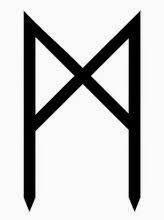
To find out what Odin had to tell me, I did the third Rune casting on Wednesday. My question for Odin was, “How do I learn to handle future conflicts.” Using the Six Rune Layout, I cast the same layout as the Five Rune one, and added, “Fresh Influences Affecting the Situation.” “Present” was Eihwaz, while “Past” was Berkano, “creating a new life.” “Help” was Kenaz, “insight and solutions,” while “Fate” was Mannaz.  The “Result” was Fehu, “wealth and good fortune”. Meanwhile, “Fresh Influences,” was Mehwaz, “change and adaptability.” Odin is telling me to use creative thinking and group support, and I would become wealthy in my relationships.
-------

The common theme in my Runes castings was Hagalaz, Eihwaz, and Mannaz. This crisis has caused me to assess my overall situation as a person with a brain injury. I need to be patient with myself and others. With the support of the group, I will be able to grow from this conflict, and handle other ones as well.

------------------
NOTE: A more experienced Rune caster noted the following "Well done, however, when trying to compare things (such as the advice you would receive from three different deities), it's best to change just one variable at a time. So, for example, you could try to see how different lay-outs would work on the same day for the same deity OR you could try to see how the same lay-out would work for different deities on  different days OR you could try to see how slight changes in the wording of your query change the outcome. As it was, you changed three variables (the days, the wording of the query, and the lay-outs), so now you do not accurately know which variable changed the outcome."

Wednesday, April 30, 2014

Divination: Norse Runes: Five Rune Layout

 Five Rune Layout          3
                                2    1    4
                                      5


To seek out Freya’s advice, I did the Five Rune cast on Monday. I asked, “What can I learn from this conflict.” The Five Rune Layout adds “Help” and “Fate” to the Three Rune Layout. The first Rune was Gebo, “gift,” the second Othila, “the ancestral legacy,” and the third Perthro, “luck.” “Help” was Hagalaz, while “Fate” was Nauthiz, “need, hardship.”

Looking at the layout, I see that this conflict is a gift. Help in the form of a crisis means that the group therapist can see how we fight and guide us through our conflict. Acknowledging our legacy means recognizing that we have injured brains, which greatly affects our perceptions. My fate was that I needed to experience this conflict to deal with my strong emotions. Perthro, Freya’s answer to me “dare the fight,” i.e. take the chance.

------------
To read the introduction to these divinations: Three Rune Layout


Monday, April 28, 2014

Divination: Norse Runes: Three Rune Layout

 Three Rune Layout:  1  2  3

To practice Rune casting, I used several Runic layouts – the three, five, and six tile ones. I did the readings in one week on particular days. (Saturday was the day of the Norns, Monday – Freya, and Wednesday - Odin.) Focusing on a single problem, I wanted to see if the answers from these various Gods would differ. I wanted advice on my conflict with another person in my therapy group for people with brain injuries.

The questions I asked for each casting focused on how I could handle this conflict and to learn from it. Processing strong emotions with an injured brain is difficult. I often find myself screaming and shaking at small irritating things, which is normal for people with brain injuries. In my therapy group, my goal is to learn how to deal with strong emotions in a constructive way.
 
To consult the three Norns, I did the Three Rune Layout on Saturday. I asked “What do I need to do to not react to this person’s provocation.” The first Rune, “The Root of the Problem,” was Hagalaz, meaning “chaos, crisis, and sudden change.” The second Rune, “the Present Situation,” was Eihwaz, “reassess the situation.” The last tile, “The Most Probable Outcome,” was Mannaz, “the support of the family.” The Norns were telling me to head off disaster by delaying my reaction, and to instead seek help from the group. By me asking for the group’s help, we could all learn about regulating strong emotions. 


Sunday, April 20, 2014

Book Review: Physical Therapy and Rehabilitation for Animals by Susan E. Davis


Susan Davis, a physical therapist for animals, wrote “Physical Therapy and Rehabilitation for Animals” for people whose pets are facing a health crisis. The author writes, “When faced with a particularly difficult challenge in life, I have always felt the best weapon of combat is knowledge. Along with that is keeping a positive attitude.” Whatever the diagnosis may be, the pet owner wants to understand how he or she can help the ailing animal. To achieve this end, Davis outlines various health problems that many animals can develop. After each ailment, she explains various therapy plans and solutions.

Although Davis focuses on dogs, she gives examples of her work with other animals – birds, reptiles, and assorted mammals. Her explanations tend to be technical but I feel that the book is helpful since many owners want to be as well informed as possible. Two things that the author repeatedly stresses is that aftercare for surgery is often neglected, and that a professional therapist is necessary for most treatment plans to be successful.

To see how useful this book can be, I spoke with a friend who rescues Welsh corgis. She has an elderly male who is arthritic, and a young male, who had knee surgery. Suggestions from this book helped my friend care for her dogs. My friend had a ramp put in to ease the climb up the stairs for both dogs. To support the neck of the arthritic dog, she used a round pillow. (This dog eventually died but his last days were spent in comfort.)

In several chapters, Davis discusses how an animal’s joints function, and how injuries occur. However, a lay person can grasp her technical presentations. Davis emphasizes that after knee surgery, physical therapy is needed. She stresses consulting a professional therapist for this, since someone without knowledge of how muscles work can cause further injury. This information spurred my friend to get physical therapy for the young male corgi.

In her book, Davis offers commonsense suggestions for pet owners in caring for their animals. Some of these activities, the owners can do themselves, while the others, they will need the help of the veterinary staff. Writing in mind for all animals, Davis helps to ease the concerns of their owners. I would recommend this book for people who love for animals, and want to enhance their lives.

PURCHASE THIS BOOK AT HER SITE: Physical Therapy and Rehabilitation for Animals

Saturday, April 12, 2014

Archeoastronomy: Inca Calendar

Though not a prehistoric society, the Inca Empire employed similar timekeeping methods and reasons for keeping a calendar. They established their calendar to maintain the welfare of their people. Furthermore, the Incas used their calendar to bind everyone together in their empire, by coordinating religious and agricultural activities from Cuzco, their capital. To keep social order, the Incas divided their cities into four quarters, with each quarter split into radical sections from a common center. The lines, called ceques, had sacred sites (huacas) along them to determine where the sun would be on a given day. Families were assigned to maintain the local huaca, to keep a sacred landscape for timekeeping.

One example of how the Incas kept time was detailed by the Spanish. They reported that overlooking Cuzco, in the northwest was a high mound called Cerro Picchu. On this hill were four marked pillars. When the sun went past the first pillar, it was time for farmers in the higher altitudes to prepare their fields. When the sun entered the two middle pillars, planting began in Cuzco. When the sun hit the middle of these two pillars, planting began in the valleys.

 The Incas also used the dark nebula constellations of the Milky Way to tell time. When the constellation Tinamou appeared, they knew to watch their crops since the tinamous (birds resembling a partridges) would come. When Toad appeared, the Incas held their religious rituals for rain, because toads brought the rainy season.

 In addition, the Incas constructed a lunar calendar to track their rituals. To keep this calendar in sync with the solar calendar, they tracked the sightings of the Pleiades. The first month began at the summer solstice, and featured the Great Feast of the Sun (Capac Inti-Rami). The following month was one of penance and fasting. In the third month, farmers harvested root crops and conducted ceremonies for growing corn. In the fourth month, farmers focused on their ripening crops. The fifth month honored the Inca Emperor at the Feast of the Incas. In the sixth month, the Incas harvested corn and gave thanks to their Gods. The seventh month was for the Inti-Raimi festival, when everyone had to go to Cuzco. The eighth month featured rituals for irrigation and water. In the ninth month, the Incas tilled their fields and sacrificed to all of their Gods for a successful growing season. The tenth month featured the Feast of the Moon. During this time, Cuzco was purified. The eleventh month was the dry season, when the Incas had ceremonies for rain. The last month was the Festival of the Dead.

 My theory of why the Incas developed their solar-lunar calendar was to ensure social order and the welfare of their people. Living in the mountains, the Incas had to pay close attention to their environment to stay alive. To feed and clothe their people, the Inca Empire structured their ritual activities around the growing and harvest seasons. Moreover, these religious rituals not only honored their Gods, but also focused on keeping the empire intact. Since the official timekeeping was done at Cuzco, everyone was conscious of the Empire in their lives.
---
Works Used:

Aveni, Anthony, “People and the Sky,” Thames & Hudson: N.Y, 2008.
Gazzo, Bridget and Sarah Cahalan, “The Ancient Future: Mesoamerican and Andean Timekeeping,” Dumbarton Oaks, 2014, http://www.doaks.org/library-archives/library/library-exhibitions/the-ancient-future-mesoamerican-and-andean-timekeeping, .
Jrcalhou, “The Inca Calendar,” WolfWikis NCSU, 2008, http://wikis.lib.ncsu.edu/index.php/The_Inca_Calendar, .
---, “Inca Calendar,” Peru Travel Diary, 2009, http://www.machupicchu-inca.com/inca-calendar.html, .
Magli, Giulio, “Mysteries and Discoveries of Archaeoastronomy,” Copernicus Books: N.Y., 2009.

Thursday, April 10, 2014

Archeoastronomy: Ancient Timekeeping

Timekeeping in prehistoric times focused on survival. To stay alive, well-fed and safe, people had to make sense of the various periodic clues in their environment. They developed calendars to time their activities to what was happening in their environment. From watching the seasons of the sun and the phases of the moon, people constructed a map of the cycles of nature. Other people used the changing stars of the night sky as well. For example, peoples of Australia watched for Arcturus, the star, to rise in the northeast sky, so that they could gather the wood-ant larva for food. Meanwhile, the !Kung of the arid Kalahari watched for the star Capella to rise in the evening sky for the advent of the rainy season.

 Calendars enabled people to focus on what they need to do to survive. In northern Maine, my family timed various chores by the calendar. March was sugaring season, when the stronger sun caused the sap to rise in trees. In April, people prepared for the ice to break on the Kennebec River to ship their lumber downstream. (This practice ended in the mid-1970s.) Then in June, berry picking season began for making jams and jellies for the coming winter. June was strawberries, July raspberries, August blueberries, and finally September blackberries. Then in September, we laid in logs for the woodstoves for heat during the winter.

Another part of human survival was conducting religious rites to ensure good relations with the Other Worldly Powers since the Gods were essential to their well-being. Calendars were used to keep these rites in sync with nature. For example, the Romans held Liberalia near the spring equinox to celebrate Liber, who governed plant fertility. When the pastures became green in April, the Romans asked the Pales to protect their livestock. The festival of Parilia (in honor of the Pales) was held to cleanse sheep before sending them out to graze.  During the dry hot days of August, the Volcanalia was held to pray to Vulcan, the God of Fire, to be merciful and quiet.
--

Works Used:
Adkins, Lesley and Roy Adkins, “Dictionary of Roman Religion,” Oxford University Press: N.Y., 1996.
Aveni, Anthony, “People and the Sky,” Thames & Hudson: N.Y, 2008.
Magli, Giulio, “Mysteries and Discoveries of Archaeoastronomy,” Copernicus Books: N.Y., 2009.

Friday, April 04, 2014

Bardic Magic: Awen Exchanged: Bardic Spirits

To speak to the Spirits of the Land, I went to the nearby railroad cut. On one side of the tracks was a small park and on the other side, a large park with a man-made lake. A pedestrian bridge crossed over the tracks to connect the two parks. Running through my neighborhood, the railroad is a constant presence in our lives. Meanwhile, the Land Spirits have accepted the railroad and often use it to connect with people. 

When I arrived at the small park, I asked to be received by the Spirits of the Land. While walking the path to the bridge, I gloried in the first day of Spring. It was a warm day, whispering of life ready to reappear. As I approached the bench by the bridge, a robin hopped out of the woods into the clearing. Cocking its head towards me, the bird trilled a melody. I was welcomed by the Spirits of the Land. 

While sitting at the bench, soaking up the warm sun, I waited for a spirit to speak to me. Then freight train rattled on through bringing with it, the Being of the Cut. Apparently this ancient Being enjoyed playing with the trains. The Being also like watching people crossing the bridge back and forth. 

The Being of the Cut first noticed people when they blasted into its hill many years ago. Curious, It approached the workers and were told that they were Irish. The workers regarded the Being as one of “Sidhe,” although It did not know what that meant. However, the Being did like that the workers always respectfully greeted It. Afterwards, the Being became more kindly disposed to people and their trains. 

The Being of the Cut told me that It knew me, and regarded me as an old friend. For many years, I would come in the Spring to look for the bluets, growing amongst the moss on the rocks at the cut. I also would search for the white and yellow violets later on. The Being enjoyed my delight at finding these little flowers. As the Being told me this, It settled around me like an old favorite blanket, cozy and warm.

 After a while, I asked for a token of our bond.  Confused, the Being said, “Are not the bluets and violets, which are soon to bloom, enough?” Embarrassed, I apologized for presuming too much. Sitting for a while longer, I wanted to make sure that the Being was not disappointed in me.

 Walking up the path to the road, I was surprised by a Promethea silk moth, a large black moth with gold-silver trim. The moth danced in front of me and showed off its gold-silver tips. Then a second one came and the two tangoed higher and higher up through the trees. I was witnessing a mating dance. Then one of the moths returned to rest on the ground, next to my feet. A few minutes later, the moth flew around me, glimmering in the sun. After that, it flew off to rest in the nearby leaf litter.

 I think that the Being wanted me to return and spend more time in its company. To the Being, I was a friend. We shared in the joy of the first day of Spring. Leaving, I felt whole, and eagerly awaited for the bluets to appear.

Wednesday, March 19, 2014

Norse Runes: Attunement


My sense of the Runes is that they tell a complete story of the Wyrd of the Well. My goal as a diviner is to uncover this story, and find meaning in it. I regard the Runic Aettir as chapters in this story, with the individual Runes as sentences. (For me in Runic divination, the questioner is a thread in the tapestry of the Wyrd.) I need to attune to the Runes to discover how the questioner’s thread fits into the overall Story.

 To prepare for the attunements, I decided that the time to do them was early in the morning. For me, the early morning is a liminal time, and my brain is fresh and open. Therefore, after my morning tea ritual, I would sit with the Runes.

For the attunement, I decided to do two Runes at a time. By learning in pairs, I could study them as a dyad. As I did, I would ask myself, “how do these Runes fit together.” I would contrast and compare each, as well.

 First, I would lay out the entire Rune set to see how the Story develops. Then, I would take the pair of the day, and ask that these Runes speak to me. As their pictures would form in my mind, I wrote down my insights. As each Rune developed into a full picture, I placed it in my memory palace.

For me, the meanings of the Runes lie on a continuum. I regard the meanings of each Rune to be fluid with a center, end, and beginning points. The center point is the “standard” agreed upon meaning. The “standard” meaning also governs the beginning and end points. As a diviner, I see shades of meaning from either side of “standard.” Therefore the Runic insights that I got were usually variations of this “standard.”
 An example of how this works for me is as follows. Hagalaz (“hail”), Nauthiz (“need”), Isa (“ice”), and Jera (“harvest”) can be viewed as one chapter of the Runic Story. These Runes can flow together to form a picture. Depicting disaster, Hagalaz is the hail pounding on the roof, causing the roof to cave in. After the roof falls in, the fire goes out in the home. Now the home owner has to make a “need” fire (Nauthiz) by rubbing two sticks together. While everyone, in the home, waits for the fire, they are “frozen,” much like the ice (Isa) that hangs from the eaves. When the warm weather comes, the ice melts, watering the fields. Jera is the field that becomes ready for “harvest.” Through these four Runes, the chapter of a cycle turning and a new one beginning is depicted.

 For me, an attunement is to go inside each Rune to hear the story that each tells. Then, the Runes become pictures or scenes, which resides in my memory palace. When I access them, the Runes flow from one to the next, each telling me what I need to know.

Saturday, March 08, 2014

Bardic Perspective: Awen Charted: Old Age

To reflect on Old Age, I went to a swampy area where three streams converge. On two sides of this area are woods, several houses on one side, and a road on another side. Crossing over the swamp was a bridge spanning the road and the houses on the hill. This is a liminal place for me for several reasons, such as the swamp is neither earth nor water. Moreover, the wild area lies between a road and houses, with the bridge connecting the two.

For me, noon represents mid-life followed by old age. After the noon hour comes the afternoon, the decline of the day. Since noon, for me, is a liminal time, I chose this time to start my meditation on Old Age.  

The day I went was a blustery winter day. The strong wind blew the dried leaves, which swirled around me, in small eddies. Meanwhile, the sparkling stream water, as it rippled over the tangled roots, reflected the weak winter sun. Seeing the dead leaves strewn about the bottoms of bare trees, I was reminded of Old Age. As the sharp wind knifed through me, it called to mind my own mortality. Moreover, I was off the beaten path, in a place of ancient decay, symbolic of Old Age. The active life, represented by the road and houses, was separated from me by this swamp.

 As I stared out at the swampy overgrown area, an ancient being of hoary old age popped out of the bog. This male being had an unkempt appearance with unruly white hair sticking out of his brows and ears. Sailing about on the wind, he played with the whirling leaves. Laughing, the being said to me, “Never be neat, clean, or civilized. Always be wild and unruly. Never be staid or docile.” As I listened, the being twinkled at me and danced off.

 As I was leaving, I felt the wildness of the swamp bubble up inside of me. Being old was a time to not to live up to anyone’s expectations, instead it was a time to be content with myself. The being’s advice had resided inside of me, and made me rethink growing old. I think I should go and play in the gusting wind with wild abandonment.

Sunday, March 02, 2014

Bardic Path Work: Awen Focus: Morning

Early each Sunday morning, I take my trash out to the dumpster near my building. Behind this dumpster is a large field bordered by woods. Beyond the woods are the railroad tracks of the Norfolk and Southern Railroad. Since everything seems so still at this time, I often go to the edge of the woods to listen to “morning.”

The Sunday, I focused on “Awen” was a winter day, devoid of greenery. I stood at the edge of the woods and awaited the day to begin, which out started grey and overcast. The sun was rising but the light was still low. First, I heard the “coo, coo, coo” of the mourning doves, who were resting in the maple trees. The red-bellied woodpecker, hopping along on a trunk of an oak tree, answered them with “Churrups, churrps.” A staccato rhythm continued with the doves and woodpecker calling and responding.

While that was going on, two Carolina wrens searched for food among the tangled basswood trees, hopping from limb to limb. Finally stopping, they began to trill loudly, “pidaro, pidaro, pidaro.” These small pugnacious birds provided the counterpoint to the doves and woodpecker. The rhythm of the bird calls became faster and faster, announcing “Morning is coming!”

 Then silence came abruptly over the field. Something unseen had passed through the woods. My grandmother referred to this phenomenon of noise then sudden silence as “an angel just walked by.” In the presence of the Sacred, we all became silent.

 After a brief while, the woodpecker quietly went “quir, quir”. Then, the two wrens answered, with “tweepudo dip dip dip.” Adding to their calls, the doves boomed “coo, coo, coo.” Again the rhythm of the doves calling and the other birds responding continued, as if nothing had happened. Once the sun became brighter, the birds stopped and went about their business. Morning had arrived.

Tuesday, February 25, 2014

Bardic Inspiration: Awen Defined: Winter trees

Since it was the middle of winter, I waited for a “January thaw day,” to listen to a tree. Behind my garden condo is a small stream with a grove of trees. My balcony faces an ancient twin oak in this grove. In fact, this oak’s branches extend to the roof of my building. I decided to listen to the twin oak, who has been my friend for many years. The oak is two males who often finish each other sentences. On this day, they were sleepy, having just woken up for the warm day.

Devoid of leaves, the oak’s branches swayed in the slight breeze. Nuthatches were searching for bugs on the trunk, while the titmice were flitting from branch to branch. A flock of geese flew overhead, honking a greeting to the tree. Sleepily, the twin oak acknowledged the geese’s calls.

A few days before a storm had blown through taking with it, the large squirrel nest from the main branches of the oak. Upset at this, the oak felt sad that the squirrels had to build a new home elsewhere. Since they were asleep at the time, the twin oak could not save the nest. Regarding themselves as a protector of life, they wanted the squirrels to feel secure with them.

As I sat with the twin oak, a squirrel jumped up on a branch near my balcony. The upset animal angrily “cheeed” at me, screaming that I was bothering the oak. Before the oak settled back down to their slumber, they said that the squirrels do like to guard them. This particular squirrel (Cut Ear) warned me not to disturb the tree again. I have no idea what this squirrel would do to me, but I certainly did not want to find out. So I went inside.

Monday, February 17, 2014

Divination: Norse Runes: Consecration Ritual write-up


 In order to consecrate my Rune set, I first researched how to conduct a Norse ritual. I also looked up what Gods governed the Runes and divination (in general). Afterwards, I wrote a simple ritual to ask the Gods to consecrate my Runes.

 To prepare for the ritual, I first took a bath. (As a Roman Pagan, I believe that ritual purity is important. For me, it is a part of showing piety to the Gods.) Then I cleansed the area where I would do the ritual. While preparing my ritual space, I laid out my divination cloth and Runes. Setting up an incense burner and lighting a candle, I then played several pieces of classical music to appease the Gods. (Roman Pagans play music to cover any imperfections during the ritual.)

 When I was finished setting up my sacred space, I hallowed the ritual space using the Hammer Sign. Calling on Thunor (Thor), the God of Thunder, I asked Him to protect the space for the duration of the ritual. Offering incense to Sibb (Sif), the Wife of Thunor, I asked Her to sanctify the space. (My relations with the Gods of the Runes are with the Anglo-Saxon Gods.)

 After doing that, I hailed the Anglo-Saxon Gods who govern the Runes and divination. They are Woden (Odin), who brought the Runes to the Worlds, Frige (Frigga), who read the Runes but kept her own counsel, and Freo (Freya), who is a Seidhkona (a Norse shaman). Freo is, also, noted for unraveling the Wyrd (fate) of people.

I regard the Norns (Fates) to be the most important for consecrating the Runes and for guiding their use in divination. These “Weavers of the Wyrd” are Urahr (what has become), Verdhandi (what is becoming), and Skuld (what shall be). For the Norse and Germanic peoples, They are the Weavers of our fates (Wyrd). To honor Them, I read a verse from the “Voluspa,” of the “Poetic Eddas.”

 Since for me, the Runes are drawn from the essence of all Nine Worlds, I, also, wanted to dedicate them to the Worlds. During the ritual, I hailed each of the Worlds and asked them to imbue their essence into my Runes. As I did, I could feel the energy of each world flow into my tiles.

 Then I consecrated each Rune, one by one. To do so, I first traced the Rune letter over each tile. As I chanting their name, I held each in the air to be blessed. After saying the meaning for each Rune, I asked that the Gods  that it would be “read right” and be worthy of the Well of the Wyrd (Fate).

 To finish the ritual, I bid farewell to each of the Gods. Then I asked Sibb and Thunor to return my ritual space back to ordinary use. Blowing out the candle, I ended the ritual and put everything away. While putting the Runes back into their bag, I could feel their renewed connection to the Well of the Wyrd.

This ritual can be found at : Runic Consecration Ritual

Sunday, February 16, 2014

Divination: Norse Runes: Consecration Ritual

Runic Consecration Ritual
1.      Hallow space with Hammer Sign +
“Hammer in the North, Hold and hallow this stead”
(Directions: east, south, west, above, and below)
Hail Thunor (Thor), the Thunderer, protect this space.
 --
2.      Cleanse space.
Hail Sibb (Sif), Wife of Thunor, may this space be sanctified.
Offer incense
 ---
3.      Greet the Gods and Others
Hail, Woden, the All Father!, May I honor your Gift and Sacrifice of the Runes
Hail Frige, Shining Lady of Asgard, May I show discernment in reading the Runes
Hail Freo (Freya), Shining Lady of the Vanir, May I be deft at understanding the Wyrd.

 Hail, Urdhr, Norn of What has become
Hail, Verdhandi, Norn of What is becoming
Hail, Skuld, Norn of What shall be.

“From there come the maidens
With knowledge of many things
Three from that sea,
Which stands beneath the tree;
One is called Urdhr,
The other Verdhandi,
They carved on sticks,
Skuld the third.
They laid down the law,
They choose the lives
Of the children of men,
The fates of men.”
Voluspa” Verse 20
---
4.      Consecrate the Runes by tracing a figure over them, and saying each out loud.
---
5. Working May these Runes draw from each of the Nine Worlds,
Midgard, the World of men,
Muspellheim, the World of raging fire, Niflheim, the World of freezing cold,
Asgard, the World of the Shining Ones, Vanaheim, the World of the Fertile Ones,
Jotunheim, the World of the Giants, Svartalfheim, the World of the Dark Elves, Ljossalfheim, the World of the Light Elves,
and Hel, the World of the Dead.

May these Runes be worthy of the Well of the Wyrd.
May these Runes read right!
 ----
6.      Open space to ordinary time and place
Hail and Farewell All!
Hail and Farewell, Woden, the Wise One
Hail and Farewell, Frige, the Frith Weaver
Hail and Farewell, Freo, the Seidhkona
Hail and Farewell the Norns, the Weavers of the Wyrd.

Hail and Farewell Sibb, Lady of the Golden Hair, may this space be ordinary
Hail and Farewell Thunor, Son of the Earth, may this space be ordinary
 --
Please note that I use the Anglo-Saxon names of the Gods since They are the Ones I am most familiar with.
 ---
Works Used:
Aswynn, Freya, “Northern Mysteries & Magick,” Llewellyn, Woodbury, MN, 1998.
Kaldera, Raven, “The Pathfinder’s Guide to the Nine Worlds,” Asphodel, Hubbardston, MA, 2007.
---, “Voluspo,” “The Poetic Edda,” Sacred Texts, http://www.sacred-texts.com/neu/poe/poe03.htm.
Krasskova, Galina, “Exploring the Northern Tradition,” New Page Press, Franklin Lakes, N.J., 2005.
Wild, Sean, “The Runes Workbook,” Thunder Bay, San Diego, CA, 2004.

Sunday, February 09, 2014

Mythical Animals: Simurgh (Simorgh) of Persia (Iran)


When I read translated excerpts of the Persian epic, “The Shahnameh (Shahnama): The Book of Kings,” by Abu’I-Qasim Firdawsi (Ferdowsi) (d. 1020-21), I encountered the mystical Simurgh (Simorgh). What drew me to this beast was that she had survived the destruction and rebirth of the world three times. I pondered what sort of wondrous beast could do this. In his writings, Joseph Nig, noted chronicler of mythical beasts, called this beast “the Wise Old Bird of the Ages.”

Described by the Persian as a beast of two natures (mammal and bird), the Simurgh was a devoted mother who both nurtured her young and several Kings of Persia. Mostly resembling an eagle, this beast also had the head of a dog, claws of a lion, and the tail of a peacock. In addition, her feathers had special healing properties.

From her perch on the Tree of Knowledge, the Simurgh would observe the affairs of humans in the world. Whenever she left the Tree, this beast would send out the seeds of goodness and wisdom. And when she landed back on the tree, the Simurgh would spread the seeds of life throughout the world.

Her ancient age and wisdom of being a mother, first attracted me to the Simurgh, since I was entering my “Cronehood.” My immediate impression of the Simurgh was of a wise old mother who cared for abandoned children and healed wounded people. Furthermore, she would guide people and teach them the ways of goodness. These aspects of the Simurgh helped me to settle into being a “Crone,” and accept my new role in life.

Later I read a translation of “The Parliament of Birds (Mantiq ut-Tayr)” by Farid ud-Din Attar (12th Century), a Persian Sufi poet. The focus of this mystical poem was the journey of several birds searching for the Simurgh, the Ruler of the Birds. As they travelled over seven valleys, some of the birds shed their undesirable qualities, while others went home. (These valleys were called “yearning,” “love,” “gnosis,” “detachment,” “unity of God,” “bewilderment,” and “selflessness and oblivion of God.”) Finally when they arrived at the place they believed that the Simurgh lived, only thirty birds remained. Now purified, these birds encountered the Divine in the being of the Simurgh. Afterwards, the birds realized that they were all the Simurgh, which also means (thirty (Si) birds (murgh)).

Ahmad Karimi-Hakkak (Professor at University of Maryland) writes that the birds were in the “all-embracing presence, a transcendent majesty speaking not just in silence but through silence.” He explains that “The Parliament of Birds,” expresses the heart of Sufism, when the individual merges into the “ocean of eternity,” the mystical ecstasy of the Divine. In this poem, the Simurgh becomes the catalyst for the transcendence of divinity.

For me, the Simurgh evolves from being a dispenser of wisdom to a being who sends life out into the world. Finally the Simurgh becomes the immutable essence of the Divine. As a Crone I would like to evolve like the Simurgh, though I could never be Divine. At the end of my days, I hope to be like the thirty birds. After the end of their mystic journey, they merged into the “ocean of eternity.” I hope to do the same after my journey to meet the Simurgh.
-----
Please note that since Iranian (Persian) does not have a Latin-based alphabet, I found several spellings for the same Iranian word. I used both the spellings used by Iranians and those more common to English speakers.

Works Used:

Allan, Tony, “The Mythic Bestiary,” Duncan Baird: London, 2008.

Karimi-Hakkak, Ahmad, “At the Sign of Simorgh: Mythical Birds and the Mystical Discourse in Persian Poetry,” Foundation for Iranian Studies, http://fis-iran.org/en/programs/noruzlectures/simorgh-hakkak,  2012.

Nigg, Joseph, “The Book of Dragons and Other Mythical Beasts,” Quarto: London, 2002.

---, “Simorgh, A Fabulous Mythological Bird,” “Tehran Times,” 27 June 2012, http://www.tehrantimes.com/highlights/99516-simorgh-a-fabulous-mythological-bird.

Vinao, Ezequiel, “El Simurgh for Piano and Electronics,” 1991-1992.

http://www.tloneditions.com/Ezequiel_Vinao_Simurgh_The_Conference_of_the_Birds.html

Zell-Ravenheart, Oberon and Ash DeKirk, “A Wizard’s Bestiary,” New Page Press: Franklin Lakes, NJ, 2007.