To understand dragons better, people have commonly divided them into
various families. As with scientific classification, organizing dragons
into groups gives folks a framework to learn about them. By studying
dragons in families, you can discern who are friendly and who are
dangerous. Since each family has their own unique talents, they can also
offer their matchless wisdom to seekers.
In Western Tradition, dragons are usually grouped into families by
the elements. I have used that system to construct my classifications of
dragons. Living in the East, the Dragons of the Air ride the winds.
Meanwhile, the Dragons of Fire reside in fire, and are of the South. In
the West, the Dragons of the Waters frolic in the waters. With the Air
Dragons and Ice Dragons, Water Dragons rule the weather, as well. Ruling
the Earth and guarding its treasures are the Dragons of the Earth, who
reside in the North. Because each dragon family governs a cardinal
direction, therefore in rituals a seeker can avoid the hostile ones and
ensure her safety.
In the World of the Dragons, there are three more families. These
groupings are from my own understanding of these Magnificent Beings.
World myths feature dragons who created and destroyed worlds. Since
these dragons have such a profound effect on the fabric of the Universe,
I refer to them as the Dragons of the Cosmos, who live in the Center.
Like many people, I was entranced by the “fire-lizards” in “The
Dragonriders of Pern” books by Anne McCaffrey. These small dragons liked
to sing and sit on people’s shoulders. Later, when reading D.J.
Conway’s books on dragons, I realized that the guardian dragons that she
talks about are the same as the “fire-lizards” of Pern. Moreover, I
have encountered these dragons whenever I go on wildflower walks,
especially in open meadows. I call them, the Dragons of the Fields.
These small playful dragons move along the East-West axis, and prefer
going from sunrise to sunset.
The last family of dragons, I encountered in ice storms and
blizzards. When I grew up in New England (US), I saw silver dragons
roaring about in the snow and ice. Since that time, I have noticed these
dragons flying about in massive blizzards. I call them, the Dragons of
the Ice. They prefer the colder darker areas of the world. Ice Dragons
traverse the North-South Axis, going from Pole to Pole.
Fire and Chaos Dragons are dangerous for different reasons.
Traditionally hostile to humans, Fire Dragons must be approached with
great care. Meanwhile, Chaos Dragons, who are a part of the universe’s
fabric, have intense unbounded energy. They can annihilate a careless
person.
Fortunately for us, the other dragon families are less formidable.
Ruling the weather together, Water and Air Dragons are both benign and
destructive. But they can be approached for soft breezes and gentle
rains. Guarding the Earth’s treasures, Earth Dragons kill first and ask
questions later. Nonetheless, their greatest treasure is their profound
wisdom. Rarely encountered by humans, Ice Dragons prefer the silence and
stillness of the Polar Regions. Their intense life force can warm the
coldest heart. On the other hand, the noisy Field Dragons love being
guardian dragons of humans.
This is a blog about nature in all her glory. The folklore and general ideas about what messages nature bring to people.
Tuesday, November 29, 2016
Monday, November 21, 2016
Tarot: Major Arcana: Astrology (2 of 2)
Mars
is force and energy that breaks through similar to The Tower. Jupiter, as the
planet of expansion and luck, is appropriate for The Wheel of Fortune.
Meanwhile, the principle energy of Uranus is liberation which matches The Fool.
Judgment and Pluto both focus on transformation.
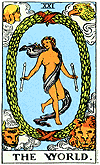
What
puzzled me the most was the connections of Cancer, the Crab to The Chariot,
Sagittarius, the Archer to Temperance, Neptune to The Hanged Man, and Saturn to
The World. As a reader, I need to know the reasons for these particular
couplings. Is there a hidden aspect to each card that these astrological
concepts focus on? Am I missing something? If so, what?
Cancer
knows where they are going and how to get there, which is appropriate for The
Chariot. However, Cancer changes moods like the wind. This points to any conflict
that needs to be examined while reading The Chariot. Also Cancer stabilizes The
Chariot since this Sign is selective in what it does.
Sagittarius
is restless and high spirited, lending movement to Temperance. The subtle
message is that Temperance should not be stagnant, but instead keep flowing.
Sagittarius gives the warning to the reader of the tendency of Temperance to remain
static.
Saturn
is the planet of limitation and fate. Paired with The World, it cautions the
reader to beware of wishful thinking. Saturn grounds The World from flights of
fancy. The World is to be earned, not handed to someone is something that the
reader should know.
This
leaves Neptune and The Hanged Man, both difficult to understand. Neptune is the
mystic, whose principle energy is transcendence. The Hanged Man is in limbo,
perhaps in a chrysalis much like the caterpillar becoming a butterfly. The two
are mystics, detached from the world. Therefore, Neptune reinforce the
otherworldliness of The Hanged Man.
Part One: tarot: major arcana and astrology
Thursday, November 17, 2016
Tarot: Major Arcana: Astrology (1 of 2)
Astrology and I have been at odds with each other for a very long time. I only study it to gain a deeper understanding of the various magical systems that incorporate astrology. Since the Tarot used today is based on concepts from the Golden Dawn, I need to know astrology for the deeper meanings.
Some
of the connections between the Zodiac Signs and the cards of the Major Arcana
make sense. Also, some planets do intuitively match certain cards. However in
other cases, I was baffled as to why the pairing. My knowledge of the more
arcane aspects of the Tarot is not as deep as I would want.
Aries,
the Ram matches well with The Emperor. They are both leaders with strong
masculine energies. Aries’ fire strengthens The Emperor’s authority. Meanwhile,
the fixed energy of Taurus, the Bull centers The Hierophant. Stubborn Taurus reinforces
traditionally-orientated Hierophant.
Virgo,
the Virgin reveals the introvert tendencies of The Hermit. Both reflect the
need for solitude for questioning minds. Meanwhile, Libra, the Scales seeks
balance as does Justice. Both stress tact and objective thinking.
Some
Signs associated with the Major Arcana are linked by animal symbolism. Since
the venomous scorpion kills, Scorpio, the Scorpion is coupled with Death.
Other Signs which represent animals associated with the Major Arcana are
Capricorn, the Goat and Leo, the Lion. Capricorn is paired with The Devil while
Leo with Strength. Goats are reputed to be stubborn reflecting the bondage
aspect of The Devil. Meanwhile, the lion is well-regarded for his strength.
In
regards to the planets, having the sun coupled with The Sun makes obvious
sense. Venus, the planet of harmony and love, matches the essence of The
Empress. Quicksilver Mercury embodies The Magician, who is an alchemist.
The
remaining parings required further investigation on my part. Because The Lovers
focus on two people and their choices, Gemini, the Twins seems to be the
logical choice. Reflecting The Lovers’ dilemma, Gemini are opposing twins. This
Sign indicates the pull on The Lovers to go into different directions as
individuals.
In
seeking future goals, Aquarius, the Water Bearer is guided by the stars. The
Star has elements of Aquarius in its essence. Meanwhile, Pisces, the Fish are
dreamers governed by the ebb and flow of life. The Moon, the card of dreams,
governs the tides, therefore the combination of Pisces and The Moon make sense.
I
did wonder why the moon was not paired with The Moon, and was instead paired
with The High Priestess. The clues for me is that both are feminine, receptive,
and imaginative. But neither dwells in illusions like Pisces and The Moon. The
moon of The High Priestess underlies her intuition.
Part Two: tarot: major arcana:astrology-2
Saturday, November 12, 2016
Animal Relationships: Predator and Prey
Read the rest at my blog at Witches and Pagans: Animal Wisdom.
Predator and Prey.
Thursday, November 03, 2016
Tarot of the Animal Lords: Mythic Images
The deck that I use is The Tarot of the Animal Lords. On the
surface, the deck seems only to be animals dressed up as various Tarot
characters. Looking deeper however, the reader will see that each animal is
connected to various myths. The associations are subtle and do require a
knowledge of animal lore.
For example, The Emperor features a lion with a golden eagle. The eagle, itself, is associated with the Roman emperors, who were the representatives of Jupiter, the Ruler of the Heavens. In Roman bird augury, the golden eagle represents the will of Jupiter. Using this train of logic, I associate The Emperor with Jupiter.
The Hierophant depicts the red deer as a priest. In Europe, this animal has religious associations. Cernunnos, God of the Celts, connected to the stage in rut, is the God of the Forest. Moreover, this Horned God is depicted on the Gundestrup Cauldron, itself a sacred artifact. The mythic association for The Hierophant then becomes Cernunnos.
The Hanged Man is a bat hanging upside down. Although he is not strictly a mythological character, I associate this card with The Batman. This character is suspended between being ordinary Bruce Wayne and the obsessed Batman. He can never completely be one being or the other, but neither is he both. The Batman is my mythological connection for The Hanged Man in this deck.
Death is represented by the raven. This corvid is associated with The Morrigan, the Dark Goddess of the Celts. She knows who will die in battle, and will tell them beforehand. Since The Morrigan is also the Goddess of Sovereignty, Her decision is always final. The sovereignty of Death leads me to The Morrigan.
The Devil is represented by the billy goat. I associate this animal with Inuus, Who is one of the aspects of Faunus, the Roman God of Fertility. Inuus is venerated at the Lupercalia in February. Young men would run through town whipping women, with straps made from goatskin. (This was to make women fertile.)
The Sun features two hares dancing in the sun. Ostara, the Anglo-Saxon Goddess of Spring, often had hares as her companions. A symbol of the reborn sun, the hare is the mythical association that I have with this card. Therefore the Goddess Ostara is The Sun in this deck.
The Tarot of the Animal Lords also have animals with mythic symbolism. The fox of The Magician does his magic on a toadstool, a traditional symbol of the fairy worlds. The Empress sits on a turtle shell throne, which symbolizes fertility. The Hierophant is accompanied by a stork, the Roman symbol of fidelity and piety.
Meanwhile, the mandarin ducks of The Lovers are the Chinese symbol for married love. In Death, the chameleon represents bad luck and misfortune as told in African myths. Moreover, the toad in The Devil is considered to be a familiar of wizards, and represents dark magic.
Further study of the folklore of animals will reveal more mythic symbols in this deck. I have only touched the surface of mythic associations for this particular Tarot deck. I have worked with The Tarot of the Animal Lords for ten years, and still find new mythic connections.
For example, The Emperor features a lion with a golden eagle. The eagle, itself, is associated with the Roman emperors, who were the representatives of Jupiter, the Ruler of the Heavens. In Roman bird augury, the golden eagle represents the will of Jupiter. Using this train of logic, I associate The Emperor with Jupiter.
The Hierophant depicts the red deer as a priest. In Europe, this animal has religious associations. Cernunnos, God of the Celts, connected to the stage in rut, is the God of the Forest. Moreover, this Horned God is depicted on the Gundestrup Cauldron, itself a sacred artifact. The mythic association for The Hierophant then becomes Cernunnos.
The Hanged Man is a bat hanging upside down. Although he is not strictly a mythological character, I associate this card with The Batman. This character is suspended between being ordinary Bruce Wayne and the obsessed Batman. He can never completely be one being or the other, but neither is he both. The Batman is my mythological connection for The Hanged Man in this deck.
Death is represented by the raven. This corvid is associated with The Morrigan, the Dark Goddess of the Celts. She knows who will die in battle, and will tell them beforehand. Since The Morrigan is also the Goddess of Sovereignty, Her decision is always final. The sovereignty of Death leads me to The Morrigan.
The Devil is represented by the billy goat. I associate this animal with Inuus, Who is one of the aspects of Faunus, the Roman God of Fertility. Inuus is venerated at the Lupercalia in February. Young men would run through town whipping women, with straps made from goatskin. (This was to make women fertile.)
The Sun features two hares dancing in the sun. Ostara, the Anglo-Saxon Goddess of Spring, often had hares as her companions. A symbol of the reborn sun, the hare is the mythical association that I have with this card. Therefore the Goddess Ostara is The Sun in this deck.
The Tarot of the Animal Lords also have animals with mythic symbolism. The fox of The Magician does his magic on a toadstool, a traditional symbol of the fairy worlds. The Empress sits on a turtle shell throne, which symbolizes fertility. The Hierophant is accompanied by a stork, the Roman symbol of fidelity and piety.
Meanwhile, the mandarin ducks of The Lovers are the Chinese symbol for married love. In Death, the chameleon represents bad luck and misfortune as told in African myths. Moreover, the toad in The Devil is considered to be a familiar of wizards, and represents dark magic.
Further study of the folklore of animals will reveal more mythic symbols in this deck. I have only touched the surface of mythic associations for this particular Tarot deck. I have worked with The Tarot of the Animal Lords for ten years, and still find new mythic connections.
Saturday, October 29, 2016
Each-Uisge (Water-Horse): Be Cautious, Be Aware
Throughout the lands surrounding the North Sea, stories abound of
dreaded lake monsters who lurk below the surface. These tales describe
many of the monsters as “water-horses.” This beast resembles a seal with
two sets of flippers, a long neck and a small head. People usually
divide “water-horses” into two types – the long-necked Nessie and the
maned Each-Uisge. While Nessie of Loch Ness is more benign, the
Each-Uisge, also of Scotland, is more sinister. Haunting lakes and
lochs, this shapeshifter kills and eats unwary humans (leaving only the
liver). The Each-Uisge usually lures people by pretending to be a docile
horse.
From ancient times, the Each-Uisge has filled people with dread and fear. The Picts depicted Him in all his ferocity their pictographs. The Romans recorded deadly sightings of this beast during their time in Britain. Described as a glistening black horse with a greenish patina, the Each-Uisge would appear on the roadside as a tame horse. Seeing relief, the weary traveler would mount Him, only to find themselves firmly affixed to the beast’s back. After that, the “horse” would quickly trot off. When the Each-Uisge smelled water nearby, He would race into the lake drowning the unfortunate victim.
One blood-curdling account tells the killing of several children by the Each-Uisge. This creature had appeared to several children as a pretty pony. As each child sat on his back, the “pony” would lengthen it to fit more children. When commanded by the Each-Uisge mount, a frightened boy ran away. As the boy escaped, he heard his friends scream as they were drowned in the lake. The next day, the sorrowful villagers only found the children’s livers floating in the water.
The Each-Uisge is called by many names throughout the North Sea region. In Norway, this beast is Backahasten or Nokken, the “brook-horse.” In The Faroes, He is known as Nukur, and Nuggle in the Orkeys. The Irish call Him, the Capall-uisce, and the Manx, the Cabbyl-Ushtey.
In Wales, the Each-Uisge is known as the Ceffyl Dwr. This small beautiful “horse” lived in mountain pools. Once someone mounted Him, the Ceffyl Dwr would fly over the water and, then melt into a mist. After the victim drops into the water, He would reform and eat the body. At other times, this beast would transform into a frog and leap on the victim’s back.
No one is quite sure what the Each-Uisge is. Is this creature, an undiscovered mammal such as a new species of otter or seal? Or are the stories too fantastic for an ordinary animal? Whatever the Each-Uisge is, everyone will agree that He is deadly and vicious.
The Each-Uisge is real to those who believe the old myths. Something lives in those lakes, pools, and lochs; Something that will kill and eat you. Ignore the myths at your own peril. Be cautious and aware that not everything you encounter is benign.
----
Note: The Kelpie is similar to the Each-Uisge, except that She dwells in rivers and waterfalls.
Drawing Copyrighted by Liza Phoenix (Own work), via Wikimedia Commons
From ancient times, the Each-Uisge has filled people with dread and fear. The Picts depicted Him in all his ferocity their pictographs. The Romans recorded deadly sightings of this beast during their time in Britain. Described as a glistening black horse with a greenish patina, the Each-Uisge would appear on the roadside as a tame horse. Seeing relief, the weary traveler would mount Him, only to find themselves firmly affixed to the beast’s back. After that, the “horse” would quickly trot off. When the Each-Uisge smelled water nearby, He would race into the lake drowning the unfortunate victim.
One blood-curdling account tells the killing of several children by the Each-Uisge. This creature had appeared to several children as a pretty pony. As each child sat on his back, the “pony” would lengthen it to fit more children. When commanded by the Each-Uisge mount, a frightened boy ran away. As the boy escaped, he heard his friends scream as they were drowned in the lake. The next day, the sorrowful villagers only found the children’s livers floating in the water.
The Each-Uisge is called by many names throughout the North Sea region. In Norway, this beast is Backahasten or Nokken, the “brook-horse.” In The Faroes, He is known as Nukur, and Nuggle in the Orkeys. The Irish call Him, the Capall-uisce, and the Manx, the Cabbyl-Ushtey.
In Wales, the Each-Uisge is known as the Ceffyl Dwr. This small beautiful “horse” lived in mountain pools. Once someone mounted Him, the Ceffyl Dwr would fly over the water and, then melt into a mist. After the victim drops into the water, He would reform and eat the body. At other times, this beast would transform into a frog and leap on the victim’s back.
No one is quite sure what the Each-Uisge is. Is this creature, an undiscovered mammal such as a new species of otter or seal? Or are the stories too fantastic for an ordinary animal? Whatever the Each-Uisge is, everyone will agree that He is deadly and vicious.
The Each-Uisge is real to those who believe the old myths. Something lives in those lakes, pools, and lochs; Something that will kill and eat you. Ignore the myths at your own peril. Be cautious and aware that not everything you encounter is benign.
----
Note: The Kelpie is similar to the Each-Uisge, except that She dwells in rivers and waterfalls.
Drawing Copyrighted by Liza Phoenix (Own work), via Wikimedia Commons
Friday, October 21, 2016
Tarot of the Animal Lords: Major Arcana: Justice, The Hanged Man, and Death
Justice
is a barn owl who stands on the edge of a mountain cliff. She holds the scales
and sword of Justice. However, this owl cannot go backwards because of the
massive tree behind her. One misstep forward, she falls to her doom. High in
the mountains, the owl stands keeping her balance. Like Justice, she has to weigh
both sides carefully or risk disaster. (Barn owls are traditionally found in
church and grave yards. This explains the artist’s choice for Justice, for me.)
The
Hanged Man presents a bat hanging between two trees under a full moon.
Underneath him is a small pool of water that mirrors his face. Around the pool
are night lilies, and two rats with their paws on skulls. Since bats sleep
upside down and during the day, this bat is perfectly content to wait
patiently. However, the rats seem to indicate a sense of impending death. I
wonder if the scene is depicting the feeling of peace just before dying. This
card is both disturbing and serene at the same time for me.
This leads to the next card, which
is Death. At the front of a cave
littered with bones and weapons stands a raven with a scythe. He has his hand
on a crowned skeleton. Behind him is a misty swamp. The only way out is to
cross the river in front. Meanwhile, a chameleon stands in from of the raven.
In African legend, this lizard is a sign of death and misfortune. The two animals
together give a sense of doom. There seems a sense of finality to the card.
Other entries in this series:
Thursday, October 20, 2016
Tarot of the Animal Lords: Strength, The Hermit, and The Wheel of Fortune
The Tarot deck that I use is The Tarot of the Animal Lords. Although
Strength is XI and Justice is
VIII in this deck, I switched them.
The switch now has Justice as the middle card of the Major Arcana. Justice then
becomes the “balancer” of the Major Arcana.
Strength
depicts a mongoose wrestling with a cobra. While that is happening, the earth
is opening up under them and volcanoes are erupting behind them. The scene is
enveloped in smoke and ash. I can almost smell the sulfur spewing out of the
earth. In front of the battling pair, are two salamanders, who are facing in opposite
directions. I feel the immediacy that someone has to decide quickly to flee or
be killed. However, the two center characters are frozen in the moment of the
chaos. Does that mean that Strength can be either the calm focus or the frozen
stance? Is the downside of Strength to be locked in a struggle oblivious to
what is going on?
The Hermit presents a black bear entering a dark cave. His lamp barely
pierces the blackness. This bear carries keys and scrolls with him. This made
me wonder if he hoped to find a treasure chest. Behind him in broad daylight is
a peaceful countryside. Right above him, dripping in honey is a beehive. I
think that the Hermit is leaving the sweetness of the known life for an unknown
future. This card elicits a feeling of answering a sacred call, of going deeper
into the Divine.
The Wheel (of Fortune) telescopes the concept to a circular tree
branch and the life cycle of the butterfly. The adult butterfly lays her eggs
on a leaf that hatches into the various stages of caterpillars until finally the
juvenile butterfly becomes the adult. And the cycle continues. To emphasize The
Wheel’s motion, the wind blows in a circle high up in the mountains. The dominant
theme of this card is a circle, going round and round. I get dizzy just looking
at The Wheel. This Wheel focuses on the cycles of life that we all experience
repeatedly at different points in our lives.
Monday, October 17, 2016
Griffin: Majesty and Nobility
The Griffin (Gryphon) has had a long association with humans. For
example, She is a part of people’s last names and featured in their
coats of arms. Since the time of Sumner, the Griffin has stood for
majesty and nobility.
Various myths depict the Griffin as the combination of the lion and the eagle. Since both of these earthy animals are monarchs of their own domains, the Griffin is considered the Ruler of Heaven and Earth. This mythic animal, with her offspring Hippogriff, are the only members of the Tribes of the Cosmos. While the Griffin protects the Tree of Life with its Golden Apples, the Hippogriff carries the worthy traveler between the worlds. Because of this, the Griffin is also the Sentinel of the Throne of Heaven and Earth.
Archeologists have uncovered representations of the Griffin from Egypt, Persia, and the Middle East. She attended the Pharaoh and guarded the Persian Emperors. From ancient times, the Griffin represented earthy and heavenly power, for She guarded the royal graves. For the Greeks, the Griffin was called “The Hound of Zeus.”
According to the ancient Greek historian, Herodotus, Griffins were native to Scythia (central Eurasia). Living in the northernmost part of the known world, these mythic animals guarded their gold from humans. Later, other writers said that Griffins lived high in the mountains of India. In their aeries, these mythic animals guarded emeralds and other treasures from those who would steal from them. Flavius Philostratus said that in India, Griffins were sacred to the sun.
The dual nature of the Griffin led Medieval Christians to associate Her with Christ. The eagle reflected the divinity of Christ, while the lion, His humanity. St. Isidore noted, “Christ is Lion because He reigns and has strength; Eagle, because after the Resurrection, He rises into Heaven.” Because of this, the Griffin is often featured in cathedral windows and carvings.
The legends say that the Griffin also guards the Holy Grail of Christ. (The Grail is carved from a single emerald.) Many Knights of the Round Table have searched for the holy artifact, but usually gave up after a futile search. Only the pure of heart was allowed to find the Grail. The Griffin killed everyone else who persisted, as She did all those who would steal from Her.
As the Monarch of the Heavens and the Earth, the Griffin teaches nobility and majesty. This fierce and intelligent animal, subject of many legends, watches intently over her domains. Protecting the Tree of Life, She ensures that only the pure of heart can receive its blessings. With her power comes her responsibility to use it wisely. Remember that this is a part of nobility. Follow Her example in what you do as you lead others.
Various myths depict the Griffin as the combination of the lion and the eagle. Since both of these earthy animals are monarchs of their own domains, the Griffin is considered the Ruler of Heaven and Earth. This mythic animal, with her offspring Hippogriff, are the only members of the Tribes of the Cosmos. While the Griffin protects the Tree of Life with its Golden Apples, the Hippogriff carries the worthy traveler between the worlds. Because of this, the Griffin is also the Sentinel of the Throne of Heaven and Earth.
Archeologists have uncovered representations of the Griffin from Egypt, Persia, and the Middle East. She attended the Pharaoh and guarded the Persian Emperors. From ancient times, the Griffin represented earthy and heavenly power, for She guarded the royal graves. For the Greeks, the Griffin was called “The Hound of Zeus.”
According to the ancient Greek historian, Herodotus, Griffins were native to Scythia (central Eurasia). Living in the northernmost part of the known world, these mythic animals guarded their gold from humans. Later, other writers said that Griffins lived high in the mountains of India. In their aeries, these mythic animals guarded emeralds and other treasures from those who would steal from them. Flavius Philostratus said that in India, Griffins were sacred to the sun.
The dual nature of the Griffin led Medieval Christians to associate Her with Christ. The eagle reflected the divinity of Christ, while the lion, His humanity. St. Isidore noted, “Christ is Lion because He reigns and has strength; Eagle, because after the Resurrection, He rises into Heaven.” Because of this, the Griffin is often featured in cathedral windows and carvings.
The legends say that the Griffin also guards the Holy Grail of Christ. (The Grail is carved from a single emerald.) Many Knights of the Round Table have searched for the holy artifact, but usually gave up after a futile search. Only the pure of heart was allowed to find the Grail. The Griffin killed everyone else who persisted, as She did all those who would steal from Her.
As the Monarch of the Heavens and the Earth, the Griffin teaches nobility and majesty. This fierce and intelligent animal, subject of many legends, watches intently over her domains. Protecting the Tree of Life, She ensures that only the pure of heart can receive its blessings. With her power comes her responsibility to use it wisely. Remember that this is a part of nobility. Follow Her example in what you do as you lead others.
Friday, October 07, 2016
Tarot: Hanged Man, The Tower, and The Devil and me
My current life can be expressed in three cards. The Tower is a visual display
of what happened to me. I was not hit by lightening but a wall literally fell
on me. In an instance like The Tower, my life was changed completely.
My
brain injury, itself, is The Devil, since it limits me in what I can do. It
inhibits me from living freely, since I have to choose and weight the
consequences of doing an activity. If I go to a party, I will become
overstimulated by the people, noise, and disruption to my daily routine. This
means two days after the party of not leaving my house and living in darkened
rooms. In response, I employ creative problem-solving to deal with each
challenge as it presents itself.
The
card that reflects me now is The Hanged Man. Now upside down in my life, I have
a different perspective on life. After nearly dying and then coming back to
life, I live between two worlds. For me, life becomes a paradox as I navigate
in a new world. For these reasons, I see my life with ebbs and flows instead of
a Hero’s Journey.
Thursday, October 06, 2016
Lake Monsters: Expect the Unexpected
Throughout the world, mysterious “monsters” are often sighted in deep water lakes. Known as “Lake Monsters,” these freshwater beasts both frighten and intrigue people. Nessie of Loch Ness is the most famous representative of these animals.
Worldwide, there are about 1,000 lakes where Lake Monsters are often seen. Most of these lakes lie in the Northern Hemisphere ranging from the northern boreal forests to the southern hardwood forests. In contrast, sightings in the Southern Hemisphere have only been in Argentina and Bolivia.
Cryptozoologists have classifications for Lake Monsters, which they consider to be undiscovered or unknown animals. The most prevalent species of Lake Monsters is the “water horse.” Nessie is a typical long-necked water horse. This type has a small head on a long neck, with a rounded body and two sets of flippers. The water-kelpie (Each-Uisge) who drowns people is an example of a maned water horse. Other famous water horses include Champie of Lake Champlain (US), Ogopogo of Lake Okanagan (CA) and Storsie (Storsjoodjuret) of Storsjon Lake (SD). Rarer species of Lake Monsters include the giant beaver of Utah, the giant shark seen in Alaska, the giant turtle of Vietnam, and the mystery dinosaur seen in China. No one is sure what They are but scientists keep investigating to determine whether They exist or are only a myth.
Often sighted but never found, Lake Monsters exist just beyond human science. Various theories as to what They are range from prehistoric plesiosaurs to primitive whales. These beasts could be new species, unknown species, or simply mutated animals. Nobody knows for sure.
Whatever Lake Monsters are, They inspire fear and curiosity in people. Fear because of They attack and drown people. Many are vicious monsters who attack unsuspecting victims in the water. Curiosity since people want to know more about Lake Monsters. These elusive beasts pop up when people least expect them. Before anyone can react, these mysterious animals disappear from sight. Learn to expect the unexpected teach Lake Monsters. Just remember to be on guard lest They attack you.
Worldwide, there are about 1,000 lakes where Lake Monsters are often seen. Most of these lakes lie in the Northern Hemisphere ranging from the northern boreal forests to the southern hardwood forests. In contrast, sightings in the Southern Hemisphere have only been in Argentina and Bolivia.
Cryptozoologists have classifications for Lake Monsters, which they consider to be undiscovered or unknown animals. The most prevalent species of Lake Monsters is the “water horse.” Nessie is a typical long-necked water horse. This type has a small head on a long neck, with a rounded body and two sets of flippers. The water-kelpie (Each-Uisge) who drowns people is an example of a maned water horse. Other famous water horses include Champie of Lake Champlain (US), Ogopogo of Lake Okanagan (CA) and Storsie (Storsjoodjuret) of Storsjon Lake (SD). Rarer species of Lake Monsters include the giant beaver of Utah, the giant shark seen in Alaska, the giant turtle of Vietnam, and the mystery dinosaur seen in China. No one is sure what They are but scientists keep investigating to determine whether They exist or are only a myth.
Often sighted but never found, Lake Monsters exist just beyond human science. Various theories as to what They are range from prehistoric plesiosaurs to primitive whales. These beasts could be new species, unknown species, or simply mutated animals. Nobody knows for sure.
Whatever Lake Monsters are, They inspire fear and curiosity in people. Fear because of They attack and drown people. Many are vicious monsters who attack unsuspecting victims in the water. Curiosity since people want to know more about Lake Monsters. These elusive beasts pop up when people least expect them. Before anyone can react, these mysterious animals disappear from sight. Learn to expect the unexpected teach Lake Monsters. Just remember to be on guard lest They attack you.
Labels:
cryptozoology,
lake,
Loch Ness,
monster,
Nessie
Friday, September 30, 2016
Mythic Animals: Magic
What is a mythic animal? Traditionally considered a product of
people’s imaginations, they are animals that do not exist on the
physical plane. In fact, many mythical animals are a combination of
several real animals. (They usually have the characteristics of both
animals.) But mythic animals are real to those who dream.
Mythic animals live on the edges of our minds. Moreover, they live in our world, in places where everything is a little wild and primitive. Furthermore, we may encounter them, when we least expect it. For example, on a foggy day or a moonlit night, you may glimpse one. I have seen dragons sunning themselves on mountains as I traveled a busy highway. Dragons have also appeared briefly in raging snowstorms in my local area.
The edges of cultivated areas and wild areas are the best places to encounter mythic animals. Since they are “between places,” these border areas have great power and mystery. At marshes and beaches, encounters with water beasties will often occur. Also, you can come upon mythic animals in deserts or deep in the forests, where things are lonely and wild.
Mythic animals come from many places. To ancient peoples, they were the forces of nature, in all her aspects. For example, thunderbirds governed the weather. Later travelers returning from faraway places told of the exotic creatures they saw. Romans reported on dragons that lived in Joppa in the Middle East. In the Middle Ages, people reported on their encounters with local dragons and other animals. They listed them in their bestiaries, describing each animal.
When people started measuring and examining the natural world, they lost their ability to see any mythic animals. At the same time, all the mythic animals seemingly disappeared. In modern times, people usually seek rational explanations for every phenomenon that they witness.
However, the mythical beasts never really went away. Some people believed that they could still see them. The mythic imaginations of these folks led scholars to continue collecting tales of griffins and others. Today, more people have been able to see more of the mythic animals.
In her book, The Great Work, Tiffany Lazic writes that “mythical beasts guide us in our quest to find the synthesis between our inner and outer worlds.” She sees their uses in heraldry, such as the griffin, connects people to the past and to the future. Because mythic animals are both products of the human imagination and composite of actual animals, Lazic believes they are excellent helpers for integration work.
How do we begin the search for the Mythic Ones? What do the mythic stories, from around the world, have in common? What is the true treasure that the Mythic Ones hold? Does it differ from mythic animal to mythic animal? How can we deepen our relations with the ones, who are friendly to humans? Are there any that we should avoid? Study the myths of the world for the answers.
One example would be the griffin (half-lion and half-eagle). Often used as a last name, this mythic animal is also featured on people’s coats of arms. Lions and eagles both represent royalty. Moreover, the eagle is the Ruler of the Skies, and the lion, Ruler of the Land. Mythology has the griffin protecting and governing both realms. Given the griffin’s exalted status, only the most noble and courageous of people could approach him.
Once we know who are friendly to humans, such as fu dogs, we can begin to approach them. When we do that, we widen our realm of possibilities and develop a new sense of worth. Our relations with them will nurture our hopes and dreams, as well as, give us a greater reverence for all life. When we embrace their energy, we become conscious of the mystical in our lives. Finally, we align ourselves with the mythical world. We bring magic back into our lives.
Mythic animals live on the edges of our minds. Moreover, they live in our world, in places where everything is a little wild and primitive. Furthermore, we may encounter them, when we least expect it. For example, on a foggy day or a moonlit night, you may glimpse one. I have seen dragons sunning themselves on mountains as I traveled a busy highway. Dragons have also appeared briefly in raging snowstorms in my local area.
The edges of cultivated areas and wild areas are the best places to encounter mythic animals. Since they are “between places,” these border areas have great power and mystery. At marshes and beaches, encounters with water beasties will often occur. Also, you can come upon mythic animals in deserts or deep in the forests, where things are lonely and wild.
Mythic animals come from many places. To ancient peoples, they were the forces of nature, in all her aspects. For example, thunderbirds governed the weather. Later travelers returning from faraway places told of the exotic creatures they saw. Romans reported on dragons that lived in Joppa in the Middle East. In the Middle Ages, people reported on their encounters with local dragons and other animals. They listed them in their bestiaries, describing each animal.
When people started measuring and examining the natural world, they lost their ability to see any mythic animals. At the same time, all the mythic animals seemingly disappeared. In modern times, people usually seek rational explanations for every phenomenon that they witness.
However, the mythical beasts never really went away. Some people believed that they could still see them. The mythic imaginations of these folks led scholars to continue collecting tales of griffins and others. Today, more people have been able to see more of the mythic animals.
In her book, The Great Work, Tiffany Lazic writes that “mythical beasts guide us in our quest to find the synthesis between our inner and outer worlds.” She sees their uses in heraldry, such as the griffin, connects people to the past and to the future. Because mythic animals are both products of the human imagination and composite of actual animals, Lazic believes they are excellent helpers for integration work.
How do we begin the search for the Mythic Ones? What do the mythic stories, from around the world, have in common? What is the true treasure that the Mythic Ones hold? Does it differ from mythic animal to mythic animal? How can we deepen our relations with the ones, who are friendly to humans? Are there any that we should avoid? Study the myths of the world for the answers.
One example would be the griffin (half-lion and half-eagle). Often used as a last name, this mythic animal is also featured on people’s coats of arms. Lions and eagles both represent royalty. Moreover, the eagle is the Ruler of the Skies, and the lion, Ruler of the Land. Mythology has the griffin protecting and governing both realms. Given the griffin’s exalted status, only the most noble and courageous of people could approach him.
Once we know who are friendly to humans, such as fu dogs, we can begin to approach them. When we do that, we widen our realm of possibilities and develop a new sense of worth. Our relations with them will nurture our hopes and dreams, as well as, give us a greater reverence for all life. When we embrace their energy, we become conscious of the mystical in our lives. Finally, we align ourselves with the mythical world. We bring magic back into our lives.
Labels:
dragon,
griffin,
magic,
mythical animals,
myths
Thursday, September 22, 2016
Tarot: Who Am I in the Cards
I took one of those quizzes about "who are you in the cards?"
I took the quiz to find what member of the Tarot Court that I am. The quiz
itself is based on the Myers-Briggs Type Indicator (MBTI), which is said to
show how people perceive the world and operate in it. Personally, I have
problems with the MBTI because it divides people into four groups of four. As
someone who is familiar with statistics, I find the MBTI methodology suspect. I
regard MBTI as something that either you believe in the results or you do not.
The
questions that this quiz asked assumes that the person who takes it is
neuro-typical with a fully functioning brain. They also have a normal
perception of life and not a distorted one. These people can choose whatever
they will whenever they want. Since everything I do costs brain function, I
have to choose what favorite activity that I can do. Also, since my visual
perception has been damaged from my injury, I see the world literally
differently from most people.
The
quiz came up with two cards for me – the Queen of Pentacles and the Knight of
Pentacles. I think that this reflects the divide between my injury and my
desires. The Knight is reliable and trustworthy but prosaic, while The Queen is
creative and mature. This reflects both my unpredictable brain and my creative
problem solving.
Friday, September 16, 2016
Animal Relationships: Introduction
To know their animal teachers more fully, people should study how
these animals relate to other animals. All animals live in ecological
systems where they have a role. Some are keystone species such as the
alligator, who makes “gator holes” that provides food and homes for the
other animals. Other animals contribute positively to the places that
they live in. Stag beetles eat dead trees to make soil. “Negative”
animals such as leeches have a role, too. They kill their host and help
to keep the animal population in balance.
Some animals ignore each other, while others compete for the same food. More importantly, many animals form special relationships. Some are allies, and still others are in predator-prey relationships. The wolf and coyote compete for beaver, while the ratel (honey badger) and honeyguide look for bees together. The plover picks off leeches from a crocodile’s gums. (The plover gets a meal, and the crocodile gets her gums cleaned.) The great white shark pursues the elephant seal but is prey to the orca. Animal relationships are indeed complex and varied.
Read more at Witches and Pagans: animal wisdom: animal relationships: introduction
Some animals ignore each other, while others compete for the same food. More importantly, many animals form special relationships. Some are allies, and still others are in predator-prey relationships. The wolf and coyote compete for beaver, while the ratel (honey badger) and honeyguide look for bees together. The plover picks off leeches from a crocodile’s gums. (The plover gets a meal, and the crocodile gets her gums cleaned.) The great white shark pursues the elephant seal but is prey to the orca. Animal relationships are indeed complex and varied.
Read more at Witches and Pagans: animal wisdom: animal relationships: introduction
Saturday, September 10, 2016
Tarot of the Animal Lords: Hero's Journey (2)
Laying out The Tarot of the Animal Lords
to follow the Hero’s Journey requires a deeper knowledge of animals. Each card in
this deck reflects either the natural history or the folkloric history of various
animals. Some animals are an obvious selection for their card such as the fox
for The Magician, the lion for The Emperor, the raven for Death, and the male
goat for The Devil.
However
to understand the other animals which are representing themes in the Major
Arcana requires knowledge of their natural history. For example, The Fool is an
European Badger setting out on his own. European badgers live in societies of
setts, which are towns constructed of burrows. Some setts are over three
hundred years old, with generations of European badgers inhabiting them. A lone
European badger going out on his own would be a fool. (In contrast, American
badgers, a separate species, usually live by themselves.)
Featuring
a flamingo for Temperance is another example. These birds live in the hot salt
flats of Africa and eat brine shrimp. This gives them their bright pink color. If
they are too pink or too white, this means that the flamingo is nutritionally
out of balance, and will need to change their diet.
To
understand other animals featured in this deck’s cards for the Major Arcana
requires knowledge of their folklore. For example, The Moon features an owl and
a cat, reminding the reader of the children’s poem, The Owl and the Pussycat, by Edward Lear. In that poem, these two
animals go out to gaze at the moon and the stars in wonder. Meanwhile, The
Lovers depict two mandarin ducks. In China, these ducks are believed to be
lifelong mates. They use mandarin ducks in their wedding decorations to
symbolize fidelity.
Each
animal that is chosen for their particular card enhances the meaning of the
Hero’s Journey for me. At first glance, each selection may seem a bit opaque
but within each card are clues to explore further. The reader can ponder each
card’s meaning further through that particular animal.
------
For more information on the Hero's Journey: Tarot: Patterns of the Major Arcana, "The Hero's Journey," and Others
Thursday, September 01, 2016
BLACK BASS FAMILY: Passion
The Black Bass Family, a family of freshwater fish in the Sunfish
Family, is well known in sport fishing for being strong explosive
fighters. This Fish Family of North America are called the Micropterus (incertae sedis)
to differentiate this Family from other fish called “Bass.” Fish in
Black Bass Family include Largemouth and Smallmouth Bass, who are
popular with anglers. Since They come in various shades of green, grey
and black, most people identify the different Members in this Family by
their jaws.
Preferring clear, clean waters, Black Bass Male usually nests in gravelly bottoms. He builds a small round “bed” and then chases after Female Black Bass, when She enters his territory. After an intense mating dance, She lays her eggs and leaves. A diligent Father, Black Bass keeps his Fry (Baby Fish) safe until They are ready to leave the nest. He constantly patrols the area guarding against anyone who would attempt eat his Fry.
Black Bass use their keen senses to hunt their prey. Their inner ears can pick up the click of the claws of a crayfish walking on pebbles. With their lateral line (a row of sensory pores that extend from their gills to their tail), Black Bass can sense vibrations in the water. Added to that is their excellent eyesight which includes seeing colors.
As an apex predator, Black Bass will eat small alligators, birds, and mammals. This wily Fish will seek out the deepest parts of a pond. Waiting patiently, He will suddenly explode into action gobbling up the unwary Duckling paddling by. Highly adaptable, Black Bass can adjust his feeding habits to wherever He lives. His popularity in sport fishing has made Black Bass a sought after fish. Because of this, He has been introduced to many places outside of North America such as Fiji and South Africa. But his voracious appetite has decimated native populations of Fish. Japan, for example, considers Black Bass to be an invasive Fish.
Black Bass are some of the scrappiest Fish that swim. Catch one, and He will fight you with wild airborne leaps and jolting strikes. “Inch for inch and pound for pound, the gamest fish that swims,” 19th Century sportsmen entered in their journals. Even today anglers feel passionate about Black Bass. Because of their high stamina and great speed, these Fish can break fishing lines and snap poles. Leaping into the air, Black Bass will throw off the lure. In cunning and skill, Black Bass will match anything that an angler can think up to try to catch Him. (Black Bass are the original Pokemon.)
Passion is what Black Bass teaches people. Exuberance for life is why these Fish are top predators. Passion is how They mate and protect their Fry. Devotion is why anglers seek to match wits with Black Bass. However, Black Bass can also warn of prolonged volatility in your life, swinging between nothingness and frenzy. Remember moderation in what you do.
Note:
Many fish are called “Bass.” The temperate bass belong to the family Moronidae and the Asian sea bass to the family Lateolabracidae. Black sea bass are members of the sea grouper family (Serranidae). The giant sea bass belongs to the wreckfish family (Polyprionidae).
Preferring clear, clean waters, Black Bass Male usually nests in gravelly bottoms. He builds a small round “bed” and then chases after Female Black Bass, when She enters his territory. After an intense mating dance, She lays her eggs and leaves. A diligent Father, Black Bass keeps his Fry (Baby Fish) safe until They are ready to leave the nest. He constantly patrols the area guarding against anyone who would attempt eat his Fry.
Black Bass use their keen senses to hunt their prey. Their inner ears can pick up the click of the claws of a crayfish walking on pebbles. With their lateral line (a row of sensory pores that extend from their gills to their tail), Black Bass can sense vibrations in the water. Added to that is their excellent eyesight which includes seeing colors.
As an apex predator, Black Bass will eat small alligators, birds, and mammals. This wily Fish will seek out the deepest parts of a pond. Waiting patiently, He will suddenly explode into action gobbling up the unwary Duckling paddling by. Highly adaptable, Black Bass can adjust his feeding habits to wherever He lives. His popularity in sport fishing has made Black Bass a sought after fish. Because of this, He has been introduced to many places outside of North America such as Fiji and South Africa. But his voracious appetite has decimated native populations of Fish. Japan, for example, considers Black Bass to be an invasive Fish.
Black Bass are some of the scrappiest Fish that swim. Catch one, and He will fight you with wild airborne leaps and jolting strikes. “Inch for inch and pound for pound, the gamest fish that swims,” 19th Century sportsmen entered in their journals. Even today anglers feel passionate about Black Bass. Because of their high stamina and great speed, these Fish can break fishing lines and snap poles. Leaping into the air, Black Bass will throw off the lure. In cunning and skill, Black Bass will match anything that an angler can think up to try to catch Him. (Black Bass are the original Pokemon.)
Passion is what Black Bass teaches people. Exuberance for life is why these Fish are top predators. Passion is how They mate and protect their Fry. Devotion is why anglers seek to match wits with Black Bass. However, Black Bass can also warn of prolonged volatility in your life, swinging between nothingness and frenzy. Remember moderation in what you do.
Note:
Many fish are called “Bass.” The temperate bass belong to the family Moronidae and the Asian sea bass to the family Lateolabracidae. Black sea bass are members of the sea grouper family (Serranidae). The giant sea bass belongs to the wreckfish family (Polyprionidae).
Friday, August 26, 2016
Tarot: Patterns of the Major Arcana, "The Hero's Journey," and Others
The patterns in the Major Arcana set up by Teresa Michelsen in The Complete Tarot Reader and that of Arlene Tognetti and Lisa Lenard in The Complete Idiot’s Guide to Tarot and Fortunetelling are variations on the traditional Fool’s Journey of the Tarot. What each author did was to split their cards into groups to make this journey more understandable for themselves. Each group embraces a particular concept which is helpful to these Tarot authors. Each of the two patterns start with a young person meeting significant people and facing challenge. After wrestling with problems, young person matures and emerges in the world spiritually enlightened. The various groupings help the reader to understand The Fool’s Journey in depth by placing focus on particular parts of it from varying points of view.
Meanwhile, Robert Place in The Tarot History, Symbolism, and Divination sees the Major Arcana differently. For him, it is not a journey, but a focus on particular aspects of the person. In his patterns, Place sets up Plato’s Three Parts of the Soul. Appetite, the first part of the soul, is represented by The Magician through The Chariot. These cards depict the desires a person has such as seeking power or love. The next group, which is Strength to Temperance, represents the Will (Spirit), the second part of the soul. These cards focus on the emotions such as seeking solitude or justice. The final group – The Devil to The World – represent Reason, the third part of the Soul. These cards highlight the mind, which Plato placed as the highest part of the soul.
Two patterns that I developed could probably be considered variations on The Fool’s Journey. The first is based on the therapeutic model of moving from illness to wellness. The Magician to The Hierophant are the various perceptions of reality, ranging from “mind over matter” to “strict rules of life.” The next group, The Lovers to Justice, are the issues of life that everyone has to cope with from changing homes to bad luck. The Hanged Man to The Tower are the struggles for people to overcome their distorted thinking and misperceptions. From The Star to The World are the rewards of healthy thinking and wellness, which only happens when the person implements these changes in their life.
The other pattern was inspired by Journey to the Dark Goddess by Jane Meredith. This Journey is to the Underworld to meet the Dark Goddess. There, the person reclaims the lost and dark parts of themselves. Meredith says that we cannot go to the Dark Goddess while we are still in our place in the world. First, we have to be stripped of everything that we value. Once in the Underworld, we meet the Dark Goddess, who holds these remnants of our selves. Whilst in the Underworld, we are dead until a turning point occurs to restore us to life. This propels us upward. Afterwards, we become whole and emerge back into the Upper World reborn.
This particular Journey has four parts. The first is “Preparing for Descent.” The Magician through The Lovers are who we are in the Upper World. We have to give up all of this to undertake the second part, which is “The Descent to the Underworld.” The Chariot to Justice denotes our removal of our status and our acceptance of our fate. The third part is “Dwelling in the Underworld.” Like the Hanged Man, we are limbo as we die. Death to The Devil explains our time in the Underworld. The turning point for “The Ascent,” the fourth part, is The Tower. When we return to the Upper World we gain The Star through Judgement. Now as The World, we are reborn.
Arranging the cards into patterns helped me to see how various processes occur in the Tarot. Each pattern highlights a different aspect of the Major Arcana. Within each pattern, I can understand how each card relates to the others such as why is Temperance between Death and The Devil. When a number of them from a group appear in a reading, the reader can figure out where the questioner is in the process.
Works Used:
Lorenz, Hendrick, “Ancient Theories of the Soul.” Stanford Encyclopedia of Philosophy. 22 April 2009. Web. http://plato.stanford.edu/entries/ancient-soul/ .
Meredith, Janet, Journey to The Dark Goddess. Moon Books: Winchester (UK). 2012. Print.
Saturday, August 20, 2016
Sturgeon: Be Responsible
Sturgeon are ancient fish who swam in the waters when the dinosaurs
first emerged on the earth. Today, these living fossils are considered
to be the most primitive of the bony fish. Sturgeon belongs to the
Acipenseridae family which has twenty-seven species. Native to the
lakes, rivers, and coastlines of Eurasia and North America, these giant
fish resemble armored torpedoes. Their distinctive bony plates (hard
scutes) stud their back and sides.
One thing that Sturgeons are well-known for are their dramatic leaping out of the water. In his poem, The Song of Hiawatha, Longfellow described this – “saw the sturgeon, Nahma leaping, scattering drops like beads of wampum.” As the largest fish in freshwater, a massive Sturgeon can kill or break the bones of unwary boaters. As to why They leap, nobody knows. Theories range from communicating in their group to Sturgeon simply enjoying doing it.
Sturgeon have been highly regarded in many cultures. In India, Sturgeons represented royalty. Among the Natives Peoples of North America, Sturgeon provided both wisdom and food. Ancient Greeks regarded sturgeon eggs (caviar) as a gift from Aphrodite, the Goddess of Love. In Europe, Sturgeon migrating up the Danube would feed entire villages by allowing Themselves to be caught. When people became too greedy, these Fish stopped coming.
In Europe and North America, Sturgeon were once plentiful. However, the demand for caviar has halved their life expectancy from over 100 years to about 50 years. In the Great Lakes, overfishing and pollution has decimated those populations. The story of Sturgeon is a sad one of people ceasing to respect Them. Now this remarkable Fish is going extinct because of human folly.
Governments in Europe and North America have made concentrated efforts to save the remaining Sturgeon. Because of this, populations for some species of Sturgeon have stabilized on the Danube, Ural, and Volga Rivers. These Fish are making a small comeback in the Great Lakes Regions as people rehabilitate the environment to be more receptive to the well-being of the Sturgeon.
Alarmed by the pending extinction of Gulf Sturgeon, U.S. Army Corps of Engineers, U.S. Air Force, state wildlife agencies and local universities combined their efforts to save this Fish. The result is that these populations of Sturgeon are thriving in Florida, and are expanding to other regional rivers. Meanwhile, Native Peoples of North America have joined with various governments and commercial fisheries to keep the Sturgeon in their regions from becoming extinct. In 1977, the citizens living around Lake Winnebago (Wisconsin) watershed formed “Sturgeon for Tomorrow.” Their efforts were rewarded with a “stunning recovery in that watershed” for Sturgeon today.
Sturgeon teaches responsibility. Because of human carelessness and deliberate action, Sturgeon, worldwide, are close to extinction. Today, people are trying to repair the damage that has been done. It is an uncertain future for Sturgeon but They are amazingly resilient fish. Willing to work with people, Sturgeon have been consuming the invasive zebra mussels and gobies in the Great Lakes. In return, people are taking responsibility for the well-being of this ancient Fish.
-----
The sturgeon of Sturgeon Moon are the sturgeon of the Great Lakes.
One thing that Sturgeons are well-known for are their dramatic leaping out of the water. In his poem, The Song of Hiawatha, Longfellow described this – “saw the sturgeon, Nahma leaping, scattering drops like beads of wampum.” As the largest fish in freshwater, a massive Sturgeon can kill or break the bones of unwary boaters. As to why They leap, nobody knows. Theories range from communicating in their group to Sturgeon simply enjoying doing it.
Sturgeon have been highly regarded in many cultures. In India, Sturgeons represented royalty. Among the Natives Peoples of North America, Sturgeon provided both wisdom and food. Ancient Greeks regarded sturgeon eggs (caviar) as a gift from Aphrodite, the Goddess of Love. In Europe, Sturgeon migrating up the Danube would feed entire villages by allowing Themselves to be caught. When people became too greedy, these Fish stopped coming.
In Europe and North America, Sturgeon were once plentiful. However, the demand for caviar has halved their life expectancy from over 100 years to about 50 years. In the Great Lakes, overfishing and pollution has decimated those populations. The story of Sturgeon is a sad one of people ceasing to respect Them. Now this remarkable Fish is going extinct because of human folly.
Governments in Europe and North America have made concentrated efforts to save the remaining Sturgeon. Because of this, populations for some species of Sturgeon have stabilized on the Danube, Ural, and Volga Rivers. These Fish are making a small comeback in the Great Lakes Regions as people rehabilitate the environment to be more receptive to the well-being of the Sturgeon.
Alarmed by the pending extinction of Gulf Sturgeon, U.S. Army Corps of Engineers, U.S. Air Force, state wildlife agencies and local universities combined their efforts to save this Fish. The result is that these populations of Sturgeon are thriving in Florida, and are expanding to other regional rivers. Meanwhile, Native Peoples of North America have joined with various governments and commercial fisheries to keep the Sturgeon in their regions from becoming extinct. In 1977, the citizens living around Lake Winnebago (Wisconsin) watershed formed “Sturgeon for Tomorrow.” Their efforts were rewarded with a “stunning recovery in that watershed” for Sturgeon today.
Sturgeon teaches responsibility. Because of human carelessness and deliberate action, Sturgeon, worldwide, are close to extinction. Today, people are trying to repair the damage that has been done. It is an uncertain future for Sturgeon but They are amazingly resilient fish. Willing to work with people, Sturgeon have been consuming the invasive zebra mussels and gobies in the Great Lakes. In return, people are taking responsibility for the well-being of this ancient Fish.
-----
The sturgeon of Sturgeon Moon are the sturgeon of the Great Lakes.
Thursday, August 11, 2016
Tarot of the Animal Lords: Mindmapping
The cards that I chose to mindmap with
were from The Tarot of the Animal Lords.
The center card for the map was II. The High Priestess. Upper left was III. The
Empress and upper right was VI. The Lovers. The bottom cards were IX. The
Hermit (left) and XXI. The World (right). I could match several cards but
forming a story that related to The High Priestess using all of them was
difficult.
Mindmapping was hard for me. I saw various relationships between the cards but they did not all fully coalesce around any one card. The individual cards seemed too discrete to mesh together. I could see the layout as an entire story. However, starting with one card and relating it to all of the rest was difficult.
The High Priestess is depicted as a seated cow elephant in a glade. She is holding an open book. Scurrying about her feet are two chipmunks fussing with the scrolls on the ground. The words that came to me for this card were “regal,” “knowledge,” “questioning,” and “self-knowledge.” Since The High Priestess guides through intuition, this became the starting point of the story, that unfolded card by card.
The Empress is a she-wolf sitting on a throne, with a turtle-shell shield
next to her. The scene around her is full of life with her pups chasing the butterflies. The similarities between her and The High Priestess are that they are crowned females sitting on thrones. Moreover, the two have two small animals next to them. One difference is that The Empress holds a scepter while The High Priestess a book. The story moves from the quiet reflection of The High Priestess to the busy life of The Empress. These two cards with their small animals mark the inner and outer lives, the spiritual and temporal.
The Lovers present two mandarin ducks standing under an orange tree. They are tenderly taking leave of each other. The High Priestess watches, knowing that they will need their intuition to guide them for what will be in store for them. The Empress notes the male’s duty to the Crown by his sword. The Lovers are caught between their spiritual and temporal lives. The story then becomes how they will solve their dilemma.
The answer is The Hermit. Holding a light, a moon bear enters a cave. Hanging from his belt are scrolls and keys. Behind him, attached to a tree branch is a beehive dripping in honey.
The Hermit’s life has become unsettled, forcing him to find his own answers. Perhaps he has experienced the horrors of war or has changed so much that his lover does not know him. The choices presented by The Empress and The High Priestess weighs heavily on him. Meanwhile, will his lover wait for him? How this drama will turn out is revealed in the next card.
The final card is The World. This card features two dancing dolphins. In the moonlight under a flowering tree, the dolphins are celebrating. The World is the answer to what happened to The Lovers. Finding solace within, The Hermit, he rejoined the world and his lover, who did wait for him. This coupled have weathered their separation and trouble. Now together, the mature pair dance in happiness, having lived through the worst and now enjoying the best.
The High Priestess told The Lovers to follow their intuition. The Empress showed them what they had to do before they could go on. Meanwhile, The Hermit had sought to understand what happened to him. Following his intuition and the advice of The Empress, The Hermit returned home. Now The World, The Lovers became whole again. Celebrating their long life, The Lovers thanked The High Priestess for her guidance.
Laying the cards out as a whole, I did move from one scene to the next. I could see the connections between each of the cards. The story unfolded with The Lovers as the final focus. The Empress and The High Priestess gave them choices. This became a story of a relationship grappling with separation and healing.
Mindmapping was hard for me. I saw various relationships between the cards but they did not all fully coalesce around any one card. The individual cards seemed too discrete to mesh together. I could see the layout as an entire story. However, starting with one card and relating it to all of the rest was difficult.
The High Priestess is depicted as a seated cow elephant in a glade. She is holding an open book. Scurrying about her feet are two chipmunks fussing with the scrolls on the ground. The words that came to me for this card were “regal,” “knowledge,” “questioning,” and “self-knowledge.” Since The High Priestess guides through intuition, this became the starting point of the story, that unfolded card by card.
The Empress is a she-wolf sitting on a throne, with a turtle-shell shield
next to her. The scene around her is full of life with her pups chasing the butterflies. The similarities between her and The High Priestess are that they are crowned females sitting on thrones. Moreover, the two have two small animals next to them. One difference is that The Empress holds a scepter while The High Priestess a book. The story moves from the quiet reflection of The High Priestess to the busy life of The Empress. These two cards with their small animals mark the inner and outer lives, the spiritual and temporal.
The Lovers present two mandarin ducks standing under an orange tree. They are tenderly taking leave of each other. The High Priestess watches, knowing that they will need their intuition to guide them for what will be in store for them. The Empress notes the male’s duty to the Crown by his sword. The Lovers are caught between their spiritual and temporal lives. The story then becomes how they will solve their dilemma.
The answer is The Hermit. Holding a light, a moon bear enters a cave. Hanging from his belt are scrolls and keys. Behind him, attached to a tree branch is a beehive dripping in honey.
The Hermit’s life has become unsettled, forcing him to find his own answers. Perhaps he has experienced the horrors of war or has changed so much that his lover does not know him. The choices presented by The Empress and The High Priestess weighs heavily on him. Meanwhile, will his lover wait for him? How this drama will turn out is revealed in the next card.
The final card is The World. This card features two dancing dolphins. In the moonlight under a flowering tree, the dolphins are celebrating. The World is the answer to what happened to The Lovers. Finding solace within, The Hermit, he rejoined the world and his lover, who did wait for him. This coupled have weathered their separation and trouble. Now together, the mature pair dance in happiness, having lived through the worst and now enjoying the best.
The High Priestess told The Lovers to follow their intuition. The Empress showed them what they had to do before they could go on. Meanwhile, The Hermit had sought to understand what happened to him. Following his intuition and the advice of The Empress, The Hermit returned home. Now The World, The Lovers became whole again. Celebrating their long life, The Lovers thanked The High Priestess for her guidance.
Laying the cards out as a whole, I did move from one scene to the next. I could see the connections between each of the cards. The story unfolded with The Lovers as the final focus. The Empress and The High Priestess gave them choices. This became a story of a relationship grappling with separation and healing.
Friday, August 05, 2016
Using Animal Oracle Cards to Discover Your Animals
My latest blog is up at Witches and Pagans.
A popular method for finding your Animals of the Heart is with animal oracle cards. While there are many fine decks, they are all limited in both the types and number of animals that they feature. Moreover, most decks are mammal-centric. Birds are usually represented by “Crow (or Raven),” “Eagle,” “Hawk,” “Hummingbird,” and “Owl.” Reptiles are limited to “Lizard,” “Snake,” and “Turtle.” Insects (and related others) are “Bee,” “Dragonfly,” and “Spider.”
Therefore, I would recommend a world-oriented deck since they will feature a wider range of animals. The methods that I suggest can work with most decks. Many popular decks tend to be North American specific, with a sprinkling of world animals. There are special themed decks which focus on Australian animals, birds, pets and other related topics. If you feel strongly about a certain grouping, then use those specialty decks.
To use the deck, shuffle the cards and deal seven cards. Study the animals and note your reactions. For example, you draw “Lizard,” what does that mean? I have only one deck out of the fifty that I own which features Tuatara, a lizard-like reptile. Therefore if an uncommon animal is calling to you, be prepared for a deeper investigation.
Read more at using animal oracle cards to discover your animals
This opens into a new window.
A popular method for finding your Animals of the Heart is with animal oracle cards. While there are many fine decks, they are all limited in both the types and number of animals that they feature. Moreover, most decks are mammal-centric. Birds are usually represented by “Crow (or Raven),” “Eagle,” “Hawk,” “Hummingbird,” and “Owl.” Reptiles are limited to “Lizard,” “Snake,” and “Turtle.” Insects (and related others) are “Bee,” “Dragonfly,” and “Spider.”
Therefore, I would recommend a world-oriented deck since they will feature a wider range of animals. The methods that I suggest can work with most decks. Many popular decks tend to be North American specific, with a sprinkling of world animals. There are special themed decks which focus on Australian animals, birds, pets and other related topics. If you feel strongly about a certain grouping, then use those specialty decks.
To use the deck, shuffle the cards and deal seven cards. Study the animals and note your reactions. For example, you draw “Lizard,” what does that mean? I have only one deck out of the fifty that I own which features Tuatara, a lizard-like reptile. Therefore if an uncommon animal is calling to you, be prepared for a deeper investigation.
Read more at using animal oracle cards to discover your animals
This opens into a new window.
Subscribe to:
Posts (Atom)