Showing posts with label Major Arcana. Show all posts

Thursday, April 13, 2017

Relating to The Tarot and Me

For me, the best method for relating to the Major Arcana of the Tarot is the character sketch. Creating a character from each card, and then melding this character into a story is challenging. Doing this makes me look deeper into each card. For example, The Hanged Man presents me with the following: Why is he hanging upside down? Who is he? How does he relate to others? The second part of creating a short story with random cards further cements the meanings of the cards for me as a reader. Writing a story using The Hanged Man, The Sun and The Chariot challenges me to see how they flow together. How does The Hanged Man relate to The Sun, and what do they have to do with The Chariot? This to me is the core of reading the Tarot – the story that the cards tell.

 Aligning the Tarot with the Tree of Life of the Qabalah reminded me why I detest the Tarot. The focus became for me one of organizing the Tarot into a system of redemption and unification with God. This runs counter to what I believe, as a Roman polytheist. I do not regard the Tarot as a tool to relate to various energies of the Universe. For me, the Tarot is simply a divination tool.

Finding patterns in the cards is the most helpful for me to connect with the Tarot. The most common pattern that people see is grouping the cards into aspects of The Hero’s Journey. Finding other patterns became a mnemonic for remembering the essence of each card in a group. I set up a pattern of the Journey to the Dark Goddess and the Return. Each card now fits into a “family relationship,” which aids in a reading. When certain cards appear, I can interpret them by know where the questioner is on this journey.

The constant repetition of learning different methods of how to relate to the cards has made me more confident in my ability to interpret the Tarot. As I worked with each method, I encountered different aspects of each card. Therefore, my reading of The Hanged Man (or any other card) becomes richer by knowing the subtext. Furthermore if I cannot relate The Hanged Man to the other cards in one way, I can employ another method. The repetition and review increased my ability to interpret a spread holistically.

Saturday, January 07, 2017

Tarot of the Animal Lords: Judgement and the World


 Judgement: This card is set in a mangrove swamp. The swamp is a liminal place, with the day being the noontime. Sitting on a mangrove tree root is a crocodile holding a staff. Perched in his open mouth is a red plover. Crocodiles and plovers live in a partnership, instead of being predator and prey. The plover gets a meal picking leeches off the reptile’s gums, and the crocodile gets his gums cleaned. The card gives the sense of balance and discernment. The scene captures a moment standing in time which I see as Judgement. 


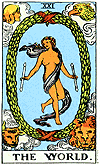
 The World: A dolphin couple dance under the trees on a beautiful summer day. They are dancing on the world, itself. Surrounded by the signs of each suit, the pair seem happy and contented. They have reached the end of their arduous journey. Eventually, The World will open up more journeys for them to go on. In the meantime, the two are happy that they have come to the end of this particular one.

Previous Cards:
Star, Moon, and Sun 

Friday, December 23, 2016

Tarot of the Animal Lords: The Star, The Moon, and The Sun

The Star: The Tarot of the Animal Lords refers to this card as The Stars, indicating that a multitude of stars can guide people. Under a starry sky dominated by one bright star, a seahorse, dressed as a clown, pours water into a mountain lake. As he kneels on a lily pad, a grebe nests on another pad nearby. The substantial size of the lily pads indicate security in navigating the unknown waters. The pair is serene and calm for The Stars will guide both to their purpose in life, although neither will know exactly how. They trust in The Star.


 The Moon: Climbing up a ziggurat stairway, a cat with a staff steps out onto a nebulous quarter moon. Perched on the staff is an owl and dangling from the perch is a crab. The scene is of a dream, an elusive wispy illusion. The whimsy of the owl contrasts with the nightmare of the crab. The cat has the owl to show him the way, while the crab urges him to rely on his intuition. In the space between reality and dreams lies the illusion of The Moon. 


 The Sun: In the glare of the enveloping sun, two hares grasp hands. Surrounded by briars and flowers, the pair dance together on green grass. The hares may be enjoying themselves in the bright sunshine, but for the reader, the sun is too bright to look at. The card cautions not to be “blinded by the light,” but do enjoy the moment. The illumination of The Sun highlights the shadow, which hides just behind the light.


Other entries in this series:
Death
Temperance, Devil, and Tower

Friday, December 09, 2016

Tarot of the Animal Lords: Major Arcana: Temperance, The Devil, and The Tower

Temperance: This card depicts a flamingo pouring water from one pitcher to another one, which is sitting on the ground. She is standing under a grove of trees, which are far from her village that is off in the distance. A slight breeze shakes the leaves, giving a sense of movement to the scene. The flamingo watches a mallard migrating, while a grebe broods on her eggs, nearby. The card gives a sense of quiet contemplation of choices yet to be made. Between leaving and staying is Temperance that seeks the balance between the two. Perhaps the flamingo will leave someday, but not today.


The Devil: A he-goat represents the devil in this card. He stands at the maw of a red-rock cavern, patting his buddy, the toad. Behind the pair, the full moon rises with the bats flying out to catch insects. With their jaunty poses and red eyes, the pair exudes a sense of malefic magic. Their air of nonchalance entices people into their web of promises. However, once someone enters the cavern, they become lost. The card suggests think before entering or end up being stuck forever.


 The Tower: A beaver is falling headlong as he is inundated by logs and water. At one time, loggers held drives to guide their sawn logs down river to the mills. Often, a log jam would occur and the logs would pile on top of each other. A logger would need to go and pull out the key log, holding back the others. This usually resulted in the death of the logger who did the task. This Tower is the raw energy that has been pent up rushing out, killing everyone in its way. How the beaver ended up this way is something for the reader to puzzle out. Was he the heroic logger or the builder of a faulty dam?


Other entries in this series:
Death
Star, Moon, Sun

Monday, November 21, 2016

Tarot: Major Arcana: Astrology (2 of 2)

Mars is force and energy that breaks through similar to The Tower. Jupiter, as the planet of expansion and luck, is appropriate for The Wheel of Fortune. Meanwhile, the principle energy of Uranus is liberation which matches The Fool. Judgment and Pluto both focus on transformation.
 
 What puzzled me the most was the connections of Cancer, the Crab to The Chariot, Sagittarius, the Archer to Temperance, Neptune to The Hanged Man, and Saturn to The World. As a reader, I need to know the reasons for these particular couplings. Is there a hidden aspect to each card that these astrological concepts focus on? Am I missing something? If so, what?

 Cancer knows where they are going and how to get there, which is appropriate for The Chariot. However, Cancer changes moods like the wind. This points to any conflict that needs to be examined while reading The Chariot. Also Cancer stabilizes The Chariot since this Sign is selective in what it does.

 Sagittarius is restless and high spirited, lending movement to Temperance. The subtle message is that Temperance should not be stagnant, but instead keep flowing. Sagittarius gives the warning to the reader of the tendency of Temperance to remain static.

 Saturn is the planet of limitation and fate. Paired with The World, it cautions the reader to beware of wishful thinking. Saturn grounds The World from flights of fancy. The World is to be earned, not handed to someone is something that the reader should know.

 This leaves Neptune and The Hanged Man, both difficult to understand. Neptune is the mystic, whose principle energy is transcendence. The Hanged Man is in limbo, perhaps in a chrysalis much like the caterpillar becoming a butterfly. The two are mystics, detached from the world. Therefore, Neptune reinforce the otherworldliness of The Hanged Man.

Thursday, November 17, 2016

Tarot: Major Arcana: Astrology (1 of 2)


Astrology and I have been at odds with each other for a very long time. I only study it to gain a deeper understanding of the various magical systems that incorporate astrology. Since the Tarot used today is based on concepts from the Golden Dawn, I need to know astrology for the deeper meanings.

Some of the connections between the Zodiac Signs and the cards of the Major Arcana make sense. Also, some planets do intuitively match certain cards. However in other cases, I was baffled as to why the pairing. My knowledge of the more arcane aspects of the Tarot is not as deep as I would want. 

Aries, the Ram matches well with The Emperor. They are both leaders with strong masculine energies. Aries’ fire strengthens The Emperor’s authority. Meanwhile, the fixed energy of Taurus, the Bull centers The Hierophant. Stubborn Taurus reinforces traditionally-orientated Hierophant.
 Virgo, the Virgin reveals the introvert tendencies of The Hermit. Both reflect the need for solitude for questioning minds. Meanwhile, Libra, the Scales seeks balance as does Justice. Both stress tact and objective thinking. 

Some Signs associated with the Major Arcana are linked by animal symbolism. Since the venomous scorpion kills, Scorpio, the Scorpion is coupled with Death. Other Signs which represent animals associated with the Major Arcana are Capricorn, the Goat and Leo, the Lion. Capricorn is paired with The Devil while Leo with Strength. Goats are reputed to be stubborn reflecting the bondage aspect of The Devil. Meanwhile, the lion is well-regarded for his strength. 

In regards to the planets, having the sun coupled with The Sun makes obvious sense. Venus, the planet of harmony and love, matches the essence of The Empress. Quicksilver Mercury embodies The Magician, who is an alchemist.

 The remaining parings required further investigation on my part. Because The Lovers focus on two people and their choices, Gemini, the Twins seems to be the logical choice. Reflecting The Lovers’ dilemma, Gemini are opposing twins. This Sign indicates the pull on The Lovers to go into different directions as individuals. 

In seeking future goals, Aquarius, the Water Bearer is guided by the stars. The Star has elements of Aquarius in its essence. Meanwhile, Pisces, the Fish are dreamers governed by the ebb and flow of life. The Moon, the card of dreams, governs the tides, therefore the combination of Pisces and The Moon make sense.

 I did wonder why the moon was not paired with The Moon, and was instead paired with The High Priestess. The clues for me is that both are feminine, receptive, and imaginative. But neither dwells in illusions like Pisces and The Moon. The moon of The High Priestess underlies her intuition.

Thursday, November 03, 2016

Tarot of the Animal Lords: Mythic Images

The deck that I use is The Tarot of the Animal Lords. On the surface, the deck seems only to be animals dressed up as various Tarot characters. Looking deeper however, the reader will see that each animal is connected to various myths. The associations are subtle and do require a knowledge of animal lore.

 For example, The Emperor features a lion with a golden eagle. The eagle, itself, is associated with the Roman emperors, who were the representatives of Jupiter, the Ruler of the Heavens. In Roman bird augury, the golden eagle represents the will of Jupiter. Using this train of logic, I associate The Emperor with Jupiter.

 The Hierophant depicts the red deer as a priest. In Europe, this animal has religious associations. Cernunnos, God of the Celts, connected to the stage in rut, is the God of the Forest. Moreover, this Horned God is depicted on the Gundestrup Cauldron, itself a sacred artifact. The mythic association for The Hierophant then becomes Cernunnos.

 The Hanged Man is a bat hanging upside down. Although he is not strictly a mythological character, I associate this card with The Batman. This character is suspended between being ordinary Bruce Wayne and the obsessed Batman. He can never completely be one being or the other, but neither is he both. The Batman is my mythological connection for The Hanged Man in this deck.

 Death is represented by the raven. This corvid is associated with The Morrigan, the Dark Goddess of the Celts. She knows who will die in battle, and will tell them beforehand. Since The Morrigan is also the Goddess of Sovereignty, Her decision is always final. The sovereignty of Death leads me to The Morrigan.

 The Devil is represented by the billy goat. I associate this animal with Inuus, Who is one of the aspects of Faunus, the Roman God of Fertility. Inuus is venerated at the Lupercalia in February. Young men would run through town whipping women, with straps made from goatskin. (This was to make women fertile.)

 The Sun features two hares dancing in the sun. Ostara, the Anglo-Saxon Goddess of Spring, often had hares as her companions. A symbol of the reborn sun, the hare is the mythical association that I have with this card. Therefore the Goddess Ostara is The Sun in this deck.

 The Tarot of the Animal Lords also have animals with mythic symbolism. The fox of The Magician does his magic on a toadstool, a traditional symbol of the fairy worlds. The Empress sits on a turtle shell throne, which symbolizes fertility. The Hierophant is accompanied by a stork, the Roman symbol of fidelity and piety.

 Meanwhile, the mandarin ducks of The Lovers are the Chinese symbol for married love. In Death, the chameleon represents bad luck and misfortune as told in African myths. Moreover, the toad in The Devil is considered to be a familiar of wizards, and represents dark magic.

 Further study of the folklore of animals will reveal more mythic symbols in this deck. I have only touched the surface of mythic associations for this particular Tarot deck. I have worked with The Tarot of the Animal Lords for ten years, and still find new mythic connections.

Friday, October 21, 2016

Tarot of the Animal Lords: Major Arcana: Justice, The Hanged Man, and Death

Justice is a barn owl who stands on the edge of a mountain cliff. She holds the scales and sword of Justice. However, this owl cannot go backwards because of the massive tree behind her. One misstep forward, she falls to her doom. High in the mountains, the owl stands keeping her balance. Like Justice, she has to weigh both sides carefully or risk disaster. (Barn owls are traditionally found in church and grave yards. This explains the artist’s choice for Justice, for me.)

 The Hanged Man presents a bat hanging between two trees under a full moon. Underneath him is a small pool of water that mirrors his face. Around the pool are night lilies, and two rats with their paws on skulls. Since bats sleep upside down and during the day, this bat is perfectly content to wait patiently. However, the rats seem to indicate a sense of impending death. I wonder if the scene is depicting the feeling of peace just before dying. This card is both disturbing and serene at the same time for me.

 This leads to the next card, which is Death. At the front of a cave littered with bones and weapons stands a raven with a scythe. He has his hand on a crowned skeleton. Behind him is a misty swamp. The only way out is to cross the river in front. Meanwhile, a chameleon stands in from of the raven. In African legend, this lizard is a sign of death and misfortune. The two animals together give a sense of doom. There seems a sense of finality to the card.


Other entries in this series:


Thursday, October 20, 2016

Tarot of the Animal Lords: Strength, The Hermit, and The Wheel of Fortune

The Tarot deck that I use is The Tarot of the Animal Lords. Although Strength is XI and Justice is
VIII in this deck, I switched them. The switch now has Justice as the middle card of the Major Arcana. Justice then becomes the “balancer” of the Major Arcana.

 Strength depicts a mongoose wrestling with a cobra. While that is happening, the earth is opening up under them and volcanoes are erupting behind them. The scene is enveloped in smoke and ash. I can almost smell the sulfur spewing out of the earth. In front of the battling pair, are two salamanders, who are facing in opposite directions. I feel the immediacy that someone has to decide quickly to flee or be killed. However, the two center characters are frozen in the moment of the chaos. Does that mean that Strength can be either the calm focus or the frozen stance? Is the downside of Strength to be locked in a struggle oblivious to what is going on?

 The Hermit presents a black bear entering a dark cave. His lamp barely pierces the blackness. This bear carries keys and scrolls with him. This made me wonder if he hoped to find a treasure chest. Behind him in broad daylight is a peaceful countryside. Right above him, dripping in honey is a beehive. I think that the Hermit is leaving the sweetness of the known life for an unknown future. This card elicits a feeling of answering a sacred call, of going deeper into the Divine.

The Wheel (of Fortune) telescopes the concept to a circular tree branch and the life cycle of the butterfly. The adult butterfly lays her eggs on a leaf that hatches into the various stages of caterpillars until finally the juvenile butterfly becomes the adult. And the cycle continues. To emphasize The Wheel’s motion, the wind blows in a circle high up in the mountains. The dominant theme of this card is a circle, going round and round. I get dizzy just looking at The Wheel. This Wheel focuses on the cycles of life that we all experience repeatedly at different points in our lives. 

Other entries in this series:


Friday, October 07, 2016

Tarot: Hanged Man, The Tower, and The Devil and me

My current life can be expressed in three cards. The Tower is a visual display of what happened to me. I was not hit by lightening but a wall literally fell on me. In an instance like The Tower, my life was changed completely.
 
 My brain injury, itself, is The Devil, since it limits me in what I can do. It inhibits me from living freely, since I have to choose and weight the consequences of doing an activity. If I go to a party, I will become overstimulated by the people, noise, and disruption to my daily routine. This means two days after the party of not leaving my house and living in darkened rooms. In response, I employ creative problem-solving to deal with each challenge as it presents itself. 

The card that reflects me now is The Hanged Man. Now upside down in my life, I have a different perspective on life. After nearly dying and then coming back to life, I live between two worlds. For me, life becomes a paradox as I navigate in a new world. For these reasons, I see my life with ebbs and flows instead of a Hero’s Journey.

Saturday, September 10, 2016

Tarot of the Animal Lords: Hero's Journey (2)

Laying out The Tarot of the Animal Lords to follow the Hero’s Journey requires a deeper knowledge of animals. Each card in this deck reflects either the natural history or the folkloric history of various animals. Some animals are an obvious selection for their card such as the fox for The Magician, the lion for The Emperor, the raven for Death, and the male goat for The Devil. 

However to understand the other animals which are representing themes in the Major Arcana requires knowledge of their natural history. For example, The Fool is an European Badger setting out on his own. European badgers live in societies of setts, which are towns constructed of burrows. Some setts are over three hundred years old, with generations of European badgers inhabiting them. A lone European badger going out on his own would be a fool. (In contrast, American badgers, a separate species, usually live by themselves.) 

Featuring a flamingo for Temperance is another example. These birds live in the hot salt flats of Africa and eat brine shrimp. This gives them their bright pink color. If they are too pink or too white, this means that the flamingo is nutritionally out of balance, and will need to change their diet.

 To understand other animals featured in this deck’s cards for the Major Arcana requires knowledge of their folklore. For example, The Moon features an owl and a cat, reminding the reader of the children’s poem, The Owl and the Pussycat, by Edward Lear. In that poem, these two animals go out to gaze at the moon and the stars in wonder. Meanwhile, The Lovers depict two mandarin ducks. In China, these ducks are believed to be lifelong mates. They use mandarin ducks in their wedding decorations to symbolize fidelity.

 Each animal that is chosen for their particular card enhances the meaning of the Hero’s Journey for me. At first glance, each selection may seem a bit opaque but within each card are clues to explore further. The reader can ponder each card’s meaning further through that particular animal.
 ------

Friday, August 26, 2016

Tarot: Patterns of the Major Arcana, "The Hero's Journey," and Others


 The patterns in the Major Arcana set up by Teresa Michelsen in The Complete Tarot Reader and that of Arlene Tognetti and Lisa Lenard in The Complete Idiot’s Guide to Tarot and Fortunetelling are variations on the traditional Fool’s Journey of the Tarot. What each author did was to split their cards into groups to make this journey more understandable for themselves. Each group embraces a particular concept which is helpful to these Tarot authors. Each of the two patterns start with a young person meeting significant people and facing challenge. After wrestling with problems, young person matures and emerges in the world spiritually enlightened. The various groupings help the reader to understand The Fool’s Journey in depth by placing focus on particular parts of it from varying points of view.
 
 Meanwhile, Robert Place in The Tarot History, Symbolism, and Divination sees the Major Arcana differently. For him, it is not a journey, but a focus on particular aspects of the person. In his patterns, Place sets up Plato’s Three Parts of the Soul. Appetite, the first part of the soul, is represented by The Magician through The Chariot. These cards depict the desires a person has such as seeking power or love. The next group, which is Strength to Temperance, represents the Will (Spirit), the second part of the soul. These cards focus on the emotions such as seeking solitude or justice. The final group – The Devil to The World – represent Reason, the third part of the Soul. These cards highlight the mind, which Plato placed as the highest part of the soul.  

 Two patterns that I developed could probably be considered variations on The Fool’s Journey. The first is based on the therapeutic model of moving from illness to wellness. The Magician to The Hierophant are the various perceptions of reality, ranging from “mind over matter” to “strict rules of life.” The next group, The Lovers to Justice, are the issues of life that everyone has to cope with from changing homes to bad luck. The Hanged Man to The Tower are the struggles for people to overcome their distorted thinking and misperceptions. From The Star to The World are the rewards of healthy thinking and wellness, which only happens when the person implements these changes in their life.

 The other pattern was inspired by Journey to the Dark Goddess by Jane Meredith. This Journey is to the Underworld to meet the Dark Goddess. There, the person reclaims the lost and dark parts of themselves. Meredith says that we cannot go to the Dark Goddess while we are still in our place in the world. First, we have to be stripped of everything that we value. Once in the Underworld, we meet the Dark Goddess, who holds these remnants of our selves. Whilst in the Underworld, we are dead until a turning point occurs to restore us to life. This propels us upward. Afterwards, we become whole and emerge back into the Upper World reborn. 

 This particular Journey has four parts. The first is “Preparing for Descent.” The Magician through The Lovers are who we are in the Upper World. We have to give up all of this to undertake the second part, which is “The Descent to the Underworld.” The Chariot to Justice denotes our removal of our status and our acceptance of our fate. The third part is “Dwelling in the Underworld.” Like the Hanged Man, we are limbo as we die. Death to The Devil explains our time in the Underworld. The turning point for “The Ascent,” the fourth part, is The Tower. When we return to the Upper World we gain The Star through Judgement. Now as The World, we are reborn.

 Arranging the cards into patterns helped me to see how various processes occur in the Tarot. Each pattern highlights a different aspect of the Major Arcana. Within each pattern, I can understand how each card relates to the others such as why is Temperance between Death and The Devil. When a number of them from a group appear in a reading, the reader can figure out where the questioner is in the process. 

Works Used:
Lorenz, Hendrick, “Ancient Theories of the Soul.” Stanford Encyclopedia of Philosophy. 22 April 2009. Web. http://plato.stanford.edu/entries/ancient-soul/ .
Meredith, Janet, Journey to The Dark Goddess. Moon Books: Winchester (UK). 2012. Print.

Thursday, July 28, 2016

Tarot of the Animal Lords: Freewriting

For freewriting, I chose I. The Magician, XI. Strength, and XVII. The Stars from the Tarot of the Animal Lords. I focused on them in order from The Magician to The Stars. (The Tarot of the Animal Lords refer to XVII. The Star as “Stars.”) As I was freewriting, I experienced each card differently. Then as I went from one card to the next, they flowed together as one. The Magician created the reality for Strength to perceive. From Strength comes the ability to receive spiritual guidance from The Star.

I. The Magician features a fox playing “find the bean” game on a toad stool. He is standing in a briar patch. Watching the fox is a scarlet tanager and a mouse. At first glance, the fox is an illusionist simply switching the bean around. As I pondered the adage, “The hand is quicker than the eye,” I perceived that the fox is also an alchemist. With his gestures, he weaves illusion into reality. As the mouse and bird watch, he weaves them into his new reality. Making the beans appear and disappear under the cups, he challenges his audience to ponder if there really is a boundary between reality and imagination.
 
 Traditionally, The Magician combines the four elements into a fifth of the spirit. The elements are represented as the bird (air), the mouse (earth), the cups (water), and the thorns (fire), in this card. The fifth element is represented by the toadstool, the alchemy of the imagination. We, as the audience, become participants in The Magician’s creation. We join in the illusion and unite with the Magician. We bring the vital element, the spark to weld the two worlds. The Magician, as the midwife, helps to birth the new world of magic realism.

 XI. Strength depicts a mongoose embracing a cobra, as the earth under them is opening up. Behind them, several volcanoes are spewing out ash. While chaos erupts around them, two salamanders intently watch the battle between the mongoose and the cobra. Strangely, the watching salamanders are active, while the mongoose and cobra remain frozen in time.
 
 My freewriting enabled me to understand how strength balances the chaos and order. The mongoose is calmly focused on the cobra, while the cobra is focused on the chaos. There is stillness within the whirlwind. Strength becomes the balance between the rational and the irrational. If the mongoose places too much focus on the cobra, he will fall into the cracks opening underneath him. If the mongoose is distracted, the cobra will slip away. Strength is deciding when to hold on and when to let go. The salamanders remind us of the choices that we have to make to keep the balance. 

XVII. The Stars features a seahorse pouring out light as he kneels on a lily pad. Beside him on another lily pad is a nesting grebe. Stars in the sky and reflected in the lake surround the pair. A glowing star dominates the sky, as the pair float in serenity and peace. A feeling of spiritual rest fills the card.
 
 In freewriting, I pondered the grebe. Why did the artist include her in the picture? What does the grebe have to do with the stars? The seahorse pours light from the sky into the lake. He is replenishing the waters of life from the heavens. Meanwhile, the grebe is simply nesting on a lily pad.
 Grebes are noted for their graceful mating. Therefore I reasoned that the grebe was the representation of “grace.” Sitting on her nest, the grebe patiently hatches the new soul. This self will be infused with the waters of life. Therefore The Star is the soul at peace after being created by the Magician and honed by Strength. 

 Freewriting provided me with an entry into each of the cards. It allowed me to focus as I let my mind wander to consider the deeper meanings in each of the cards. Freewriting allowed free association, which brought about a deeper inquiry. For me, it was a good method to get to know the cards.

Thursday, January 28, 2016

Tarot: The Tarot of the Animal Lords: focus on Death

The focus of my character sketch for “The Tarot of the Animals Lords” is XIII. Death. The card depicts a foggy day, shrouding the landscape in mist. A raven stands at the entrance of a cave. In one hand, he holds a scythe, and with the other pats the crown of a skeleton lying beside him. In front of the raven is a chameleon resting near his feet.

 In the outline of the story that I created from my character sketch, I focused on Raven and his deeds. The other four cards I used complete the story (in order) were XV. The Devil, XVI. The Tower, VII. The Chariot, and VIII. Justice, respectively. In my opinion, each of these cards reflected many of the facts of the Death card. 

 Raven gloats that he is now the Ruler of the Land. Through stealth, he has vanquished all of his rivals. As he talks to his spy, Chameleon, Raven muses on how he united with Goat to do more mischief. He ponders his next move to keep his power intact.

 The scene shifts to The Devil. In a cavern with their backs to the rising moon is a goat and a toad. The standing goat is patting the toad, which squats behind him. The rocky cavern is empty except for these two figures.

 Goat is waiting for Raven to arrive for more plotting of mischief. He muses how they pulled the key log from Beaver’s dam, and sent him to his death. As Goat wonders what Raven will do next, Toad agrees to meet with Chameleon. Since Chameleon is a double agent, he will find out if Raven is plotting against them. 
 
 As Major Arcana cards, Death and The Devil fit together, since we are all in bondage to death. The Devil shows people their limitations, fears, and beliefs that hold them back. Moreover, Death is the biggest fear and limitation of all. For me, Death reflects the positive aspects of The Devil, as a final release from our fears.
 
The next card, The Tower features a beaver being flung over the falls as his dam breaks. Flying over him is a raven. The rush of water and flying logs reflects the beaver’s doom.  In this scene of the story, Beaver screams, “Help! Raven did this! Help!”

Both The Devil and Death are reflected in The Tower card. Death in the form of the raven flying overhead is the cause of the dam breaking. (Ravens are traditional symbols of death.) In the Tarot, The Tower comes after The Devil to break The Devil’s hold on us. The dam in The Tower reflects the holding power of certain beliefs. Once Death comes, the dam breaks and everything floods out. The suddenness of the flood washes away any limitations that we may hold.
 
 Next in the story comes The Chariot. Over the mountains, a crested crane rides a mute swan. As they fly towards the plains, the sun is rising. Standing on the swan’s back, the crane is aloof as he eyes the vista below him. In the distance are migrating swans.

In my story, Crane hears Beaver’s cries, and races to help. It is unsure whether he will arrive in time or not. If he does not, he still will be a witness to what has happened to Beaver.
 
 In the Major Arcana, The Chariot is movement. For me, The Devil, The Tower, and The Chariot reflects the several states of Death, which can be both sudden and gradual. The Devil holds death to a single instance, whilst The Tower shatters death completely. Whereas The Tower is sudden change, The Chariot is steady, the mid-point between the two extremes of inertia and discrete movement. Meanwhile, both Death and The Tower push forward to overcome The Devil’s active inertia.

 The last card in the story is Justice. This card depicts a barn owl, standing on a cliff’s edge, with a sword and scales. As day dawns over the mountains, a tern flies over the owl’s head. In nature, barn owls are known as voracious ratters. Moreover, they are often found in church yards, and have become associated with death. Because of this, I connected Justice with Death.

 Owl looks down at the scene of Crane’s rescue of Beaver. She decides to send Tern to Raven to ask him, why Beaver? As Justice, Owl will go down to deal with Raven, since she is equal to him in power.
 
 One aspect of Justice is dealing with unlawful death and administering lawful death. Moreover in Justice and Death, the owl’s sword and the raven’s scythe act as the same in conducting their respective duties. Both are impartial in what they do, and do not favor anyone. 

What I learnt from doing this character sketch is how the cards flow into each other, telling a story with relative ease. Death was the focus of these other four cards, with each highlighting a facet of this Major Arcana card. Also within each card were elements that related to the others in the group. The Chariot and The Tower are both about change, whilst The Devil is contained by Justice. Together, these cards weave an intricate story of intrigue and power.

Saturday, June 06, 2015

Tarot: Major Arcana: Tarot of the Animal Lords: Fool to Lovers (2 of 2)

  
V. The Hierophant. Dressed in ritual robes, the red stag stands stiffly holding his staff of religious office. On his antlers perches a cardinal, while standing next to him is a stork. (All these animals are connected with piety and religion.) In the background, the trees are straight with groomed, rounded crowns. As rising sun highlights the sacredness of the grove, the Hierophant offers a sense of order and strictness. Meanwhile, the bareness of green landscape emphasizes the uncluttered serenity of the Hierophant’s interior life.

 
VI. The Lovers. Two Mandarin ducks gaze tenderly at the other. (In animal lore, Mandarin ducks are devoted partners.) Since the male is wearing a sword, I think that these two are greeting each other after a war. Surrounding them is an orange grove (a tree noted for love). Moreover, the Lovers are standing under an arbor of oranges and orange blossoms, as orange butterflies flutter around them. The color orange gives me a feeling of tenderness and mature love. The activity of the summer’s day in the orchard fills me with contentedness. Love encompasses all things.


Other entries in this series:

Friday, June 05, 2015

Tarot: Major Arcana: Tarot of the Animal Lords: Fool to Lovers (1 of 2)

The Tarot deck that I used to experience the Major Arcana was “The Tarot of the Animal Lords,” (Pietro Alligo and Angelo Gianni). I chose this deck because it features animals which allows me more in-depth readings. Also, the deck uses Rider-Waite motifs, which is helpful to me in learning the Tarot.

 To experience each card, I started by thinking about why each animal was featured. Then, I thought about what the animals were doing. As I viewed each card, I observed the landscape, season, and time of day. If there was any predominant color, I wrote that down, as well. Whenever I felt a feeling such as being pricked with thorns or freezing cold, I noted that too.

What I learned by observing and then experiencing the cards, is that often the minor details will merge into a whole. The various details caused me to ponder why they are there and what their meanings are. As I reflected on each, I would receive feelings that settled inside me. By experiencing the cards instead of just viewing them, I intuitively came to know what each meant.


 The cards as I perceived them.
0. The Fool. This card highlights a young European badger walking through a dark, snowy forest on a winter’s day. Along with his hobo stick, he carries a puffin, whilst a magpie sits in a tree branch watching. After laughing about how absurd carrying a puffin around is, I then felt the cold and darkness. I became aware of an adventure that was tempered with foreboding. The dynamics of the Fool for me was represented by the magpie, who was wryly amused by the pair.

 I. The Magician. This card features a red fox playing “find the bean under the cup,” with an audience of a field mouse and a scarlet tanager. Standing in a briar thicket, he uses a giant toadstool as his table. Although I feel pricked by the briar thorns, I cannot stop myself, since I want to play the game, too. The fox is an illusionist and if I am not careful, I will be caught in his invention. Meanwhile, the toadstool and the autumnal colors speak of alchemy, with the fox being the master Magician. When I entered the briar patch, I stepped in a world of mystery, beyond my senses.


II. The High Priestess. In a glen of cedar trees, a cow elephant sits regally on a tree stump with an open book, whilst sunlight bathes her head. At her feet are two striped squirrels sitting in the yellow asters. These squirrels are taking her bits of knowledge and “squirreling” them away. I feel that this High Priestess will keep the mysteries, only telling them to those who will secret them away. (Matriarch elephants hold the wisdom of their herd.) Meanwhile the curves between the trees and those of her tusks remind me of the moon, where the secrets are often kept. The bright sunlight tells me that if I develop the inner sight then I can see the mysteries, which are hidden in plain sight.

III. The Empress. Sitting on a turtle throne, a she-wolf gazes off in the distance, lost in thought. Surrounding her are her playful pups, who are chasing the butterflies. While the Empress sits in a field alive with flowers, a toucan sits behind her watching the pups. Although all life is exploding around her, the Empress seems remote and untouchable. Even though I feel safe being watched by the toucan, I wonder about the Empress. Is she serene or merely removed? Meanwhile, the profusion of butterflies and mallow flowers at her feet give a hint of her fertile powers.

 IV. The Emperor. Dressed in casual clothes, the Emperor wears a crown and rests his hands on a sword, as a falcon perches on the hilt. Adding to this casual feeling is his throne which is a tree stump. Ruling the African veldt, the Emperor, who is a lion, stares directly at me with a look of authority. With his sense of easy power, the Emperor cares not what he wears or sits on, for he is in control. Meanwhile, the bright sun highlights his potent aura.


Other entries in this series:

Wednesday, August 20, 2008

Working with the Tarot: Major Arcana and the Court Cards


(XII. Hanged Woman: Spider Woman)

For a month, I drew two cards each day from the “Animal Divine” Tarot deck. The cards I chose were from the Major Arcana and the Court Cards. I added the Court Cards to become better acquainted with them.

The King of Wands (Gama Sennin, Japanese) appeared at least four times a week. When I thought about this card, I focused on the toad sitting on His shoulder. Although the author said that the animal was a frog, I saw a toad, which is a predictor of future financial gains. My late father-in-law, an accountant, was known as “The Toad”. I see the King of Wands as him speaking to me about my finances.

For me, it was difficult to read traditional meanings for each card in this deck. Before I could understand the author’s meanings, I had to study each card. To read this Tarot deck, a grounding mythology is needed.

For example, The Tower (XVI) has Thunderbirds flying about. No tower was crashing. However, in mythology, Thunderbirds bring fierce winds and storms, tearing things apart. The Thunderbirds represented destruction.

The Chariot (VII) has Freya, the Norse Goddess, riding a boar. Again, this seems to be a departure from the traditional Chariot card. As a Goddess of passion and fertility, She moves people forward.


Copyright: Virginia Carper, Animal Teachers, 2008. Contact me at animalteachers @ gmail.com
------------