Friday, August 21, 2015

Animal Messengers

My blog post at "Witches and Pagans" discusses how animals deliver messages.

"Sometime ago, I dreamt that I was a giant squid playing with the other squids in the blue ocean. Wiggling my tentacles, I had fun jetting from here to there. When I woke up, I pondered what Giant Squid had wanted to tell me."

 "While pondering my dream, I understood that Giant Squid wanted me to play more. Moreover, She came to remind me to be more flexible. With my brain injury, I have become a fixed thinker. Since it takes me a long time to do my chores, I tend to focus solely on getting them done. Giant Squid decided to enter my dreams to have me become more fluid in my waking life. She told me to zoom away from housework and go play."

Read the rest at Animal Wisdom: Messengers
 

Friday, August 14, 2015

CERATOSAURUS: Accept Yourself

Debivort at English Wikipedia [GFDL (www.gnu.org/copyleft/fdl.html) or CC-BY-SA-3.0 (http://creativecommons.org/licenses/by-sa/3.0/)], via Wikimedia Commons

Called “horned lizard,” because of her two “horns” on her head, Ceratosaurus lived during the Late Jurassic. This puzzled many paleontologists since She was a primitive meat-eating Dinosaur. (These Dinosaurs were thought to only have lived in the late Triassic.) Ceratosaurus live amongst the more advanced Dinosaurs such as fearsome Allosaurus and ferocious Torvosaurus.

One of the oldest known Ceratosaurs (a Family of Primitive Meat-eaters), Ceratosaurus was one of the first of her Family to be discovered. Found in the 1880s, She was named in 1884 by the paleontologist Othniel C. Marsh. The family of Ceratosaurus is a highly diverse group, including Noasaurus, with his strange teeth and Abelisaurus, with her ridiculously short arms, all dissimilar Dinosaurs. Ceratosaurs are often lumped with Coelophysis’ Family. However, Coelophysis and his relatives are an earlier branch of the Theropods (Meat-eaters).

Modestly-sized Ceratosaurus shared the Western U.S. landscape with giant Allosaurus, a formidable predator. However, She was a hunter to be reckoned with, with her short powerful neck and large teeth. This effective predator, also, had a massive tail and bulky body. Small enough to be agile,Ceratosaurus chased fast prey on her two strong legs. Using her superior hunting skills, She ate quite well.

What made Ceratosaurus stand out amongst the other Meat-eaters was her ornamentation. Her nasal “horn” was an extension of the bones at her snout. Her other “horn” was the fusion of separate bones. Besides her nose “horn,” Ceratosaurus had two short brow ridges and bony knobs above her eyes. Unlike other Theropods, She had osteoderms (plates) running down her back. This ridge made Her resemble an ancient dragon.

Standing out in the landscape, Ceratosaurus, so different from the other Theropods, demonstrates how to “let your freak flag fly.” Her odd and strange appearance shows a sense of adventurous and unconventional thinking. Ceratosaurus accepts Herself. Being comfortable with who She is, Ceratosaurus is a consummate hunter, succeeding in living well. Let Her teach you how to accept yourself, “warts and all.”

Thursday, August 06, 2015

COELOPHYSIS: Fierceness

Jeff Martz, U.S. NPS
One of the earliest Dinosaurs known to be a Theropod, Coelophysis was a fierce, little Meat-eater who lived during the late Triassic (about 21 million years ago). Slightly built with hollow bones, Coelophysis ran swiftly on his two long legs. In fact, the most prevalent proof of his existence were his footprints found on fossilized trackways.

The Dinosaur Family that Coelophysis belongs to is extremely diverse. The Coelophysoida (Coelophysis and Friends) includes Birds and probably Tyrannosaurus Rex. Many paleontologists regard the taxonomy of His Family to be fluid, and under constant review. About the only thing that Members of this Family have in common is that They are more closely related to Birds than to Carnosaurs, who are the other Meat-eaters.

Discovered in 1881 by David Baldwin, Coelophysis was named by Edward Cope 1889. Then in 1947, a huge number of fossils were found at Ghost Ranch in New Mexico (U.S.). Apparently, these Coelophysis were caught in a massive flood. This huge cache of fossils gave paleontologists much to study about Coelophysis.

Built to hunt, Coelophysis had pointed, serrated, and bladed-like teeth to bite down on his victims. He could also tear out the flesh. With his long fingers and claws, Coelophysis could either grasp or clutch his prey. In other words, He hunted any way He could.

Whilst studying the fossils at Ghost Ranch, scientists found that Coelophysis came in two types. The gracile (the more slender ones) seemed to be females whilst the robust ones seemed to be males. Another find, which was quite troubling, was uncovering young Coelophysis inside the adults. After much investigation, scientists concluded that the adults did not eat the young, since the flood threw everyone together. Their bones had mixed together.

Small and light Coelophysis was a feared predator. Using his long legs, He could run at fast speeds to chase down his victims. Since He had quick reflexes, Coelophysis darted and dodged about to confuse his prey.

Although Coelophysis was small, He was big in terror. Moreover, He passed on that fierceness to his descendants like Velociraptor. Like Him, They inspired terror in their victims. Fierceness comes in all sizes, for it lies in the attitude of the person. Let Coelophysis show you how. But do not be so terrifying, that you frighten everyone.

Monday, August 03, 2015

White Lions: "A Gift from God"

By Stano Novak (Own work) [CC BY 2.5 (http://creativecommons.org/licenses/by/2.5)], via Wikimedia Commons  
A Note on White Lions:
Legends of White Lions exist in various oral traditions, in the Timbavati Region of Africa, from the time of Queen Numbi, who ruled about four hundred years ago. Tradition holds that once every century a White Lion appears. A gift from God, White Lions represent the good in all creatures. In the 1970s, White Lions were found in the Timbavati Region in South Africa. (They are now in South African zoos for protection from poachers.)

White Lion's Teachings Also Include:

“Championing righteousness and promise, White Lion Dreaming teaches us to look for, identify, and celebrate the golden glow of potential in others.” Copyright: “Animal Messengers” by Scott Alexander King

Lion Christian Symbols:
Lion: Christ
With Cross-Shaped Nimbus: Lion of the Tribe of Judah
Carrying a Book: Christ as the Teacher
Sleeping: Christ, the Divine Watcher
Winged: St. Mark, the Evangelist

Friday, July 31, 2015

LION: Group Dynamics

Known as the King of the Jungle, Lion actually lives on the open African grasslands. Originally, He ranged from the Mediterranean Sea to Asia and south to Africa. Hunted by Romans for their Games, Lion first disappeared from Europe and Asia Minor. As Lion hunting increased, his range shrank to where now Lion lives only in Africa.

Unlike most members of the Cat Family, Lion is social. He lives in a Pride and forms coalitions with his Male Friends. In his Pride, Lionesses work together to hunt and chase off predators. Meanwhile with his Male Partners, Lion defends their territory against intruders. With his Coalition, Lion rules the Pride for a few years until a new Coalition arises. Then He and his Male Partners leave.

When Lions hunt, They form a cooperative group. Whether They are killing Seals on a beach or Cape Buffalos on the savannah, the Pride forms a plan of action. Some Lionesses wait downwind while their Sisters herd the animals towards Them. Other Lionesses travel around the prey to close off avenues of escape. Suddenly, a Lioness shows Herself, causing panic among the prey. The animals rush headlong into the Pride’s ambush.

Because Lion is yellow, and loves sleeping in the sun, He has been the symbol of the Sun for many cultures. People so admired Lion, that they thought He possessed spiritual powers equal to his physical attitudes. As King of the Beasts, Lion was wise and just.

Killing a Lion was a symbol of manhood. In Africa, young men were initiated through lion combat. The Zulu and Masai were expected to defeat a lion to become a man among their peoples. In Ethiopia, the Emperor awarded the bravest warriors with a lion mane headdress.

In China, Lion is a mythic creature, a symbol of nobility and dignity. Guardian Lion statues protect Chinese buildings. Lion Dancing, which has a very long tradition, is an essential part of Chinese festivals. The Lion Dance brings good luck, prosperity, and happiness to the people at the festival.

Lion teaches constructive group dynamics. When hunting, Everyone contributes to bringing down the prey. Working together patiently makes for a successful hunt. Even though Lions have strong personalities, They cooperate successfully. Learn from Lion how to accomplish much in your group.
a lion
Lion’s Teachings Also Include:
“We need to know how to relax when we are stressed. Lion gives us spiritual strength, he teaches us to be strong and proud and not let important things in life be taken for granted, like family.” Copyright: Rabbit’s Warren of Wisdom.
Lion’s Wisdom Includes:
Nobleness
Proper Use of Power and Strength
Group Energy
Community
Roles in A Group
Balanced Leadership
Male Friendship
Sisterhood
Conservation Note: Lions are endangered and are protected by international treaties.

Thursday, July 30, 2015

Blogging on Animal Wisdom at Witches and Pagans.

Dear readers, I now have another blog, where I write about general topics on animal wisdom. I will post links to the blog here.

However, I will continue writing here as well. I have a lot to say that doesn't always fit the topic of animal wisdom.

Look for more postings on the teachings of dinosaurs next week. 

Animal Wisdom: Connecting People and Animals.  Will open in a new window.

My introduction to Animal Wisdom

Thursday, July 23, 2015

SPERM WHALE: Exploring the Abyss

The largest of all Toothed Whales, Sperm Whale can dive longer, faster, and deeper than any other Mammal. Known as nature’s submarine, Sperm Whale is well equipped to hunt in the ocean abyss for Giant Squid. Swimming in total darkness, He uses his echolocation to locate Squid. His huge head, which makes up a third of his total body length, houses the wax-filled spermaceti organ that helps Him to dive deep. With steady clicks, Sperm Whale approaches his Prey, then surprises Giant Squid with a sonic scream, disabling Him.

Among Whales, Sperm Whale has a unique social life. Elder Mother Sperm Whale governs his Nursery Pod. In the tropics, Sperm Whale Mothers, Females, and Young Males live together. When Sperm Whale reaches maturity, He leaves and joins a Bachelor Pod. Together, He and his Friends roam from the Polar Seas, where Squid lives, to the Tropics where the Nursery Pods are. When He is older, Sperm Whale will navigate the oceans by Himself.

Diving vertically into the abyss, Sperm Whale searches for Giant Squid. Using echolocation, Sperm Whale clicks until He sense the outline of Squid in the murky depths. No one knows what exactly happens in the murky depths; only that Sperm Whale is usually victorious. Like this extraordinary Whale, you can explore the Abyss. Just remember to surface from time to time.

Sperm Whale’s Teachings Also Include:
“There is more character in the Sperm Whale's head. As you behold it, you involuntarily yield the immense superiority to him, in point of pervading dignity. In the present instance, too, this dignity is heightened by the pepper and salt colour of his head at the summit, giving token of advanced age and large experience.” – Copyright: “Moby Dick”, Herman Melville

Sperm Whale’s Wisdom Includes:
Being Comfortable with Your Own Self
Being Comfortable with Your Own Sex
Diver of the Deeps
Lord of the Seas

Conservation Note: Sperm Whales are endangered, and are protected by international treaties. Because of extensive hunting, numbers of Sperm Whale Males are seriously low.

For reading on the teachings of Moby Dick, the most famous sperm whale of all: Moby Dick (opens in new window)

Thursday, July 16, 2015

BALEEN WHALE FAMILY: Travel the World

Southern Right Whale
The largest Animals that have ever lived on earth, Baleen Whales depend on tiny organisms (Krill) for food. They strain the Krill (Norwegian for ‘whale food’) through bristly baleen plates in their mouths. Since Baleen Whales have no teeth, They swallow or gulp their food whole.

Each Baleen Whale has their own type of baleen and style of feeding. Bowhead Whale, who has the largest baleen, feeds yearlong in the Arctic. Meanwhile, Right Whale cruises with her mouth (which is full of finely fringed baleen plates) open. Swimming on his side, Gray Whale stirs up sediment in the shallow waters with his head. Using his tongue, Gray Whale pumps the sediment into his mouth, strains out the dirt, and eats his prey.

Songs of the Whales” made Baleen Whales famous in the 1970s. Unlike Toothed Whales, who communicate with clicks, Baleen Whales use vocal sounds. Forming a language, these complex songs, which can last for 15 minutes, travel long distances through the ocean depths. Blue Whale uses the lowest sound on the bass register. Fin Whale also emits bass-frequency grunts, but not as low as Blue Whale. Among the Whales, Humpback Whale sings his famous songs during mating season.

Besides their songs, Baleen Whales are also known for their long migrations. Many spend summers in the food-rich polar waters, and move to warmer waters in the winter for breeding. Baleen Whales in the Southern Hemisphere migrate from the Antarctic to New Caledonia. Meanwhile, in the Northern Hemisphere, They go from Greenland to the West Indies. As They go on their epic migrations, Baleen Whales live on the energy stored in their bodies. Although Many Baleen Whales are not sociable, as a rule, They will travel in small groups to their winter and summer grounds.

Baleen Whales are great travelers. On their annual migrations, Some Whales cover a distance almost equal to half the earth’s circumference. Long journeys do not seem to faze Them. “Come see the world,” the Baleen Whales call to you.

Families of Baleen Whales (Mysticeti):
Rorquals (Blue, Fin, Humpback, Minke, and Sei)
Right Whale
Pigmy Right Whale
Gray Whale
Bowhead Whale

Note: Baleens are thin, long, triangular plates of keratin (same material that human hair and nails are made from). These plates grow down from the Whale’s gums, covering the upper jaw.

Conservation Note: Baleen Whales are seriously endangered, and some species may not recover. They are protected by international treaties. Moreover, many countries have restrictions on whale watching to keep the whales safe during breeding seasons.

Friday, July 10, 2015

Runes: "Double Chevron" Spread

An explanation of Runes (opens new window)

For the third reading, I used another spread from Krasskova’s book. The Double Chevron spread, which consists of two intertwined “V’s,” helps people to look into the Well of the Wyrd and uncover any spiritual influences that are in their lives. In this spread, Runes 6, 7, and 8 intersect Runes 1, 2, 3, 4 and 5 at Runes 2 and 4. The corner Runes 1, 5, 6, and 8 are the external influences on the questioner. The interior Runes 2, 3, 4 and 7 are the internal influences coming from the questioner.

 My question for the Runes was “Do you have any guidance for me about my brain injury.” I am at a crossroads on what my direction in life should be now. I felt the need to consult the Runes about this.

 For the external influences, I drew (1) Dagaz, (5) Eihwaz, (6) Perthro and (8) Thurisaz. (Their traditional meanings are “day,” “horse,” “dice” and “thorn.”) Dagaz said to me to expect rapid change, and Eihwaz pointed out that the transformation will come from the Worlds. Perthro indicated that that source would be the Well of the Wyrd, whilst Thurisaz counseled that this would be a focused change.

 The internal influences were (2) Fehu, (3) Algiz, (4) Isa and (7) Hagalaz. (Their meanings are “wealth,” “elk,” “ice” and “hail” respectively.) Fehu told me of the connection from the Gods, one of which is protection (Algiz). Isa, to me, represented the dynamic interactions that are provided by having boundaries. Hagalaz told me again of the descent into the Realms of the Dead. As I go into those places, I will be protected with gifts from the Gods, which also includes firm boundaries.

From the entirety of the reading, I see that my injury placed me between the Worlds of the Dead and the Living, where I have a foot in both. My injury has transformed me and I must embrace it, instead of fighting it. Since public blogging is now an aspect of my new direction, I can be a voice for all the animals.

Thursday, July 09, 2015

Runes: Three Rune layout, "Hammer Spread (9 Runes)"

I usually do my divination in the afternoon after I have my tea. The ritual of afternoon tea puts me into a reflective frame of mind. After tea, I would cleanse my divination space, lay out my cloth, put crystals out for clarity of signal, and finally light a candle. After doing the Hammer Rite for protection, I arranged myself to do Runic divination. After asking my question, I would pull each Rune out of the bag. When I laid them on the cloth, I would ask the Norns to bless my reading.

 For the first divination, I did the Three Rune drawing. I asked, “What guidance can you give me about having a high profile blog?” I was nervous about blogging about animals on a public platform.

As I was shuffling the Runes in the bag, Uruz jumped out. I put that Rune aside; then I drew out Eihwaz, Gebo, and Kenaz. To interpret the Runes, I consulted Galina Krasskova’s book, “Runes: Theory and Practice.” The standard meanings for Eihwaz is “yew,” Gebo “gift,” Kenaz “torch,” and Uruz “strength.” Going deeper into the Runes themselves, Eihwaz became for me the Yggdrasil, the axis mundi of the Worlds, the World Tree itself. Gebo, then, is the gifts from the Gods, with the “X” indicating that we are acting in a partnership. Kenaz is now the spark of the Divine leading me. Uruz is important since it grounds these other Runes by establishing boundaries for Them to work in.

From these Runes, I formed the sentence for my reading: “From the World Tree, I am given the gift of connection with the Divine. Therefore I can write knowing that there are firm boundaries to protect me. The Runes answered my deeper issue of being able to deal with the public.

For the next two divinations, I used two spreads featured in Krasskova’s Rune book. However, now, I set up a small altar in my divination space. The Runes informed me that They were more than simply divination tools, and wanted to be accorded the proper respect. To explore in depth, about being in the public eye, I used the Hammer Spread. I asked, "What spiritual challenges are there for me for being so public." The Hammer Spread has Runes 1, 2, 3, 4, and 9 in a vertical line with Runes 5, 6, 7, and 8 crossing at Rune 4. Runes 1 through 4 are the spiritual lessons for me to learn, Runes 5 through 8 are the physical manifestations of this spiritual lesson. Rune 9 at the top is for anything else that the Runes may have to say.

The Runes detailing the spiritual lesson were (1) Wunjo, (2) Hagalaz, (3) Othala and (4) Algiz. (The traditional meanings for these Runes are “joy,” “hail,” “family estate” and “elk” respectively.) Wunjo, for me, is the mystical Tree working through me whilst Hagalaz is the shadow work with the Dead. (After my brain injury, I have been blogging about extinct animals.) Meanwhile Othala becomes the protective boundary that the Ancestors surround me with, strengthened by Algiz, for things of the spirit. These Runes are telling me that the Great Tree will bring forth my work with the Dead (including animals), with the protection of my Ancestors.

For the physical manifestations of this lesson, I drew Thurisaz, Ansuz, Gebo, and Uruz. (Traditional meanings are “thorn,” “God,” “gift” and “strength.”) I interpreted Thurisaz to mean swift and contained fortitude, with Ansuz, opening my voice. Gebo gives balance for my struggle, whilst Uruz gives me strength to transform. With fortitude, my voice will become balanced and strong.

 For Rune 9, I drew Tiewaz (“Tyr”), which means for me, “moral clarity.” When I blog, I should be scrupulous in what I write. The Hammer Spread helped me to gain insight in what was bothering me about blogging. I was counseled by the Runes to forge ahead in this endevour.

Friday, July 03, 2015

Tarot: Tarot of the Animal Lords: Daydreaming (2 of 2)

XIV. Temperance
 
(This shows a flamingo pouring water from one pitcher to another. Meanwhile a grebe nests at her feet.) 

As I watched Temperance, the Flamingo, pour her water, I noticed her wistful watching of the migrating Mallard Duck. I kept thinking that she seemed restless while waiting for Mother Grebe to hatch her eggs. Perhaps pouring the water back and forth, steadied her, and helped to her to be balanced for the moment. For Temperance knew that once the eggs were hatched, she could leave. “Temperance” taken to the extreme meant to me the inability to move. 


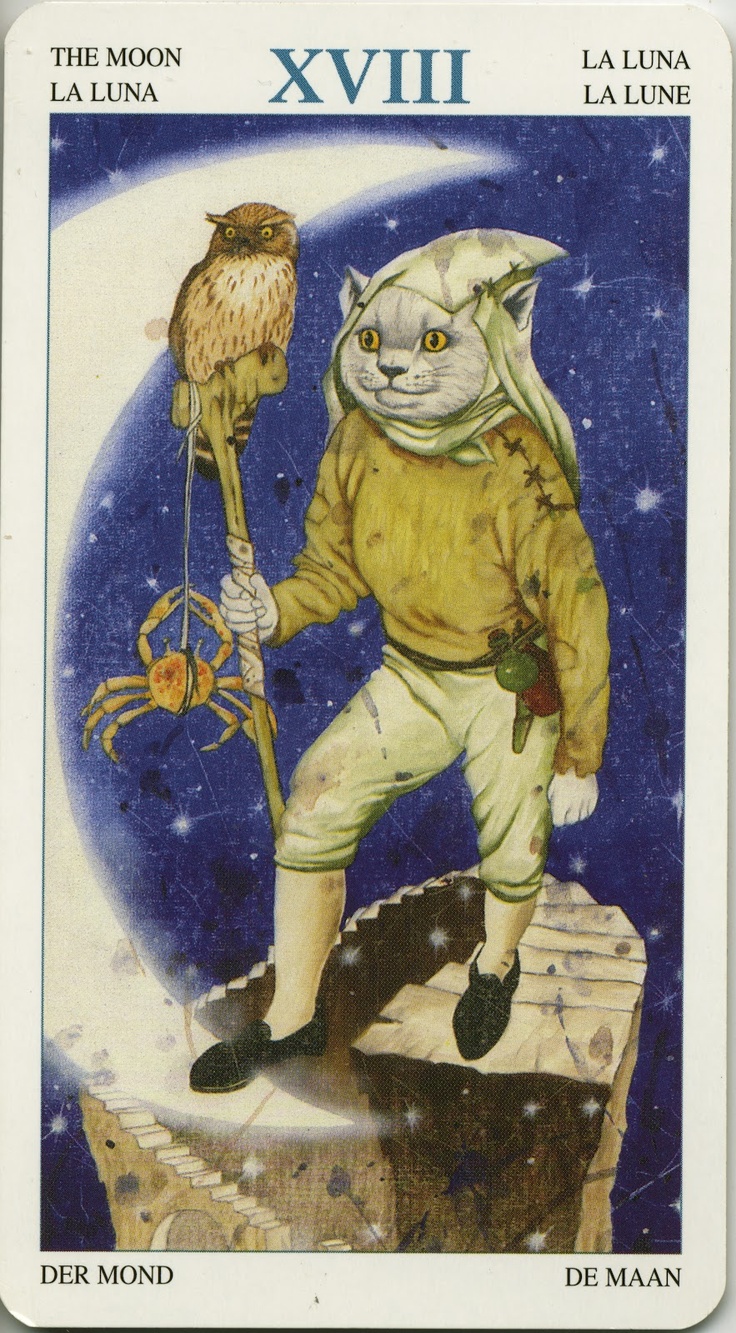
XVIII. The Moon

(This card features an owl and a cat ascending a stair way to the crescent moon. They are taking a crab with them.)

 Walking up the staircase, I marveled at the Moon, who invited me to sit on it. The Owl and Cat told me that they were going taking Crab home. As the trio set off, riding on the Crescent Moon, Crab explained that he needed to return to his lady friend, before the Full Moon. Watching this surreal scene, I felt that I had entered a dream world of moon glow and mystery. Perhaps I did, with the illusions taking me on a confusing magical trip.


 XX. Judgement

(A crocodile sits on a mangrove tree root holding a stick. A plover perches on his open mouth.)

 Drifting in a canoe in the swamp, I stopped to ask the Crocodile where I was. He told me it was hard to talk with a plover in his mouth, whilst the Plover merely grunted at me. After picking off the leeches from the Crocodile’s mouth, he explained that they lived in balance, taking and giving. The Crocodile smiled, telling me that Plover was his dentist. He said that he gets clean gums, whilst Plover gets a meal. As I pondered the pair, I realized that one aspect of judgement was knowing when to enter the Crocodile’s mouth.

Thursday, July 02, 2015

Tarot: Tarot of the Animal Lords: Daydreams (1 of 2)

When I meditated on the various cards with the "Tarot of the Animal Lords", I would enter the landscape of each card. Sometimes the characters would speak to me. At other times, I would join them in their activity. What I learnt from doing this exercise was the shadow side of the cards.


To see The Fool (opens in new window)

0.The Fool.
 Standing in the snow, I asked The Fool if he was freezing, as the Magpie, perched in the nearby tree, laughed. After walking to a nearby small cave in a hill, we made a cozy fire inside, Sitting in the warmth, The Fool told me that he was taking his friend, Puffin, home to his family in the Arctic. He was ready for this adventure, but was unsure if he made the right decision. However, he was with his friend and that was what mattered to him. This made me see The Fool as someone who did things, without much thought. But this Fool did know what was important.

To see The Emperor (opens in new window)

IV. The Emperor.
 As I was walking on the African veldt, The Emperor stopped and challenged me. He roared at me that I was trespassing in his kingdom. This was his land as far as the falcon flew, and the source of his power. Startled, I asked for permission to enter his kingdom. He allowed me in as long as I understood that the trappings of power did not matter, only the wielding of power itself. His savageness made me pause about the nature of power and its uses.

To see The Hierophant (opens in new window)


V. The Hierophant
The Hierophant greeted me with a traditional greeting of peace. Also, he noticed that I kept staring at the cardinal perched on his antlers. Laughing, The Hierophant told me that whimsy in life is important or everything will become stagnant and hidebound. What he taught me was that play was as necessary to the Spirit as was discipline.

XII. The Hanged Man
 (This card depicts a bat hanging upside down, whilst the full moon shines down on him. Below the bat are two mice, with skulls, sitting around a pool of water.)

 I stepped into the pool, accidentally splashing The Hanged Man, and woke him up. Amused, he saw how confused I seemed. The Hanged Man told me that he liked hanging upside down in the full moon, since it gave him a sense of peace and quiet. Then as I tried to leave, I got stuck in the pool, and the Mice had to pull me out. The Hanged Man taught me that it is good to pause and wait, but not too long, or one will get stuck in the mire.

Thursday, June 25, 2015

BELUGA WHALE: Friends You Can Trust

Known as “Ghost Whale”, Beluga is the only whale that is all white. Because of her pale color, Russians named Her, Belulcha, which means “white one”. Like Manatee, Beluga was once thought to be a mermaid. Today, She is a major character in children’s stories.

Like her Mother, Beluga returns to the same river estuary every year. Her Mother first took Her to their “home” when She was a Calf. However, when the ice freezes over her estuary, Beluga will leave her home for warmer coastal waters. But come the springtime, She returns with her Calf to feed in the nourishing Polar waters of their estuary.

Unlike other Whales, Beluga has a flexible neck, and can move her head from side to side. Because of her unique ability, She does a visual sweep of the ocean floor while swimming. Her famed flexibility extends to other parts of her body as well. Beluga’s bendable flippers help Her get out of tight squeezes. Her moveable face makes Her one of the most expressive whales. In fact, She often forms her mouth into an “O”. When She is unhappy, Beluga will squirt the offender with streams of water from her puckered mouth.

Since She travels in pods of a hundred or more Whales, having a social life is important to Beluga. Called “Sea Canary”, She chirps, peeps, and squeaks to her Pod Mates. In her Pod, Beluga talks with Them all, using trills, chirps, and clucks. Sometimes, She sounds like a rusty gate or an out-of-tune string band, conversing with other Belugas.

Life in Beluga’s Pod is loud and noisy. The only time, She and her Friends are silent is when Orca (Killer Whale) is near. Then silence rules the ocean waters. Beluga shows that, with friends you can trust, you will always know when danger is near.

Thursday, June 18, 2015

Dinosaurs: HERRERASAURUS: Being Avant-garde


(Copyright: Nobu Tamura)

Living in the late Triassic (about 225 million years ago), Herrerasaurus, one of the oldest Dinosaurs, emerged with a breakthrough body plan. A fast and ferocious hunter, this Meat-Eater set the standard for future Dinosaurs. Living just before the Age of Dinosaurs, Herrerasaurus had to cope with Protosuchus, the hunter of Dinosaurs. This ancient relative of the modern crocodile dominated the landscape. To evade this formidable predator, Herrerasaurus had to use his speed and agility, escaping through the underbrush.
Herrerasaurus was a predator in his own right. As one of the first predators to walk on two legs, He started the chain that resulted in future Dinosaurs like Tyrannosaurus Rex ruling the land. To successfully hunt, Herrerasaurus had sharp claws on his fingers. These claws had hooks to slice meat from the bones. Meanwhile, the bones in his short arms reminded paleontologists of modern Birds. One feature unique to Him was his sliding lower jaw, which enabled Herrerasaurus to rake his teeth through his prey. As one of the first Dinosaurs, Herrerasaurus is considered by scientists to be a Basal (Basic) Theropod. (Theropods includes T.-rex and other Raptors.)
First found on an Argentine ranch in 1950, Herrerasaurus (Herrera’s lizard) was not considered a new species. Only in 1988, when his skull was discovered, did anyone know that He was different. Then after scientists determined that He was a Dinosaur, they had a spirited debate about what Family Herrerasaurus belonged to. Since He was found in the same region as Eoraptor, They decided upon “Basal Theropod.”
As one of the first Dinosaurs, Herrerasaurus pushed the envelope beyond what existed at the time. To the Others, He was “the Shock of the New.” Living more than 100 million years before T.-rex, He stood up to hunt his prey. Furthermore, his arms precluded the advent of Birds. Herrerasaurus helped to usher in the Age of the Dinosaurs. He was avant-garde, since He was innovative, and expanded the boundaries of what Dinosaurs could become. When you embrace being avant-garde, you may be laughed at, but who knows what future you have allowed to come into being. Let Herrerasaurus show you how to shock people with the New.