In January 2017, two notable orcas died – Granny (also known as J2)
and Tilikum. Both lived tragic lives in different ways. Granny, captured
and released because of her age, saw the gradual extinction of her pod
due to pollution and overfishing. Tilikum, captured as a calf, killed
three people arising from his torment at being a performing killer
whale. Both animals were the impetus for humans to reconsider the ethics
of using animals for entertainment. The result was an ending of orca
shows at major marine parks.
---
Called Orca (“Sea Devil”) by the Romans, Killer Whale is the only member of the Whale Family (Cetacea)
to hunt other Mammals. The largest Dolphin of the sea, Killer Whales
uses stealth and trickery in hunting. Her original scientific name, Dephinus orca, meant “demon dolphin.” In recognition of her size and complex social life, Killer Whale’s current scientific name is Orcinus Orca, after the Ancient Roman God of the Netherworld.
Ruled by an old Matriarch, Killer Whale’s Pod travels throughout the
oceans in search of food. (Some pods may reside in one area, while
others travel about.) Like Wolves on land, She hunts with her “wolf
pack”. Because of this, Killer Whale is called the “Wolf of the Seas”.
Her tightly knit pod hunts and drives Blue Whale into areas where He
cannot escape. Killer Whale works with her Pod Mates biting and
harassing Blue While until He dies. Then They share in their meal.
In Killer Whale’s Pod, They assist each other in raising Calves.
Killer Whale and her mates learn their dialect of Orca language from
their Mothers. In addition, Mother Killer Whale also teaches her Calf
proper pod behavior. Meanwhile, the ancient Matriarch ensures that All
learn their pod’s history and culture.
When She is not busy learning or hunting, Killer Whale likes to
play. She pops out of the water (spy hopping) or spouts loudly to
surprise her Friends. She likes to ride the wakes formed by boats and
whales. Sometimes, Killer Whale forcefully slaps her flukes against the
water while remaining partly underwater (lob tailing). She plays for the
sheer joy of it.
Even in her flamboyant black and white colors, Killer Whale blends
into the ocean. Every pod member has a different pattern on their bodies
to identify each other and stranger Killer Whales. Her Mate has a high
dorsal fin to tell Him apart from Female Killer Whale. Together in the
pod, They roam the seas in search of adventure.
Killer Whale raises her Calf to know their language and culture. She
passes on their pod’s history to Him. Because Killer Whale lives a long
life, the pod reflects the culture and traditions of many generations.
Pay attention to your cultural traditions says Killer Whale.
This is a blog about nature in all her glory. The folklore and general ideas about what messages nature bring to people.
Showing posts with label ocean animals. Show all posts
Thursday, January 12, 2017
Thursday, July 23, 2015
SPERM WHALE: Exploring the Abyss
The largest of all Toothed Whales, Sperm Whale can dive longer, faster, and deeper than any other Mammal. Known as nature’s submarine, Sperm Whale is well equipped to hunt in the ocean abyss for Giant Squid. Swimming in total darkness, He uses his echolocation to locate Squid. His huge head, which makes up a third of his total body length, houses the wax-filled spermaceti organ that helps Him to dive deep. With steady clicks, Sperm Whale approaches his Prey, then surprises Giant Squid with a sonic scream, disabling Him.
Among Whales, Sperm Whale has a unique social life. Elder Mother Sperm Whale governs his Nursery Pod. In the tropics, Sperm Whale Mothers, Females, and Young Males live together. When Sperm Whale reaches maturity, He leaves and joins a Bachelor Pod. Together, He and his Friends roam from the Polar Seas, where Squid lives, to the Tropics where the Nursery Pods are. When He is older, Sperm Whale will navigate the oceans by Himself.
Diving vertically into the abyss, Sperm Whale searches for Giant Squid. Using echolocation, Sperm Whale clicks until He sense the outline of Squid in the murky depths. No one knows what exactly happens in the murky depths; only that Sperm Whale is usually victorious. Like this extraordinary Whale, you can explore the Abyss. Just remember to surface from time to time.
Sperm Whale’s Teachings Also Include:
“There is more character in the Sperm Whale's head. As you behold it, you involuntarily yield the immense superiority to him, in point of pervading dignity. In the present instance, too, this dignity is heightened by the pepper and salt colour of his head at the summit, giving token of advanced age and large experience.” – Copyright: “Moby Dick”, Herman Melville
Sperm Whale’s Wisdom Includes:
Being Comfortable with Your Own Self
Being Comfortable with Your Own Sex
Diver of the Deeps
Lord of the Seas
Conservation Note: Sperm Whales are endangered, and are protected by international treaties. Because of extensive hunting, numbers of Sperm Whale Males are seriously low.
For reading on the teachings of Moby Dick, the most famous sperm whale of all: Moby Dick (opens in new window)
Among Whales, Sperm Whale has a unique social life. Elder Mother Sperm Whale governs his Nursery Pod. In the tropics, Sperm Whale Mothers, Females, and Young Males live together. When Sperm Whale reaches maturity, He leaves and joins a Bachelor Pod. Together, He and his Friends roam from the Polar Seas, where Squid lives, to the Tropics where the Nursery Pods are. When He is older, Sperm Whale will navigate the oceans by Himself.
Diving vertically into the abyss, Sperm Whale searches for Giant Squid. Using echolocation, Sperm Whale clicks until He sense the outline of Squid in the murky depths. No one knows what exactly happens in the murky depths; only that Sperm Whale is usually victorious. Like this extraordinary Whale, you can explore the Abyss. Just remember to surface from time to time.
Sperm Whale’s Teachings Also Include:
“There is more character in the Sperm Whale's head. As you behold it, you involuntarily yield the immense superiority to him, in point of pervading dignity. In the present instance, too, this dignity is heightened by the pepper and salt colour of his head at the summit, giving token of advanced age and large experience.” – Copyright: “Moby Dick”, Herman Melville
Sperm Whale’s Wisdom Includes:
Being Comfortable with Your Own Self
Being Comfortable with Your Own Sex
Diver of the Deeps
Lord of the Seas
Conservation Note: Sperm Whales are endangered, and are protected by international treaties. Because of extensive hunting, numbers of Sperm Whale Males are seriously low.
For reading on the teachings of Moby Dick, the most famous sperm whale of all: Moby Dick (opens in new window)
Wednesday, July 23, 2014
GULL: Judging by Appearances
Most people encounter Gulls at beaches, usually when Gulls are
scavenging for food or resting on boat docks. Some people watch Gulls
drop Clams on hard rocks or on parking lots to open up the Clams. As
opportunists, Gulls exploit whatever They can use, wherever They find
it.
A readily recognizable group of Birds, Gulls have solidly built web-footed legs for running and swimming. With their long wings, Gulls can easily hunt over large areas of water. Most people can identify these white, grey, and black Birds, although names of particular species elude them.
Gulls live in colonies of many Birds. Usually nesting on rocky cliffs, tens of thousands of Gulls share a breeding territory with other Birds such as Pelicans, Herons, and Terns. Somehow in all the confusion of all these Birds, individual Gulls find each other and work things out.
In Salt Lake City, Utah (USA), a monument to California Gull sits in front of the State Capitol Building. Shortly after the Mormons settled the area, millions of Crickets began to devour their crops. But then thousands of California Gulls came and ate their fill of Crickets. In gratitude for saving their lives, the Mormons decided to honor California Gull.
Another Gull story involved a trainer of the Cleveland Indians Baseball team. While the beloved trainer was near death, a lone Sea Gull stayed near the dugout. After he died, the Gull remained to comfort the ball players, then left. These two Gull stories reflect how Gulls can be spiritual messengers.
Most people see Gulls as messy, noisy, and aggressive Birds. But imagine what the beaches would look like if you had no Sea Gulls – a silent beach covered with garbage. Gulls have a place in this world that people need to accept.
Gulls teach that appearances can be deceiving. Most people regard these noisy, troublesome Birds as pests. No man sees the services that Gulls provide, for example, eating garbage and cleaning up beaches. Gull teaches to judge by actions.
A readily recognizable group of Birds, Gulls have solidly built web-footed legs for running and swimming. With their long wings, Gulls can easily hunt over large areas of water. Most people can identify these white, grey, and black Birds, although names of particular species elude them.
Gulls live in colonies of many Birds. Usually nesting on rocky cliffs, tens of thousands of Gulls share a breeding territory with other Birds such as Pelicans, Herons, and Terns. Somehow in all the confusion of all these Birds, individual Gulls find each other and work things out.
In Salt Lake City, Utah (USA), a monument to California Gull sits in front of the State Capitol Building. Shortly after the Mormons settled the area, millions of Crickets began to devour their crops. But then thousands of California Gulls came and ate their fill of Crickets. In gratitude for saving their lives, the Mormons decided to honor California Gull.
Another Gull story involved a trainer of the Cleveland Indians Baseball team. While the beloved trainer was near death, a lone Sea Gull stayed near the dugout. After he died, the Gull remained to comfort the ball players, then left. These two Gull stories reflect how Gulls can be spiritual messengers.
Most people see Gulls as messy, noisy, and aggressive Birds. But imagine what the beaches would look like if you had no Sea Gulls – a silent beach covered with garbage. Gulls have a place in this world that people need to accept.
Gulls teach that appearances can be deceiving. Most people regard these noisy, troublesome Birds as pests. No man sees the services that Gulls provide, for example, eating garbage and cleaning up beaches. Gull teaches to judge by actions.

Monday, May 05, 2014
WALRUS: Hidden Talents
Although Walrus’ home is the Arctic, He is well known. Familiar to
everyone, Walrus is often depicted in cartoons as a banker. With his
long tusks, wrinkled skin, and mustache, He makes an unforgettable
sight.
Walrus spends his days resting on ice floes or swimming in open water
near the shore. Where there is no ice, He hauls out (pulls himself out
of the sea) on to rocky shores. Walrus enjoys sunbathing, and like
many people, He gets sunburned. (His name “Walrus” comes from the Norse
languages for
“rust-colored whale.”)
Usually, you can find Him in a big pile of other Walruses, usually a hundred or more. Walrus communicates with his Friends with knocks, bells, clacks, and whistles. However, if Someone takes up too much room, Walrus will poke Him with his tusks, forcefully telling the other Walrus to “Move over.”
Walrus uses his distinctive mustache to search for food. He feels the sandy bottom with his sensitive whiskers. When Walrus finds a Clam, He squirts high power jets of water out of his mouth. He uses his talent to imitate a water drill to loosen the Clams living under the mud. Afterwards, He sucks up the Clams like a vacuum cleaner.
Walrus has many hidden talents. He moves on all fours as fast as a man can run. He uses his “squirt” to get clams. Walrus’ strong sense of touch comes from his mustache. There is a lot more to Walrus than his tusks. Remember how Walrus uses his talents and learn how to use yours.
Related to Seals and Sea Lions, He shares the same Pinniped
characteristics of ‘fin feet’. Walrus may have flippers for feet, but
He is better known for his tusks. People in the Arctic call Him “tooth
walker”. Moreover, Walrus’ scientific name Odobenidae is Greek for “one who walks with his teeth.”
Usually, you can find Him in a big pile of other Walruses, usually a hundred or more. Walrus communicates with his Friends with knocks, bells, clacks, and whistles. However, if Someone takes up too much room, Walrus will poke Him with his tusks, forcefully telling the other Walrus to “Move over.”
Walrus uses his distinctive mustache to search for food. He feels the sandy bottom with his sensitive whiskers. When Walrus finds a Clam, He squirts high power jets of water out of his mouth. He uses his talent to imitate a water drill to loosen the Clams living under the mud. Afterwards, He sucks up the Clams like a vacuum cleaner.
Walrus has many hidden talents. He moves on all fours as fast as a man can run. He uses his “squirt” to get clams. Walrus’ strong sense of touch comes from his mustache. There is a lot more to Walrus than his tusks. Remember how Walrus uses his talents and learn how to use yours.

Wednesday, September 04, 2013
Mythic Animals: Sea : Hippocampus and Kraken
Comparing Hippocampus with Kraken is a study in opposites. For example, Hippocampus has recognizable body parts such as the upper body of a
horse, the lower boy of a fish, and the fluked tail of a dolphin. Kraken is more of an amorphous blob
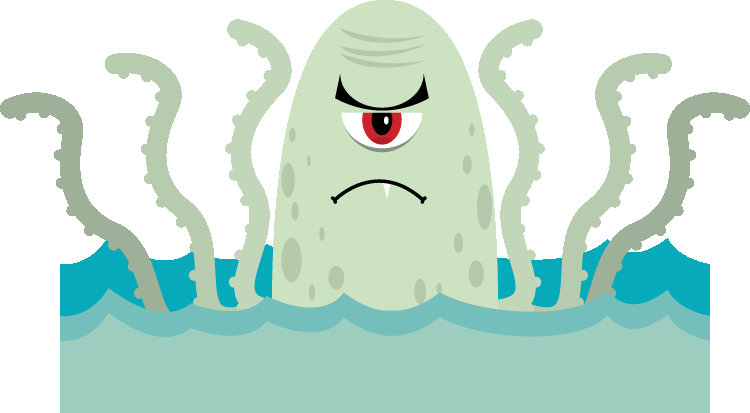
with multiple arms. Rising from the depths of the ocean, fierce Kraken would grab ships with its arms,
drag them down, and eat the people inside. In contrast, friendly Hippocampus would tow disabled ships to
shore and aid drowning sailors. Found throughout the seas of the world, Hippocampus is often seen near the
shore in the white foam of the waves. Meanwhile, Kraken prefers the deeper oceans. This beast often signals its
presence by creating a giant whirlpool.
However, Kraken and Hippocampus do have one thing in common – Poseidon, the Greek God
of the Sea. To pull his golden chariot, Poseidon created Hippocampus from sea foam. Called by a Norse name, Kraken is better known to the Greeks as
Scylla and Charybdis. Poseidon’s wife, Amphitrite, jealous of his infatuation
with Scylla, changed her into a Kraken.
Meanwhile, Charybdis, Poseidon’s daughter, was punished by Zeus for stealing
cows. Unlike Scylla, sailors know only of Charybdis by her gigantic whirlpool. Scylla and Charybdis now live in the Strait of Messina, between Italy and
Sicily.
Works Used:
Allan, Tony, “The Mythic Bestiary,” Duncan Baird: London, 2008.
Krystek, Lee, “The Kraken,” The UnMuseum, 2006, http://www.unmuseum.org/kraken.htm.
Nigg, Joseph, “The Book of Dragons and Other Mythical Beasts,” Quarto: London, 2002.
Zell-Ravenheart,
Oberon and Ash DeKirk, “A Wizard’s
Bestiary,” New Page Press: Franklin Lakes, NJ, 2007.
Tuesday, July 03, 2012
MANTA RAY: Agility
Looking like a giant bat, Manta Ray is the largest of the Rays. She
prowls the surface of the seas, unlike other Rays. When She swims,
Manta will leap out of the sea from time to time. Somersaulting and
cartwheeling on the sea's surface, the Manta inspires awe.
Called by some "devilfish", Manta Ray will circle small boats, scaring people, but never hurting them. This graceful creature glides through the ocean eating plankton. Alone, Manta Ray sails through the seas. Manta Ray shows you how to navigate rough seas, but, remember, unlike the Manta Ray, you do not have to do it alone.
- Manta Ray's Wisdom Includes:
- Ebb and Flow
- Strength
- Love and Happiness
- Living Large
- Light
- ----------------
Tuesday, June 05, 2012
Ray Family: Grace
![]() |
| an eagle ray |
Seen on sea bottoms, Rays often appear to be a part of the seabed. While Rays are hovering, They are looking for food. Finding what They seek, a Ray will suddenly sweep up from the bottom and glide through the darkening sea. Shaped like a kite with a tail, a Ray will flap his pectoral fins, while speeding toward the prey. Watching a Ray move is watching grace in motion.
- Ray's Wisdom Includes:
- Illusion
- Self-Defense
- Freedom
- Fluid Movement
- Confidence
- Piercing the Veil of Darkness
Tuesday, May 29, 2012
Finned and Water Ones: Moving through fluid realms, with intuition
Fish were the first vertebrates to appear on earth, about five
hundred million years ago. Since that time, They have evolved into one
of the most diverse and successful of animal groups. The "lobe-finned"
Fish such as the Lungfish, are the oldest, and can live for brief
periods on land. Sharks and Rays have no bones, only cartilage. Bony
Fish range from Sturgeon to Trout to Seahorses.
Other animals who live in water are the Crustaceans, Cephalopods, and Jellyfish. Crustaceans live in freshwater, deep oceans, and tidal pools. Their claws and hard shells serve to protect Them from predators. Cephalopods, with their tentacles, are known for their inky defenses. Jellyfish float from North Pole to South Pole, seeking food.
Not every animal that swims in water is a Fish, but every animal has something to teach. Since water is a fluid element, these Water Ones move and change. They demonstrate an innate grace. The Water Ones are unusual to land dwellers but They beckon all to come into the unknown depths to explore, to play, and to learn. Even the Ones who live between land and water teach lessons of flourishing and flexibility.
Many animal wisdom books list "Fish" or perhaps "Salmon" for Finned and Water ones. Since Fish range from the peculiar looking Seahorse to the fierce Great White Shark to the scrappy Largemouth Bass, to discuss Fish wisdom in general terms seems to be a bit absurd. One can generalize some characteristics for Finned Ones' or Water Ones' families such as Crabs walk sideways or that Salmon migrate home.
Other animals who live in water are the Crustaceans, Cephalopods, and Jellyfish. Crustaceans live in freshwater, deep oceans, and tidal pools. Their claws and hard shells serve to protect Them from predators. Cephalopods, with their tentacles, are known for their inky defenses. Jellyfish float from North Pole to South Pole, seeking food.
Not every animal that swims in water is a Fish, but every animal has something to teach. Since water is a fluid element, these Water Ones move and change. They demonstrate an innate grace. The Water Ones are unusual to land dwellers but They beckon all to come into the unknown depths to explore, to play, and to learn. Even the Ones who live between land and water teach lessons of flourishing and flexibility.
Many animal wisdom books list "Fish" or perhaps "Salmon" for Finned and Water ones. Since Fish range from the peculiar looking Seahorse to the fierce Great White Shark to the scrappy Largemouth Bass, to discuss Fish wisdom in general terms seems to be a bit absurd. One can generalize some characteristics for Finned Ones' or Water Ones' families such as Crabs walk sideways or that Salmon migrate home.
- Finned and Water Ones' Teachings Include:
- Sensitivity To Emotions
- Sexuality
- Flexiblity
- Energy of Transformation
- The Unknown
- Grace
- Adaptation
Thursday, August 27, 2009
Wandering Albatross: Soaring
Gliding vast distances across the seas, Wandering Albatross has the longest wingspan of any living bird (11 feet (3 meters)). Roaming the Southern Ocean, She floats on updrafts with her long narrow wings. Turning into the wind, Wandering Albatross soars on the currents. Using the wind’s energy, She rises up and then coasts downward, saving her strength with her dynamic soaring.
Swooping low over wave tops, Wandering Albatross settles on the sea’s surface for eating. As She sits on the water with her folded wings, Wandering Albatross dabbles for Squid and Cuttlefish. After scooping up Octopus with her huge bill, She rises again with the wind.
Only on land is Wandering Albatross clumsy. Nicknamed “Gooney Bird”, She makes untidy take offs and landings. When landing, She often crashes into a breeding colony. While walking, Wandering Albatross often trips over her huge feet.
----------------------
-----------------------
copyright: Virginia Carper Animal Teachers
Swooping low over wave tops, Wandering Albatross settles on the sea’s surface for eating. As She sits on the water with her folded wings, Wandering Albatross dabbles for Squid and Cuttlefish. After scooping up Octopus with her huge bill, She rises again with the wind.
Only on land is Wandering Albatross clumsy. Nicknamed “Gooney Bird”, She makes untidy take offs and landings. When landing, She often crashes into a breeding colony. While walking, Wandering Albatross often trips over her huge feet.
----------------------
-----------------------
copyright: Virginia Carper Animal Teachers
Monday, August 24, 2009
Teachings of the Albatross Family: Limitless Blessings

(Photo copyrighted by The Royal Albatross Colony)
Lords of the ocean skies, Albatrosses are rarely seen on land, preferring the life on the open ocean. Since They contained the souls of lost comrades, many sailors revered these birds. In addition, many cultures venerated Albatrosses because of their ability for continuous flying.
Dynamic flyers, They soar in the skies taking advantage of the ocean winds. Looping in a roller-coaster fashion, Albatrosses expend little energy while flying. Spreading their winds to the wind, off They go on their travels.
There are four groups of Albatrosses. The Great Whites are known for their huge size and white coloring. Named by Dutch sailors, Mollymawks (“foolish gull”) resemble Gulls. Instead of the sub-Antarctic islands, the North Pacific Albatrosses live near the equator. Named for their dark plumages, Sooties live close to the Atlantic and Indian Oceans.
For life at sea, Albatrosses developed a unique beak called a tubenose. Their tubular nostrils on either side of their beaks enable Them to smell food. Also the grooves from their nostrils excrete excess salt that these Birds may ingest while eating at sea.
Going only land to breed, Albatrosses encounter lots of their Friends there. Often loud, noisy places, their colonies are full of courting and feeding Birds. Closely packed in, Breeding Pairs often number into the thousands. (Only Sooties nest in solitary places.) However Albatrosses breed very slowly, only laying one egg every other year.
Well equipped for life at sea, Albatrosses know no boundaries. They carry the souls of dead mariners to the heavens. They travel the oceans sailing on the winds. Let Albatrosses bring you limitless blessings. Just remember to come to land once in awhile to stay grounded.
Science Note: Related to Shearwaters and Petrels.
The Royal Albatross Colony at Taiaroa Head, on the tip of the Otago Peninsula, New Zealand, is the only mainland breeding colony for any albatross species found in the southern hemisphere.
----------------------
-----------------------
copyright: Virginia Carper Animal Teachers
Monday, August 18, 2008
Moby Dick: Whale Avenger
One of the most famous of Whales is Moby Dick of Herman Melville’s novel, “Moby Dick”. Besides being white, Moby Dick has a wrinkled forehead, large hump on his back, and a curved jaw with crooked teeth. This giant white Sperm Whale took revenge on the whalers, who hunted him.
Harpoons did not seem to hurt him. One of Moby Dick’s favorite tricks was to swim away as if he was fleeing, then suddenly turn on the whalers, and smash their boats. Moby Dick was based on an actual white Sperm Whale who lived near the island of Mocha off of Chile. Mocha Dick, the White Whale of the Pacific, had become known in the 1800s for his violent attacks on whaling ships. When He was finally killed in the 1850s, sixty year old Mocha Dick was toothless, blind, and had eighteen harpoons sticking out of his body.
Moby Dick’s Teachings Also Include: “Nor was it his unwonted magnitude, nor his remarkable hue, nor yet his deformed lower jaw, that so much invested the whale with natural terror, as that unexampled, intelligent malignity which, according to specific accounts, he had over and over again evinced in his assaults. More than all, his treacherous retreats struck more of dismay than perhaps aught else. ” – Copyright: “Moby Dick”, Herman Melville
Moby Dick’s Wisdom Includes:
Lessons of Aggression and Obsession
Taking the Initiative
---
For the teachings of Sperm Whales: Sperm Whale (opens in new window)
Wednesday, July 18, 2007
Teachings of the Sea Turtle

GREEN TURTLE
Perseverance
(U.S. Forest Service)
One of the largest of the Sea Turtles, Green Turtle likes living in warm, shallow waters where sea grass, Her favorite food, grows. She locates the vegetation with Her excellent underwater eyesight. Swimming at great speeds underwater, She travels near the coasts in search of sea grass.If you find Green Turtle far out to sea, She is on Her way to Her nesting beaches. She is meeting the male Turtles there for mating. Both male and female Green Turtles return to the same beaches year after year. Usually, these beaches are the same ones from which the Turtles were hatched.
Although Mother Green Turtle is awkward on land, She still comes up on the beach to build Her nest. Mother Turtle drags herself on to the beach to dig a large hole with Her flippers. Once She lays Her eggs, Mother Turtle pushes sand over the eggs. Then, She hauls Herself back over the beach to the sea.
Green Turtle teaches perseverance. Watch Her as She struggles to lay Her eggs. Graceful in the sea, Mother Turtle comes on land, an alien hostile environment, to provide a nest for Her young.
Green Turtle’s Teachings Include:
“As about, so below, and within. The gentle turtle acknowledges the delicate balance between ocean and earth, and reminds us of the importance of respecting both.” Copyright: “Wisdom of Australian Animals”, Ann Williams-Fitzgerald .
Green Turtle’s Wisdom Includes:
Home
Being Grounded
Healing Knowledge
Respect
Persistence
Subscribe to:
Posts (Atom)